USPS non-profit rates have just gone up. The fix isn't cheaper postage — it's mailing fewer people with confidence
Strategy & Frameworks

Ranking a donor file to mail fewer people with confidence in response to rising USPS non-profit postage rates
Effective 12 July 2026, USPS raised mailing-services prices by an average of 4.8%. Non-profit Marketing Mail got a softer bump, but every drop now costs more — which makes every wasted piece more expensive. Here's what changed, what it costs you, and the one move that pays for the increase several times over.
What changed on 12 July
On 27 May 2026, the Postal Regulatory Commission approved USPS' proposed pricing changes, which take effect 12 July 2026.
USPS filed these rates with the commission on 9 April 2026 under Docket R2026-1 and published the final tables on Postal Explorer on 17 June 2026.
The headline is an average price increase of 4.8% across First-Class Mail, USPS Marketing Mail, Periodicals, Package Services and selected Special Services. But averages hide the detail that matters to fundraisers.
For non-profit mailers, the news is comparatively gentle. Non-profit Marketing Mail gets a softer adjustment, roughly 3 to 5 per cent, which keeps it one of the most cost-effective options for fundraising and member mailings.
Non-profits get preferential bulk mail rates, and the changes preserve that preferential structure — but rates do go up. Non-profit letters still cost 50-52% less than commercial rates.
What it costs your program
The per-piece numbers look small. The campaign numbers don't.
Non-profit Marketing Mail letter rates ranged from $0.178 (5-Digit) to $0.239 (Mixed); expect those to rise 4-5%, putting non-profit 5-Digit at roughly $0.186-$0.187 per piece after the change. In practice, a non-profit mailing 100,000 donor appeals at 5-Digit presort will see postage costs rise roughly $900 per mailing after 12 July.
Now multiply that across a season. For organisations running multi-touch year-end appeals — say, three donor mailings between October and December — the cumulative impact can exceed $2,500 on a single segment. Stack several segments and the increase quietly becomes a five-figure line item.
Two structural changes to check now
Beyond the rates, two changes take effect the same day:
A new barcode fee: A $0.25 fee applies to Marketing Mail parcels mailed without a valid IMpb barcode. If your mail house isn't already barcoding parcels, get compliant before your next drop.
Combined presort minimums: Mailers can now combine presorted letters with postcards to meet the 500-piece minimum for presorted Marketing Mail. Previously, each mail class had to hit the minimum independently. That's a small win for mixed-format campaigns.
There's also a structural shift in how deep preparation is rewarded. Drop ship and commingling strategies remain important; discounts for Sectional Center Facility entry are increasing, and the pricing gap between three digit and five digit presort levels is getting wider. Presort depth and commingling are worth more after 12 July than before it.
The real lever isn't postage. It's precision.
You can shave cents through sortation and drop-ship discounts, and you should. But the biggest cost in a mail program is not the rate — it's the letters that were never going to convert.
Higher postage sharpens that math. Every piece that reaches a donor who won't respond is now a slightly bigger waste, and those slivers add up fast across a 100,000-piece file. The instinct under budget pressure is to over-mail to feel safe. The stronger move is the opposite: mail fewer people, with confidence, and protect net revenue.
That's a targeting decision, not a postage decision — and it's the decision most house files are set up to get wrong. Rules and segments carried over from last year rarely predict who's worth mailing this year.
How ranking the file changes the outcome
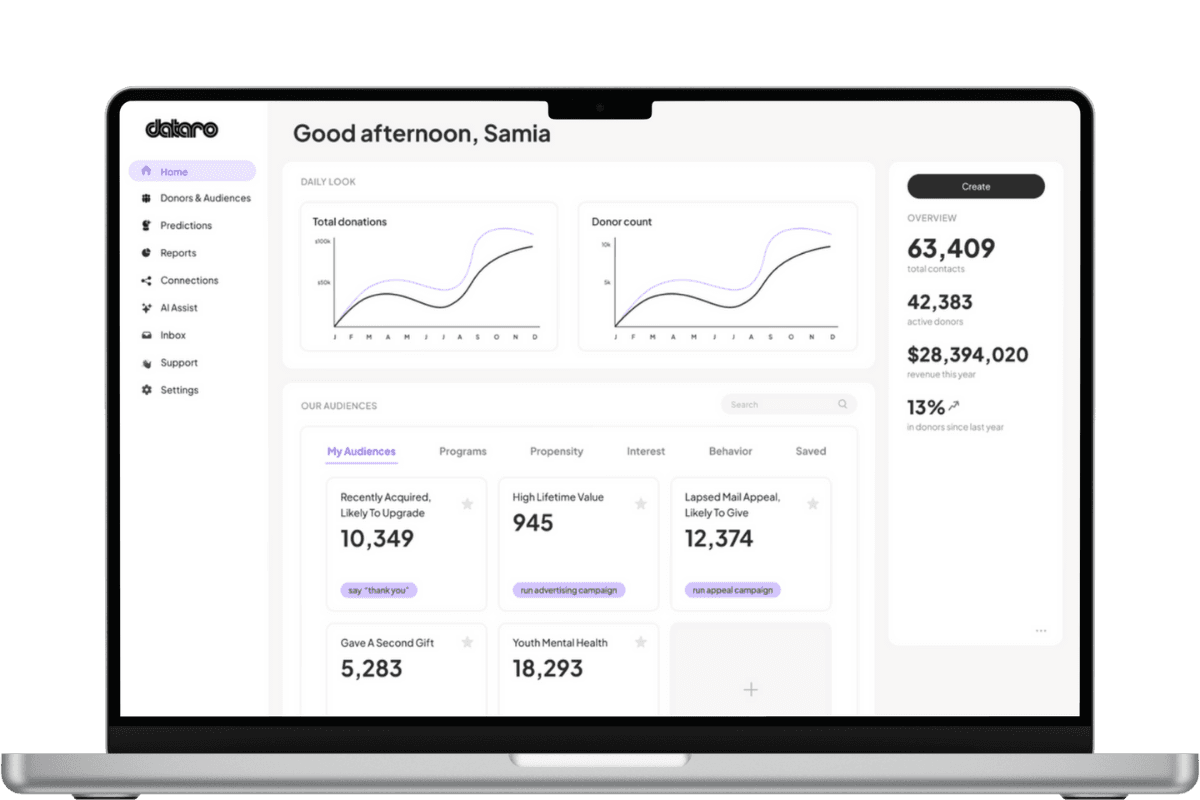
Dataro sits on top of your CRM and turns your donor data into ranked lists and clear cut-offs, so you can answer two questions before a single letter prints: who to focus on, and what to do for each of them.
Two models do the heavy lifting for appeals:
Appeal Response scores every donor by their likelihood of responding to a direct mail appeal, so you can size your audience, cut waste and still capture every likely gift.
Expected Mail ROI estimates the net revenue each donor is likely to produce, so you can set a defensible mail-file cut-off instead of guessing where to draw the line.
The result is a shorter, sharper file: fewer packs, lower postage and net revenue held — or grown — because the donors you dropped weren't going to give anyway.
Proof this works
This isn't theory. Fundraising teams are already cutting volume and raising more:
UNICEF Australia lifted net appeal income 26% and campaign ROI 35% while mailing 15,000 fewer donors, saving about $30,000 in mail costs.
The Baker Institute raised $489,612, up 70% year over year, while mailing 8,000 fewer packs — with a $40 higher average gift and a 4-point lift in response rate.
Both did it by mailing fewer people with more confidence. A 4.8% postage increase barely registers against results like that.
What to do before your next drop
Confirm the mechanics. Check your presort depth, commingling and IMpb barcode compliance with your mail house — these matter more after 12 July.
Rank the file, don't reuse last year's segments. Score every donor for appeal response and expected ROI before you set the audience.
Set a defensible cut-off. Mail the donors worth mailing, suppress the rest, and reinvest the postage savings where response is strongest.
The rate increase is fixed. What you pay to reach donors who won't give is not.
Related articles
Discover more insights into nonprofit fundraising and data from the Dataro team.