How to convert one-off donors into recurring donors
Strategy & Frameworks

Sustainable recurring giving growth comes from a system that aligns form design, messaging, audience and timing, not a single form fix.
Most fundraising teams try to grow recurring giving by fixing the donation form. It's the obvious first move, and it usually helps for a quarter. Then the gains flatten.
The reason is simple: conversion is not one lever. It's three working together. Sustainable growth comes from treating recurring giving as a system, not a one-time form fix.
This guide compares the three levers that drive recurring giving conversion and shows how to make them compound.
What does it take to convert one-time donors into recurring donors?
Converting one-time donors into recurring donors means moving a supporter from a single gift to an ongoing, scheduled commitment. It depends on three levers: donation form design, messaging and creative, and donor audience and timing.
Form design and messaging lift the conversion rate of the people you ask. Audience and timing decide who you ask and when. Pull all three and the gains hold. Pull one and they stall.
Lever 1: Donation form design
The form is where intent becomes action. Small friction points cost conversions, so this is the fastest lever to improve.
Practical moves that work:
Offer a monthly option by default, or make it the visually prominent choice
Show suggested monthly amounts framed around impact, not just pound figures
Reduce fields to the minimum and support digital wallets
Confirm the recurring commitment clearly so donors trust what they signed up for
Form design has a ceiling. It improves the experience for people who already reached the form. It can't tell you which one-time donors are worth asking in the first place.
Lever 2: Messaging and creative
Messaging is the case for why a single gift should become a monthly one. It shifts the donor from a single act to an ongoing relationship.
What tends to move the needle:
Frame recurring giving as sustained impact, not a bigger ask
Use specific, concrete outcomes a monthly gift makes possible
Personalise the ask to the donor's history and cause
Keep the copy plain and direct, and lead with the donor's role
Like form design, messaging lifts the response rate of whoever receives it. But sending the strongest message to the wrong audience, or at the wrong moment, wastes it.
Lever 3: Donor audience and timing
This is the lever most teams underuse. Not every one-time donor is a good recurring prospect, and readiness changes over time.
Ask the wrong donor and you get silence. Ask the right donor too late and you miss the window right after their first gift, when intent is highest.
Getting this right means answering two questions:
Who among our one-time donors is most likely to start a recurring gift?
When is each donor most likely to say yes?
This is where prediction earns its place. A propensity model can rank one-time donors by recurring giving likelihood, so you focus the ask on the people most ready to convert and time it well. You mail fewer people with confidence and protect results.
How the three levers compare
Lever | What it controls | Strength | Limitation |
|---|---|---|---|
Form design | The conversion experience | Fast to improve, immediate lift | Only helps people who reach the form |
Messaging and creative | The case for recurring giving | Raises response for who you reach | Wasted on the wrong audience or timing |
Audience and timing | Who you ask and when | Concentrates effort on ready donors | Needs reliable signals, not last year's rules |
The pattern is clear. Levers 1 and 2 raise the rate. Lever 3 raises the base you apply that rate to. You need all three.
Why a single form fix stalls
A form fix gives you a one-time step change, then plateaus. It optimises the last few seconds of a journey while leaving the two decisions that matter untouched: who to ask and when.
Treating recurring giving as a system changes the maths. When you ask a well-chosen audience, at the right moment, with a clear message, on a low-friction form, each lever multiplies the others.
That's the difference between a good quarter and durable growth.
How to build recurring conversion as a system
Use this sequence to move from one-off fixes to a repeatable rhythm:
Rank your one-time donors by likelihood to start a recurring gift
Set the timing, with a priority on the window right after a first gift
Match the message to the donor's history and cause
Remove friction on the form and default to monthly
Measure conversion by segment, then feed results back into the next cycle
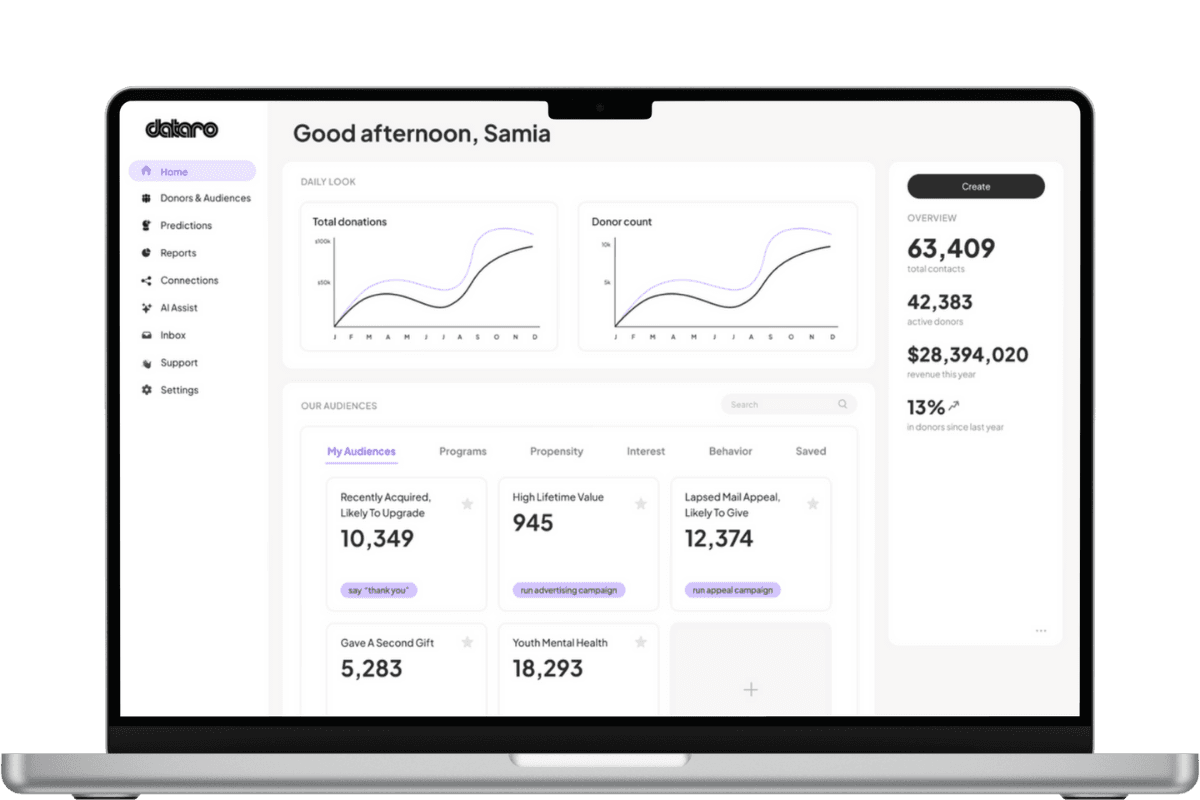
Dataro's predictive layer sits on top of your CRM and returns ranked actions: which one-time donors to ask, and what to do next. Your team runs the appeal in the tools it already uses, then results sharpen the next round.
Key takeaways
Recurring conversion runs on three levers, not one
Form design and messaging lift your rate; audience and timing set who you apply it to
A single form fix delivers a step change, then plateaus
Prediction concentrates effort on donors most ready to convert
Sustainable gains come from running the levers as one repeatable system
Conclusion
A better form helps. A better message helps more. But the teams that grow recurring giving year after year do something harder: they treat conversion as a system and get precise about who they ask and when.
Start by ranking your one-time donors and timing the ask. Then let form and message do their work on an audience that's ready to say yes.
Related articles
Discover more insights into nonprofit fundraising and data from the Dataro team.