How to decide which donors to focus on
Strategy & Frameworks

Predictive rankings help fundraisers focus on the right donors and mail fewer people with confidence.
The short answer
To decide which donors to focus on, rank every record by how likely each person is to act, set a cutoff you can explain to stakeholders and start with the highest-ranked names. This replaces last year's segments and gut feel with a shortlist your team can approve and run.
Definition: donor prioritisation
Donor prioritisation is the process of ordering your donor file by predicted likelihood to give, upgrade or lapse, then choosing where to draw the line before you spend budget or staff time.
Why is targeting so hard right now?
Teams are flat while goals rise and channels multiply. Mail, paid media and staff time all cost more, so waste is easier to see and harder to justify.
Most targeting still runs on manual segmentation. Rules and segments from last year no longer feel predictive, so teams over-mail to feel safe or under-mail out of fear.
The result is expensive guesswork. Fundraisers spend hours pulling lists, negotiating exclusions and defending where to draw the line, which slows approvals.
What does good prioritisation look like?
Good prioritisation produces two things a team can act on:
A ranked list of donors, ordered by predicted propensity to act
A clear cutoff that stakeholders can approve without a debate
Each record should also carry a recommended next action, so focus turns into execution rather than another dashboard to interpret.
How to build a ranked, defensible shortlist
Use a simple sequence you can repeat each cycle.
Pull the full eligible audience from your CRM.
Rank each record by predicted likelihood to give or respond.
Set a cutoff tied to your goal and capacity, not habit.
Attach a next-best action to each name: ask, upgrade, steward or suppress.
Send the list back into your CRM as an audience or task list.
Measure results, then sharpen the next cycle.
The aim is fewer, better touches. You mail fewer people with confidence and protect results instead of expanding the list to reduce anxiety.
Ranked lists vs. traditional segmentation
Approach | Strengths | Trade-offs |
|---|---|---|
RFM and manual segments | Familiar, quick to set up, no new tools | Backward-looking, coarse buckets, hard to defend cutoffs |
Wealth or capacity scores | Useful for major-gift research | Signals capacity, not likelihood to act now |
Predictive ranked lists | Donor-level, forward-looking, execution-ready | Requires clean CRM data and a repeatable rhythm |
Segments group people who are not the same. Ranked lists treat donors as individuals, which is where precision comes from.
Practical takeaways
Rank the whole file, then cut. Do not start with last year's segments.
Tie the cutoff to your goal and team capacity so it is easy to justify.
Pair every priority with a next action, or focus stalls.
Keep the loop short: predict, act, measure, repeat.
Conclusion
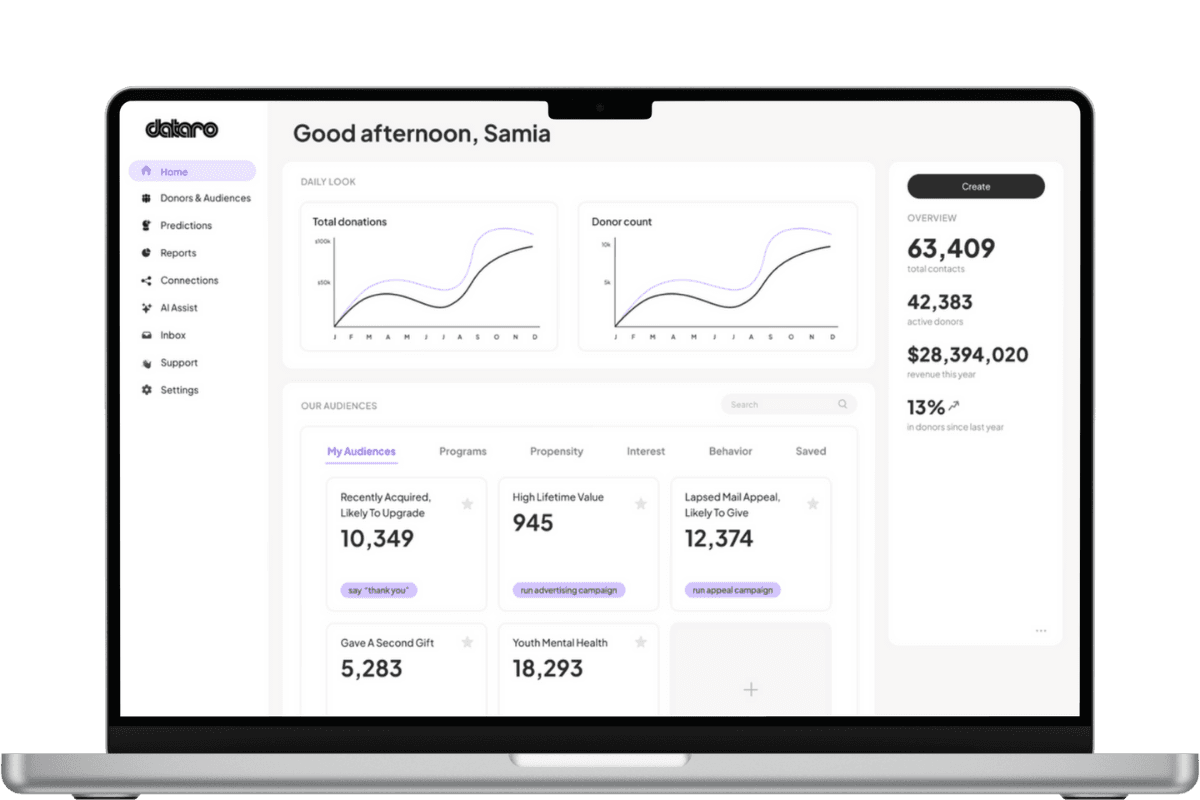
Focus is the first decision every fundraising team owns. Move it off gut feel and onto ranked, explainable priorities, and you spend less on waste, protect team capacity and run programmes that are easier to approve. Dataro sits on top of your CRM and turns your data into ranked lists, clear cutoffs and next actions, so you can answer who to focus on and what to do next.
Related articles
Discover more insights into nonprofit fundraising and data from the Dataro team.