Which recurring giving optimisation tool do you actually need?
Strategy & Frameworks

Recurring giving growth comes from fixing your binding constraint, not buying every tool at once.
Most non-profits shopping for a "recurring giving tool" are really asking three different questions at once. That is why the market feels confusing: donation platforms, predictive donor intelligence and A/B testing tools all promise more monthly donors, but each fixes a different part of the problem.
The fix is to diagnose before you buy. Recurring conversion breaks into three levers. Find the one holding you back, then match it to the right tool category.
What are the three levers of recurring giving?
Recurring conversion is the rate at which supporters start and keep a monthly gift. Three levers drive it:
Donation form and checkout UX: how easy it is to complete a recurring gift.
Offer and messaging: what you ask for, how you frame it and the creative around it.
Donor audience and timing: who you ask and when you ask them.
Each lever has a vendor category built to move it. Buying the wrong category for your constraint wastes budget and leaves the real problem in place.
Lever 1: donation form and checkout UX
The problem it solves: supporters want to give monthly but drop off during checkout.
Friction here is common and measurable. Long forms, no digital wallets, weak mobile flows and no one-click upgrade all cost conversions. If your form-visit-to-completion rate is low, or mobile lags desktop badly, this is likely your binding constraint.
Tool category: donation platforms and checkout optimisers. These tools own the giving form, payment options, recurring-gift defaults and the upgrade prompt at the moment of donation.
How to spot this constraint: track completion rate by device, cart abandonment on the form and the share of gifts defaulting to monthly. If those numbers are weak, fix the form first.
Lever 2: offer and messaging
The problem it solves: traffic and audience are fine, but the ask does not convert.
This lever covers the recurring ask itself: the suggested amount, the framing, the impact statement and the creative. Small changes to ask ladders, headlines and images can move conversion, but only testing tells you which changes work.
Tool category: A/B testing and creative optimisation tools. These let you test variants of copy, ask amounts, layouts and imagery, then keep what wins.
How to spot this constraint: you have steady traffic and a working form, but conversion on the recurring ask has plateaued. If you are guessing which message works rather than testing it, this is your gap.
A caution: testing needs volume. Low-traffic pages take a long time to reach significance, so this lever pays off fastest for organisations with steady digital reach.
Lever 3: donor audience and timing
The problem it solves: you are asking the wrong people, or the right people at the wrong time.
A clean form and a sharp offer still underperform if the ask lands with donors who will never convert, or misses the ones who would. The highest-leverage question is often who to ask and when, not what the button says.
Tool category: predictive donor intelligence. These tools rank supporters by their likelihood to start a monthly gift, flag recurring donors at risk of cancelling and recommend the next action per donor. They sit on top of your CRM and return ranked actions into the tools you already use.
How to spot this constraint: your one-time-to-recurring conversion is low across the file, churn is eating your gains, or you are mailing and emailing the same broad list every time. If you cannot say who to ask this month, timing and audience is your constraint.
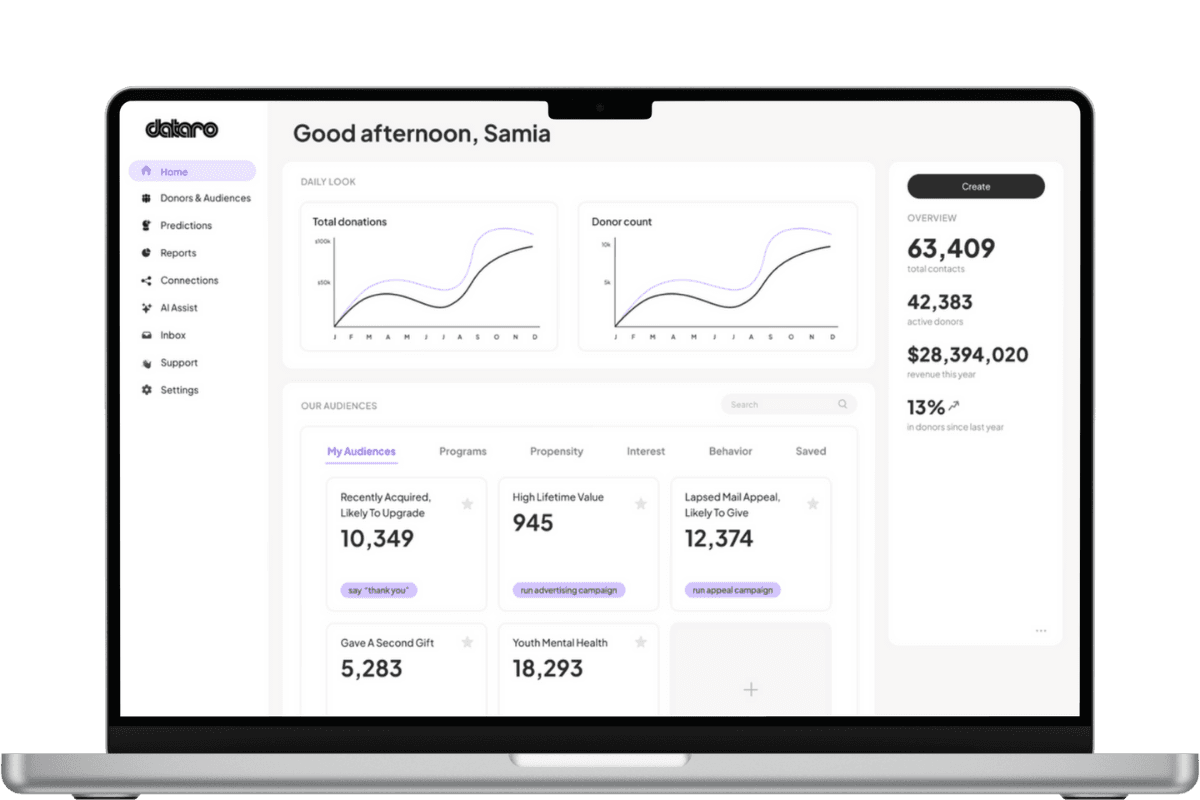
This is where Dataro focuses. Two specialist models are built for this lever: Recurring Giving Likelihood identifies one-time donors most likely to start a monthly gift, and Recurring Donor Churn Risk flags monthly donors likely to cancel so you can act before revenue churns.
Comparison: which tool fixes which lever?
Lever | Symptom | Tool category | What it changes | Trade-off |
|---|---|---|---|---|
Form and checkout UX | High drop-off at checkout, weak mobile completion | Donation platforms and checkout optimisers | The giving form, payment options, recurring defaults | Fixes conversion at the point of donation, not who arrives there |
Offer and messaging | Steady traffic but flat conversion on the ask | A/B testing and creative tools | Copy, ask amounts, layout, imagery | Needs traffic volume to reach significance; slow on low-traffic pages |
Audience and timing | Low one-time-to-recurring rate, high churn, broad blast lists | Predictive donor intelligence | Who you ask, when you ask, next action per donor | Depends on CRM data quality; complements rather than replaces channel tools |
How to diagnose your binding constraint
Run this quick check before you buy anything:
Pull your recurring funnel: form completion rate, conversion on the recurring ask and one-time-to-recurring rate across the file.
Find the weakest number relative to benchmark. That points to your lever.
Check volume. Low traffic favours audience and timing work over testing, because testing needs sample size.
Check churn. If you are adding monthly donors but net recurring revenue is flat, retention and timing outrank acquisition creative.
Buy for the constraint you found, not the tool with the best demo.
Most teams find the levers stack. A better form helps only if the right people reach it. Better creative helps only once the form works. And precise audience and timing protect the gains from both.
Practical takeaways
Diagnose first. The three levers are form and checkout UX, offer and messaging, and audience and timing.
Match the category to the constraint: donation platforms for checkout, A/B testing tools for creative, predictive donor intelligence for who and when.
Low-traffic teams get more from audience and timing than from testing.
If churn is eating growth, prioritise retention and timing over acquisition creative.
Predictive donor intelligence sits on top of your CRM and returns ranked actions, so it works alongside the platform and testing tools you already run.
Conclusion
There is no single recurring giving tool. There is the tool that fixes your binding constraint. Map your funnel to the three levers, find the weakest link and buy for that. When the constraint is who to ask and when, predictive donor intelligence gives you ranked actions per donor, so you can grow monthly revenue and protect it before it churns.
Related articles
Discover more insights into nonprofit fundraising and data from the Dataro team.