Non-profit predictive AI: how to focus fundraising and act with confidence

Nic Miller
Strategy & Frameworks

Predictive AI turning donor data into ranked lists and clear next actions for fundraising teams
Fundraising teams are asked to do more with less, but most targeting still runs on manual segmentation and gut feel. Predictive AI changes that. It reads the donor data you already have and returns ranked lists and clear next actions, so you can decide who to focus on and what to do next.
This guide explains what nonprofit predictive AI is, how it works and where it pays off. It is written for fundraising leaders who want fewer debates and clearer choices.
What is nonprofit predictive AI?
Nonprofit predictive AI is software that analyses donor history and behaviour to forecast what a supporter is likely to do next, then ranks donors by that likelihood. Instead of static rules, it produces propensity scores and ranked lists a team can act on right away.
In plain terms: it tells you who to contact, who to prioritise and who is at risk, so you spend budget and staff time where they count.
How does predictive AI work for fundraising?
The model learns from your own data: gift history, recency, frequency, channel response and engagement signals. It then scores each donor for a specific outcome, such as the chance of giving to the next appeal or cancelling a recurring gift.
Those scores become a ranked list. High-ranked donors rise to the top. Low-ranked donors fall away. You set a cutoff, approve the list and run the work in the tools you already use.
The pattern is simple and repeatable:
Predict: score donors and produce a ranked list for a specific programme
Act: assign a next action, such as mail, call, upgrade or suppress
Measure: track what changed against a holdout or prior result
Repeat: feed results back so the next cycle gets sharper
What can predictive AI predict?
Common models map to everyday fundraising decisions:
Next gift likelihood: who is most likely to give to the next appeal
Recommended ask: a suggested ask amount for each donor
Lifetime value forecast: the long-term value of a supporter
Recurring churn risk: which monthly donors are likely to cancel, early enough to act
Lapsed reactivation: which lapsed donors are most likely to return
Each output answers a concrete question, so the work lands as a task rather than a dashboard.
Predictive AI vs. traditional methods
Most teams still rely on RFM scoring, manual segments or wealth screening. Each has a place, but each has limits predictive AI addresses.
Method | What it does | Trade-off |
|---|---|---|
Manual segments | Groups donors by simple rules | Coarse, static and slow to update |
RFM scoring | Ranks on recency, frequency, value | Backward-looking, treats donors as buckets |
Wealth screening | Estimates capacity to give | Shows capacity, not likelihood or timing |
Predictive AI | Scores each donor for a future action | Needs clean data and clear ownership to act on outputs |
The difference is direction. RFM and segments describe what happened. Predictive AI estimates what a donor will do next, at the individual level, so you can mail fewer people with confidence.
Where does predictive AI pay off?
The value shows up wherever capacity is tight and waste is visible.
Appeals: cut the mail file to the donors most likely to respond, then protect net revenue
Retention: flag recurring donors at risk early, while there is still time to act
Mid-value and major gifts: surface donors with rising value before they are obvious
Stewardship: prioritise thank-you and upgrade moves that compound across programmes
In each case the goal is the same: fewer, better touches instead of over-mailing to feel safe.
Practical takeaways
Start with one decision. Pick a single programme, such as your next appeal, and use a ranked list to set the cutoff.
Treat outputs as actions. A score only helps if it becomes a task with an owner and a deadline.
Measure against a holdout. Hold back a small control group so you can show what the model changed.
Keep it explainable. Choose tools whose outputs are clear and easy to justify to stakeholders.
Mind your data. Predictions are only as good as the gift history and engagement signals behind them.
How Dataro fits
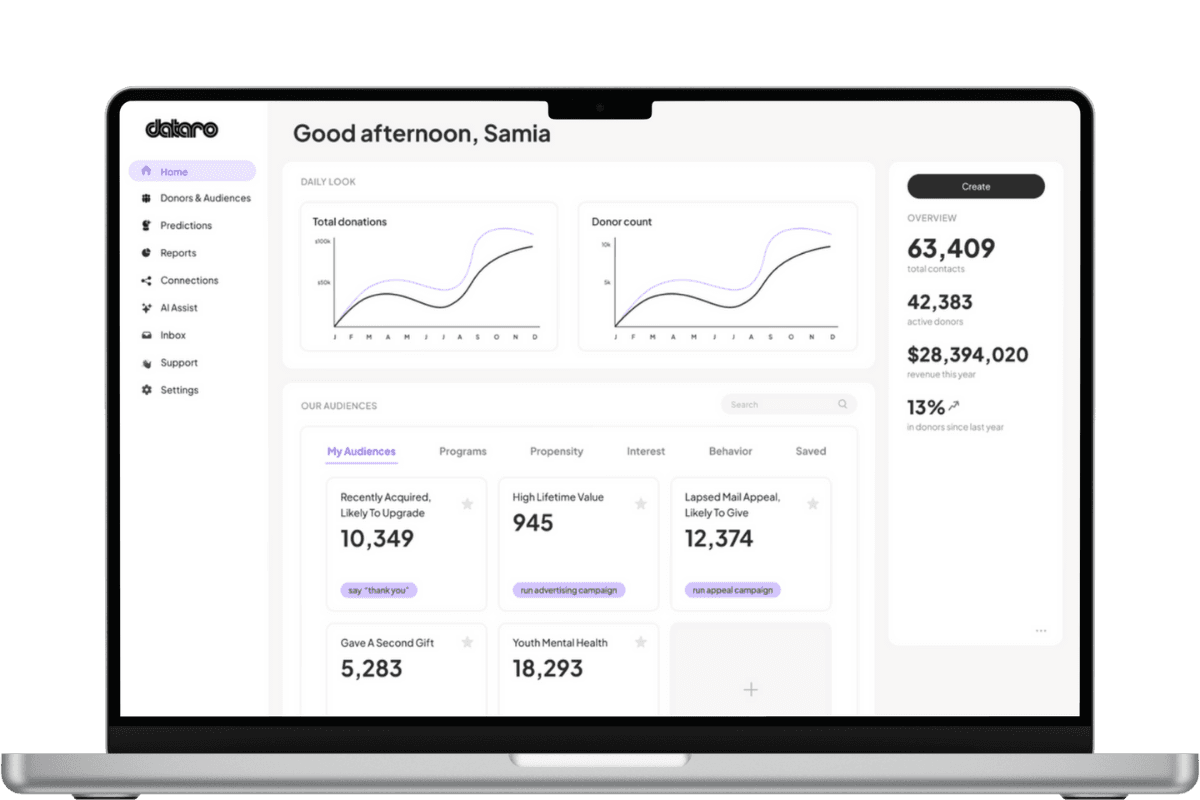
Dataro is a predictive layer that sits on top of your CRM. It reads your data and returns ranked lists, clear cutoffs and a recommended next action on each record, then syncs those outputs back as audiences, tasks and fields. You keep your systems and your team. You replace the guesswork.
Conclusion
Predictive AI is becoming the baseline for modern fundraising. It answers two questions every team faces: who to focus on and what to do next. Used well, it means fewer debates, clearer cutoffs and programmes that are easier to run and easier to justify. Start small, measure the lift and let each cycle make the next one sharper.
Related articles
Discover more insights into nonprofit fundraising and data from the Dataro team.