Mid-level done right: how prediction and personal touches drive donor growth

Mike Johnston
General

Mid-level donors are often the same people as major donors, and prediction plus personal touches turns them into a growth engine.
Mid-level giving is one of the most overlooked levers in fundraising. In a recent Dataro workshop, Mike Johnston of HJC and Marisol from ACN International shared how they built mid-level programmes that grow revenue without growing the team.
The throughline was simple: use prediction to focus on the right people, then act with personal, well-timed touches.
Why mid-level deserves attention
Most teams pour energy into major gifts and treat mid-level as an afterthought. The numbers argue otherwise.
Across large studies of non-profits, mid-level donors make up about 1% to 5% of annual donors but 20% to 35% of revenue. They punch far above their weight.
Johnston pointed to Blackbaud Institute research covering $1 billion in giving. On six wealth and demographic markers, mid-level and major donors looked almost identical. The gap in real estate value was under 3%. The gap in discretionary income was 13%. The average age was the same.
"Mid-level donors are major donors," Johnston said. The better the mid-level experience, the sooner those relationships move toward major and planned giving.
Start with focus, not volume
Most teams have limited staff and budget, so they cannot contact everyone. That is where prediction changes the math.
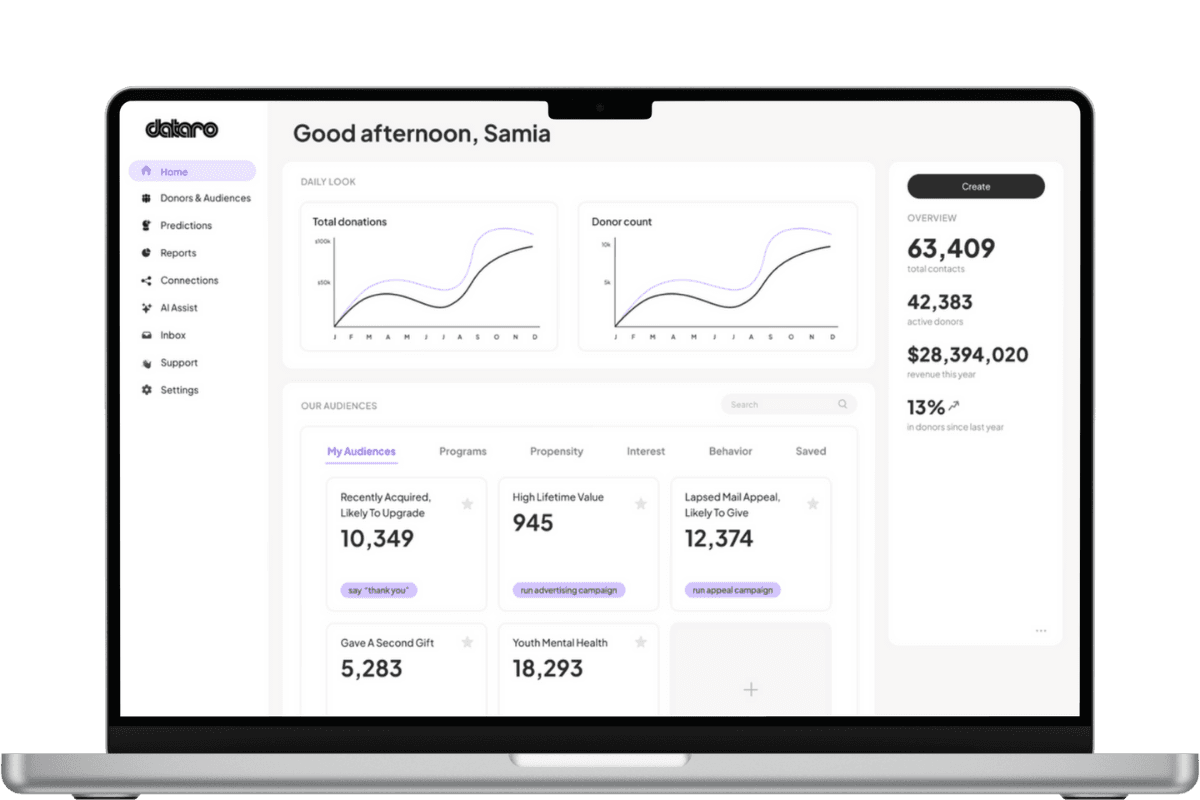
Instead of mailing 27,000 people, a team might mail 2,200 of the right people. Dataro reads your CRM data and returns ranked lists of mid-level prospects against thresholds you define, so you decide who to focus on before you spend a £.
That smaller, sharper list is what makes personal stewardship affordable. As Marisol put it, mid-level is "one to a few": not the one-to-many of mass appeals or the one-to-one of major gifts, but a focused group you can treat with real attention.
The ACN International story
ACN International, a Catholic charity with 25 offices, started with Dataro in 2022. ACN Spain ran the first test in 2023.
The team took the top 1,000 predicted mid-level prospects and sent 1,000 personalised Christmas cards, followed by thank-you calls and event invitations. When they refreshed the list, they found that 100 of the roughly 900 people they reached had already become major donors.
A later campaign to 500 major prospects and 1,000 mid-level prospects produced a response rate near 28% and raised €259,000. Most of that revenue came from the mid-level segment, not the major donors.
Encouraged, ACN Spain went further with a mission-led campaign supporting nuns in a remote village in Argentina. They expanded the list from 1,000 to 2,600 mid-level prospects and used a sequenced journey: a letter, thank-you calls, personal email, WhatsApp and a simple thank-you video. Response rates, revenue and average gift all rose again.
Across ACN's 25 offices, 2.6% of benefactors now drive 21.4% of donation income, excluding legacies and major donors. That is €9.3 million from 5,735 benefactors, or about €1,630 per mid-level donor each year.
ACN did not hire a new team. It reprioritised existing staff time, freed up by letting prediction handle the targeting.
Prediction is only half the job
Finding the right people answers who to focus on. What you do next matters just as much.
Johnston walked through Breakthrough T1D in Canada, formerly JDRF. Its mid-level programme had been flat for years: about 3,900 donors, no growth in revenue or donor count and a renewal rate of 14%.
The team mapped a cross-functional journey, built a lifecycle plan and rebranded the programme as "Beyond Insulin." They gave donors agency, including the choice of which research projects to fund, and used social proof to recruit like-minded supporters.
The result was roughly 1,000 new mid-level donors, close to $1 million in added annual revenue and a higher average gift and retention rate.
Creative that carries the mission
Both programmes leaned on what Johnston calls the "MacGuffin," a physical object that drives the story. ACN's motorcycle campaign asked donors to fund a $3,000 motorcycle that gave priests and nuns the mobility to reach their communities. The offer was specific, mission-connected and easy to picture.
The lesson: pair predictive targeting with creative that makes the ask concrete and personal.
Practical takeaways
Treat mid-level as a programme, not a one-off campaign. Build a journey, a lifecycle plan and clear stewardship.
Use prediction to keep the list small and sharp so you can afford personal touches like calls, video and WhatsApp.
Give donors agency. Let them choose what their gift supports.
Make the offer specific and mission-led. A concrete object or project outperforms a generic ask.
Remember that mid-level and major donors are often the same people. Steward for the long term.
You may not need new hires. Reprioritise existing time once targeting is automated.
The bottom line
Mid-level giving rewards focus over volume. Prediction tells you who to contact, and thoughtful journeys, lifecycle planning and creative tell you what to do for each of them.
As Marisol said, this work is "just the beginning." For teams stretched thin, it is a practical way to protect revenue, deepen loyalty and grow, without adding headcount.
Related articles
Discover more insights into nonprofit fundraising and data from the Dataro team.