Campaign benchmarking and performance analytics for fundraising
Strategy & Frameworks

Clean, modern editorial cover for a fundraising strategy article on campaign benchmarking and performance analytics: an abstract analytics dashboard with comparison bar charts, trend lines and benchmark markers, conveying measurement and continuous improvement. On-brand, professional, uncluttered.
Fundraising teams are being asked to do more with less. Costs are up, teams are flat and every appeal gets scrutinised. Benchmarking and performance analytics are how you answer the hardest question after a campaign ends: what should we change next time?
This guide explains what campaign benchmarking is, which metrics matter and how to turn results into sharper decisions for the next appeal.
What is campaign benchmarking?
Campaign benchmarking is the practice of comparing a campaign's results against a reference point to judge performance and decide what to change. The reference point can be your own past campaigns, a segment target or a sector average.
Performance analytics is the wider discipline: measuring what happened across a campaign so the next cycle gets sharper. Benchmarking gives those numbers meaning. A 2% response rate means little on its own. Against last year's 1.4% on the same segment, it tells you something worth acting on.
Why benchmarking matters now
Most teams still plan campaigns on last year's segments and gut feel. That leads to over-mailing to feel safe or under-mailing out of fear. Benchmarking replaces that guesswork with evidence.
Done well, it does three things:
Shows where budget and staff time are being wasted
Reveals which segments and channels actually drive net revenue
Gives you a clear, explainable case for the cutoffs you set next time
The payoff is precision. You can mail fewer people with confidence and protect results, rather than expanding the list to reduce anxiety.
Which metrics should you benchmark?
Start with a small set you can measure consistently. Tracking everything dilutes attention. These metrics cover most direct-response and multichannel programmes:
Response rate: share of a segment that gave
Average gift: total raised divided by number of gifts
Net revenue: income after the cost of the campaign
Return on investment: net revenue relative to spend
Cost to raise a pound: total cost divided by total raised
Retention rate: share of prior donors who gave again
Upgrade rate: share of donors who increased their gift
Pair revenue metrics with cost metrics. A campaign can lift gross income and still lose money. Net revenue and ROI keep the picture honest.
What should you benchmark against?
There are three useful reference points. Most teams need all three.
Benchmark type | What it answers | Trade-off |
|---|---|---|
Internal, over time | Are we improving against our own past? | Most reliable, but can hide sector-wide shifts |
Segment or channel | Which parts of the file and which channels perform best? | Sharpens targeting, but needs clean data to compare fairly |
Sector or peer | How do we compare with similar organisations? | Useful context, but definitions vary and data is often dated |
Lead with internal benchmarks. They are the most controllable and the most defensible. Use segment and sector comparisons to add context, not to override what your own data shows.
How to run a campaign benchmarking cycle
A repeatable rhythm beats a one-off report. Use this loop after every major campaign:
Define the question. Decide what you need to learn before you pull a single number.
Set the reference point. Pick the past campaign, segment target or sector figure you will compare against.
Measure consistently. Use the same definitions each cycle so results are comparable.
Compare and explain. Identify the gaps and the likely reasons behind them.
Decide what to change. Translate findings into a specific action: who to contact, who to suppress and what the next ask should be.
The last step is where most analytics stops and where the value actually sits. A benchmark that does not change a decision is just a number in a deck.
From reporting to action
Benchmarking tells you what happened. It does not tell you what to do next. That gap is where campaigns stall.
This is the difference between reporting and a predictive layer. Dashboards explain the past. A predictive layer sits on top of your CRM and turns your data into ranked lists, clear cutoffs and a recommended next action on each record.
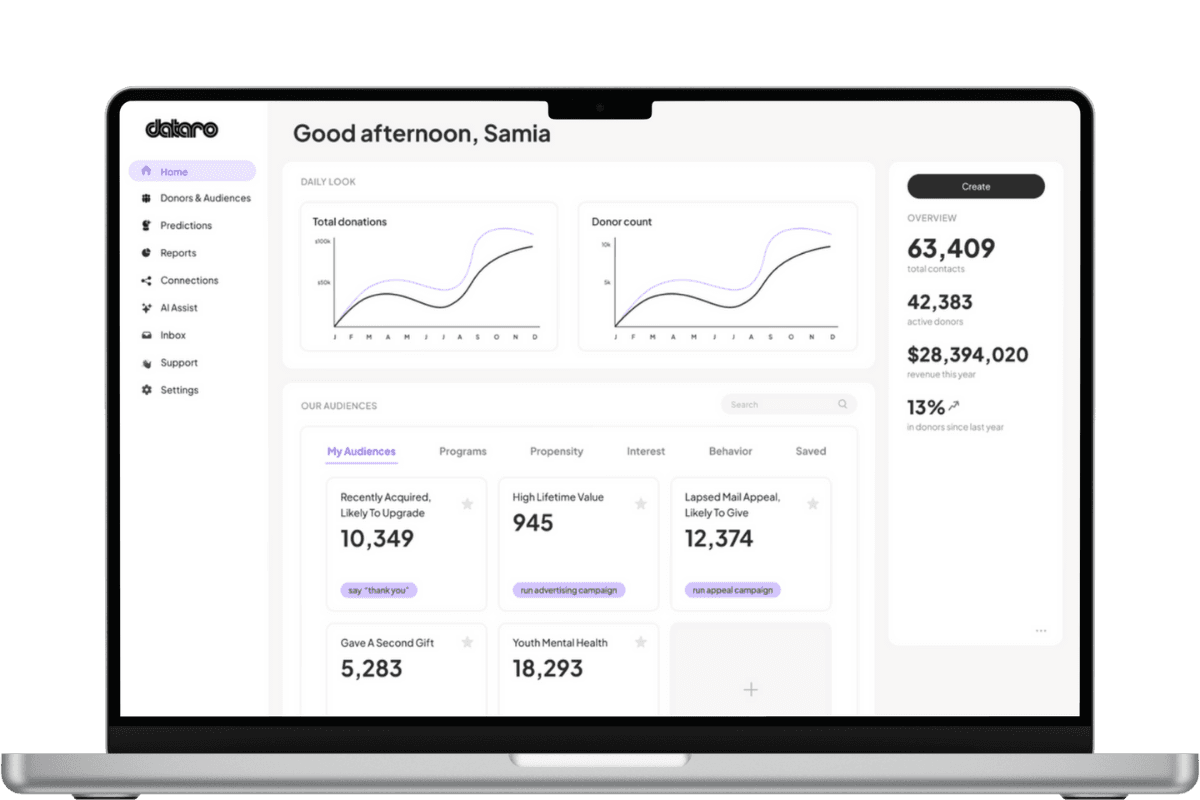
Dataro fits into the measure step of a simple loop: predict, act, measure, repeat. Benchmarks show what changed, then feed the next round of ranked actions so each campaign gets sharper. Instead of debating who to include, you get a ranked list you can explain and approve.
Practical takeaways
Benchmark against your own past first, then add segment and sector context
Track a small, consistent metric set and always pair revenue with cost
Measure the same way every cycle so comparisons hold up
End every benchmark with a decision, not a dashboard
Feed results back into targeting so the next campaign improves
Conclusion
Benchmarking is not about producing more reports. It is about closing the loop between what happened and what you do next. Measure consistently, compare against the right reference points and turn every result into a clearer decision about who to focus on and what to do next. That is how fundraising gets more precise, campaign after campaign.
Related articles
Discover more insights into nonprofit fundraising and data from the Dataro team.