Donor lifecycle optimisation: a clear framework and how to measure lift
Strategy & Frameworks

Donor lifecycle optimisation works only when each stage has a clear next action and you prove the lift with a holdout test.
Donor lifecycle optimisation is the practice of prioritising the right donors and choosing the right next action at each stage of the donor relationship, from first gift to lapse and win-back. Done well, it means fewer touches, better timing and revenue you can protect.
The problem is the language. Vendors and consultants use donor journey optimisation, lifecycle management, fundraising intelligence and next-best action to describe overlapping ideas. That makes it hard to compare tools or brief your team. This guide untangles the terms, sets one clear framework and answers the question most buyers ask last but should ask first: how do you measure the lift?
What is donor lifecycle optimisation?
Donor lifecycle optimisation is deciding who to focus on and what to do next across every stage of the donor relationship, so programs compound instead of resetting with each campaign.
Two decisions sit underneath it. Every fundraising team makes them with or without software:
Focus: who should we prioritise right now, and why?
Act: what is the right next action for each of them, across every program?
Everything else in this space is a different label for helping teams answer those two questions.
The terminology, untangled
The terms below are often used interchangeably. They describe related but distinct things. Reading them side by side makes the differences clear.
Term | What it usually means | Where it fits |
|---|---|---|
Donor journey optimisation | Mapping and improving the stages a donor moves through | The map: stages and transitions |
Lifecycle management | Running programs and touches across those stages | The operations: campaigns and cadence |
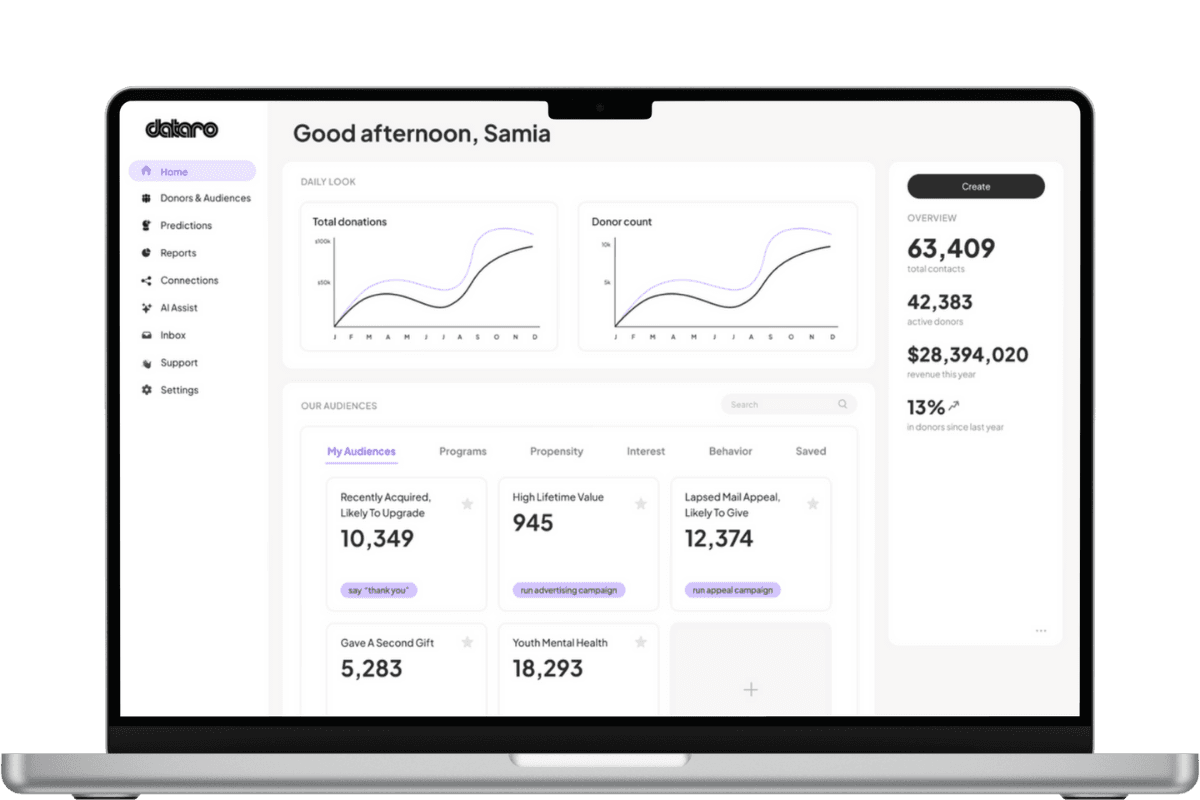
Fundraising intelligence | Software that turns CRM data into ranked priorities and next actions | The engine: predictions and prioritisation |
Next-best action | The single recommended step for one donor right now | The output: one action per record |
Donor lifecycle optimisation | The umbrella goal: right donor, right action, at every stage | The outcome: compounding results |
The practical takeaway: journey optimisation is the map, lifecycle management is the day-to-day operation, and next-best action is the output you actually execute. Optimisation is the goal that ties them together. When a vendor says fundraising intelligence, ask what ranked actions it puts in front of your team and how it proves they worked.
The five-stage framework
Most donor relationships move through five stages. Treat each stage as a decision point with a clear owner and a clear next action.
Acquisition
Bring in new donors at a sustainable cost. The focus decision is which prospects and channels are worth the spend. The act decision is the offer, ask amount and welcome that follow a first gift.
Conversion
Turn a first-time or one-off donor into a committed giver, often a regular or monthly donor. The signal to watch is early engagement. Act early, because second-gift conversion is where most donor value is won or lost.
Retention
Keep committed donors giving. Retention is a core growth lever, not a reporting metric. The job is to spot who is at risk early enough to do something about it, then run a simple intervention before the value churns.
Upgrade
Move donors to a higher level: a larger regular gift, a mid-value ask or a major-gift conversation. The focus decision is who has both the propensity and the capacity to give more. The act decision is the ask ladder and the timing.
Reactivation
Win back lapsed donors worth the effort. Not every lapsed donor is worth a mailing. Rank them by likelihood to return, then concentrate spend on the highly ranked and suppress the rest.
The pattern repeats at every stage: rank the file, set a clear cutoff, assign one next action and hand it to an owner. That is how activity compounds instead of resetting each quarter.
How do you measure lift from lifecycle optimisation?
This is the buyer question that separates real programs from dashboards. Lift is the extra result your optimisation produced compared with what would have happened anyway. You cannot read it off a campaign report, because a report cannot show the donors who would have given without your intervention.
To measure lift, you need a holdout test.
What is a holdout test?
A holdout test, also called a control group test, sets aside a random sample of eligible donors who do not receive the optimised treatment. You compare their results with the treated group. The difference is the lift you can credibly attribute to the change.
How to run one
Define the population. Choose the donors eligible for the treatment, for example everyone the model ranks highly for an upgrade ask.
Randomise. Split them into a treatment group and a holdout group at random. Random assignment is what makes the comparison fair.
Size the holdout. Make it large enough to detect a meaningful difference. Small holdouts on small programs produce noise, not answers.
Run the treatment. Give the treatment group the optimised action and the holdout group your usual approach or nothing.
Measure the gap. Compare response rate, net revenue per donor or retention rate across the two groups over a fixed window.
Check significance. Confirm the gap is larger than normal random variation before you scale.
An example
Say you rank 20,000 lapsed donors and plan a win-back series. Hold back 10% at random. If the treated 18,000 return at 6% and the 2,000 holdout returns at 4%, your lift is 2 percentage points, or a 50% relative gain, and you can size the revenue it produced. Now the result is easy to explain and easy to justify to a board.
Common measurement mistakes
Comparing this year to last year. Too many things change to isolate the effect.
Using a self-selected control. If the holdout is not random, the comparison is biased.
Reading gross revenue only. Measure net revenue per donor so cost is included.
Stopping too early. Give retention and reactivation effects time to show.
Skipping the holdout entirely. Without a control group, lift is a guess.
Practical recommendations
Start with one stage where the stakes are clear, usually retention or reactivation, and prove lift there before expanding.
Give every ranked list a cutoff and a single next action, not just a score.
Build a small holdout into every optimisation program by default, so measurement is standard rather than an afterthought.
Report net revenue per donor, not activity volume. Fewer, better touches should show up as protected or higher revenue.
Keep the method the same across cycles so results are comparable over time.
Conclusion
The terms will keep multiplying, but the work does not change. Donor lifecycle optimisation is answering two questions at every stage: who to focus on and what to do next. A five-stage framework of acquisition, conversion, retention, upgrade and reactivation gives you the map. A holdout test gives you the proof.
If you can rank the file, set a cutoff, assign a next action and measure the lift against a control group, you have a program you can run every week and a result you can defend.
Related articles
Discover more insights into nonprofit fundraising and data from the Dataro team.