Dataro vs competitors: which fundraising tool actually helps you decide
General
Fundraising teams are being asked to do more with less. Goals rise, teams stay flat and the cost of every mail piece, email and staff hour is under scrutiny. So when it's time to plan a campaign, the safe default kicks in: send to more people, reuse last year's segments and hope it works.
That's not a tooling problem. It's a decision problem. Before you spend budget, you have to answer one question well: who deserves our attention right now, and why?
This is where Dataro and the wider "AI for fundraising" market diverge. Most tools market data, automation or an all-in-one suite. Dataro leads with the decision. Here's how that plays out when you compare options.
The decision most tools skip
Focus is the first decision every fundraiser makes, whether or not they have software for it. Which donors, prospects and segments are worth prioritising before you commit time and money?
What makes it hard isn't a lack of data. It's a lack of a defensible cutoff. You need a short list stakeholders can approve and a reason you can explain when someone asks, "Why these people and not those?"
Most categories of software touch the edges of this decision without owning it:
CRMs store the data but leave the prioritising to you.
BI and dashboards explain what already happened.
Marketing automation helps you send more, faster.
Wealth screening tells you who has capacity, but not who to act on now.
Each is useful. None of them hands you a ranked list with a cutoff you can defend.
Where the main alternatives land
It helps to be precise about what competing tools are built to do. That makes it easier to see where Dataro fits and where it doesn't.
CRMs (Salesforce, Blackbaud, Bloomerang, Virtuous, Bonterra)
These are systems of record. They hold constituent data and history, and most now offer AI as an add-on. They're essential, but they're not built to turn your file into prioritised actions across programs. Dataro sits on top of the CRM and does that work without asking your team to switch systems.
Wealth screening and prospect research (iWave, Windfall, DonorSearch)
These tools enrich major-gift prospects and estimate capacity. That answers "who could give a lot," which matters for major gifts. But capacity isn't the same as priority. Dataro drives cross-programme decisioning that moves past "who has money" into who to prioritise, when and what to do next, across appeals, retention, mid-value and legacy.
Predictive point solutions and "AI operating systems" (Avid, Squark AI)
These are positioned as predictions plus automation. The gap is usually workflow. A model score that never reaches a fundraiser's task list doesn't change behaviour. Dataro is built to be workflow-real: outputs your team can run next week, across multiple programmes, with lift tied to outcomes rather than model claims.
Digital fundraising platforms (Fundraise Up, Classy, Givebutter, Engaging Networks)
These optimise a channel, like donation forms, peer-to-peer or email. Valuable work, but channel-bound. Dataro coordinates who to focus on and what to do next across the whole donor file, not inside a single channel.
Agencies (Moore, RKD, Pursuant)
Agencies bring strategy and execution as a service. Dataro is built to compound in-house capability with a repeatable decision rhythm you own, so the value stays with your team.
Focus and Act: the two decisions that endure
Strip away the category labels and fundraisers make two decisions on repeat:
Focus: Who should we focus on right now, and why?
Act: What's the right thing to do for each of them, across every programme?
Most donor scoring stops at Focus. It hands you a list and walks away. The harder, more valuable question is Act. A high-scoring donor might need an upgrade ask, a stewardship touch, a recurring-giving conversion or a handoff to major gifts. The action depends on the donor, not the score alone.
This is why "predictive donor scoring" on its own isn't enough. A score is an input. A next-best action assigned to an owner and a workflow is something your team can run. That distinction is the difference between a dashboard you argue about and a decision you act on.
What "good" looks like in practice
When Focus and Act work together, the day-to-day changes in concrete ways:
You get a ranked list with a clear cutoff, not a 40,000-name file to negotiate down.
You can explain your targeting to a board member or a finance lead without flinching.
Donor segmentation moves from coarse buckets to donor-level priorities.
At-risk recurring givers surface early, while there's still time to intervene.
Each touch points to a next step, so programmes compound instead of resetting.
The goal isn't more activity. It's fewer, better decisions you can defend.
How Dataro fits your existing stack
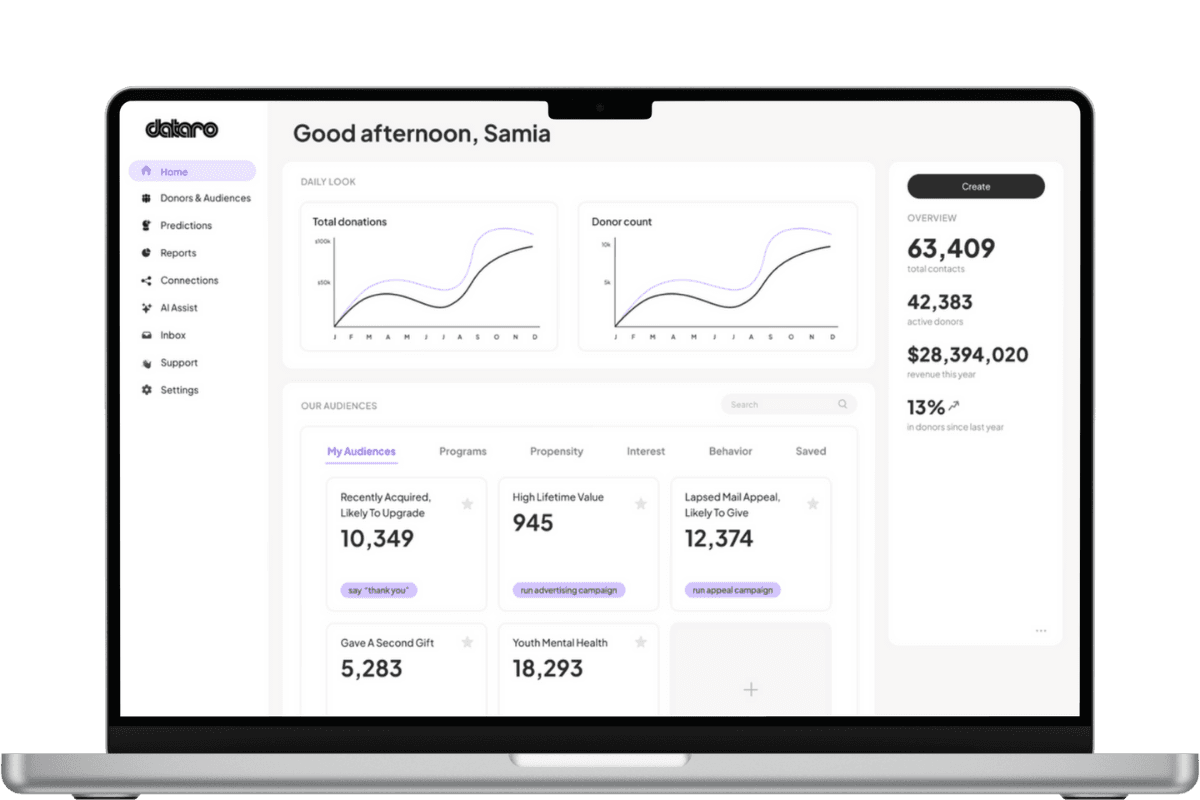
Dataro doesn't replace your CRM, your BI tools or your marketing automation. It adds a decision layer on top of what you already run. The loop is simple:
Your CRM holds the data and history.
Dataro reads that data and returns ranked priorities, cutoffs and next actions.
Those outputs land back in your CRM as audiences, tasks, tags or lists.
Your team runs the work, and results flow back as fresh signals.
Predict, act, measure, repeat. Because outputs land in the tools you already use, adoption is low-lift and time-to-value is short.
Choosing between Dataro and the alternatives
If you need a system of record, buy a CRM. If you need to know who has wealth, use a screening tool. If you need to optimise one channel, a digital platform will help.
But if the real problem is deciding who to focus on and what to do next, across every programme and in a way you can defend, that's the decision Dataro is built for.
The shorthand is easy to repeat to a colleague. Competitors mostly market AI, data, automation or all-in-one. Dataro leads with predict, act, measure, repeat, and anchors on decisions your team can run and justify.
The cost of staying with guesswork
Do nothing and the default holds: over-mail to feel safe, reuse last year's rules and watch approvals slow because the targeting is hard to defend. That's wasted budget, donor fatigue and a team stretched thinner each quarter.
The alternative is a steady rhythm of fewer, sharper choices, where every name on the list has a reason and every touch has a next step. Want to see what that looks like with your own data? Ask to see an example output and judge the decision, not the demo.
Related articles
Discover more insights into nonprofit fundraising and data from the Dataro team.