Dataro vs competitors: how to compare fundraising intelligence tools
General
Fundraising teams are being asked to do more with less. Goals rise, teams stay flat and donors are harder to predict. So when it's time to plan a campaign, the safe default becomes "send to more people" or "use last year's segments." Everyone knows it isn't precise, but it feels safer than guessing.
That's the gap most fundraising tools try to fill. The question is how they do it, and where Dataro fits. This guide walks through how Dataro compares to other tools across the decisions fundraisers actually make: who to focus on, and what to do for each donor next.
The two decisions every fundraiser makes
Strip away the software and there are only two decisions on the table:
Focus: Who deserves our attention right now, and why?
Act: What's the right thing to do for each of them, across every programme?
Most tools touch one slice of this. A CRM stores the data. A wealth screening tool tells you who has capacity. A digital platform optimises a donation form. None of them answer both questions in a way your team can run next week.
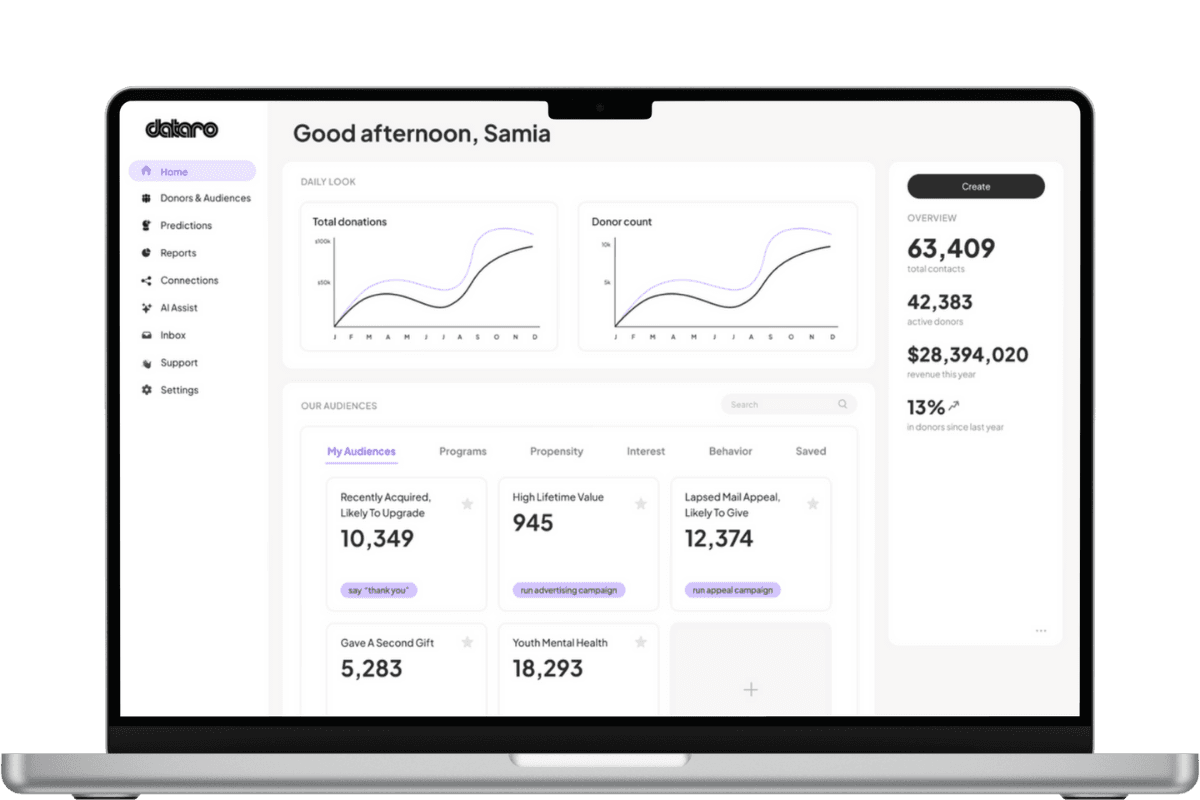
Dataro is a fundraising intelligence platform. It sits on top of your CRM, reads your data and returns ranked priorities and next actions mapped to Focus and Act. The goal isn't more activity. It's fewer, better decisions you can defend.
Dataro vs the tools you already use
It helps to name what Dataro is not, so you don't compare it to the wrong category.
CRMs (Salesforce, Blackbaud, Bloomerang, Virtuous, Bonterra)
These are systems of record. They hold constituent data and history, and "AI" is usually an add-on. Dataro doesn't replace them. It sits on top and turns that data into decisions and actions across programmes, without asking your team to change systems.
Wealth screening and prospect research (iWave, Windfall, DonorSearch, Hatch)
These tools enrich major-gift records and answer "who has capacity." That's useful, but capacity is only part of the picture. Dataro drives cross-programme predictive decisions: who to prioritise, when and what to do next. Automated prospect research becomes one input, not the whole answer.
Predictive point solutions (Avid, Squark AI)
These position around predictions plus automation. Dataro's difference is that it's workflow-real, multi-programme and measurable. Outputs land back in your CRM as audiences, tasks, tags and lists, so the work is execution-ready rather than a model claim.
Digital fundraising platforms (Fundraise Up, Classy, Engaging Networks, Givebutter)
These optimise channels: forms, peer-to-peer, email. Dataro coordinates who and what next across the whole donor file and every programme, not a single channel.
Agencies (Moore, RKD, Pursuant)
Agencies bring services-led strategy and execution. Dataro builds in-house capability with a repeatable decision rhythm and measurable outcomes, so the value compounds.
The shorthand: most competitors market AI, data, automation or "all-in-one." Dataro leads with a loop you can run, predict then act then measure then repeat, anchored on decisions your team can explain.
What this looks like across your programmes
Here's where the capabilities you're likely evaluating actually fit.
Predictive donor scoring and segmentation
Instead of last year's rules, Dataro scores donors on signals and returns ranked lists with defensible cutoffs. That moves you from coarse segments toward donor-level prioritisation. You're treating people like people, not bucketing everyone into the same rule.
Donor data enrichment and profiling
Enrichment and profiling sharpen the inputs. Wealth screening tells you capacity. Dataro folds capacity, behaviour and propensity together so the ranked list reflects the full picture, not one variable.
Next-best-action recommendations
This is the Act decision. For each donor, what should follow: upgrade, steward, suppress or hand off to another programme? Dataro assigns next actions to an owner and a workflow, so activity compounds instead of resetting after every send.
Campaign ROI and targeting
Rising costs make waste visible. Precision is the strategy: mail fewer people with higher confidence, protect results and free up budget. Dataro ties targeting to outcomes so each cycle gets sharper.
Personalised fundraising content
Once you know who and what next, content can match the moment instead of the segment. The decision drives the message, not the other way around.
How the loop runs
The operating model is simple enough to repeat to a colleague:
CRM: your data and history live here.
Dataro: reads that data, returns ranked priorities, cutoffs and next actions.
Back to CRM: outputs land as audiences, tasks, tags or fields.
Action: your team runs the work, then results flow back as new signals.
Adoption stays low-lift because Dataro adds a decision layer. It doesn't replace your systems.
Why governance matters in the comparison
Trust is a buying criterion, not a nice-to-have. Leaders need decisions they can explain, audit and get approved. If you can't explain a cutoff, you can't use it.
When comparing tools, ask whether the outputs are inspectable and defensible. A score you can't explain creates the same problem as a guess: it just looks more confident. Dataro's outputs are built to be defended in front of stakeholders who care about risk and explainability.
What changes when you get this right
Without a clear decision rhythm, the cost is familiar: wasted budget, donor fatigue, hours lost pulling lists and slow approvals because no one can defend the choices.
With one, the picture shifts. You target with more precision, protect team capacity and run programmes that are easier to execute and easier to justify. Fewer debates, clearer cutoffs, execution-ready next actions.
Most tools help with a piece of this. The real question when comparing Dataro to competitors is whether a tool answers both Focus and Act, returns work your team can run and produces decisions you can defend. That's the standard worth holding every option to.
If you want to see what ranked actions look like on your own data, the best next step is a short working session with an example output. That beats any feature comparison chart.
Related articles
Discover more insights into nonprofit fundraising and data from the Dataro team.