Who receives a high-value pack? Three questions to ask to help maximise returns
General
What’s the best way to decide which donors should receive a high value pack in a direct mail appeal? It’s an extra investment, so we need to be careful that the expense is justified. Here are a few tips to ensure you are getting the best value for money for your organisation.
A quick note: having a great story to tell is obviously crucial and something we’re not considering in this brief article.
1. How effective is your high value pack to start with?
If you’re going to invest extra money in additional content, then of course you want to know what return you get for it. If you’re not already accustomed to designing A/B tests to measure the results from sending more expensive mail, now is the time to begin.
We recommend these tests be conducted regularly with statistically matched groups, one receiving the standard pack and the other receiving the high value pack. Metrics to consider include total raised, net return, average gift amount, and response rate. If you’re sending high value packs in your next appeal and haven’t done a recent A/B Test, now’s the time to do so. Here is an example of a recent experiment we conducted with Greenpeace
2. Who is most likely to give a larger gift right now?
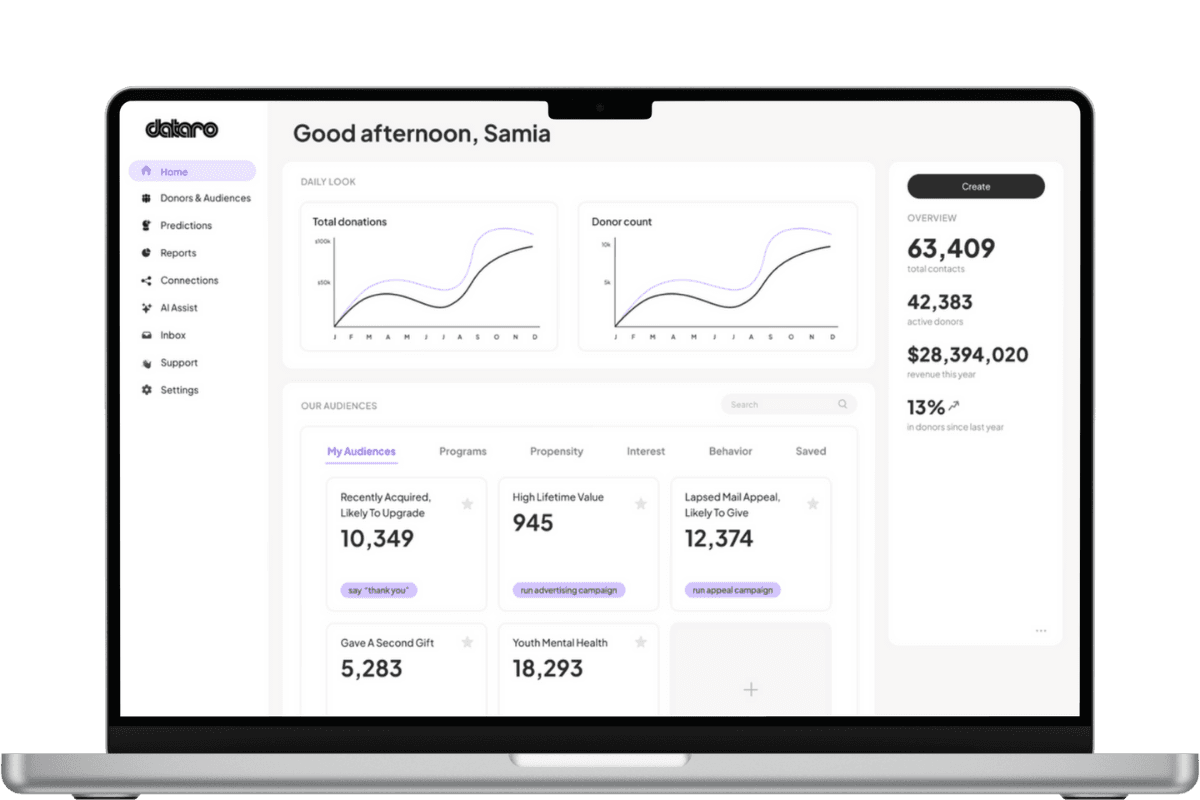
Using AI-driven tools like Dataro’s donor scoring, it’s possible to predict how likely each donor is to give a larger gift in an appeal. For instance, Dataro often provides predictions for how likely donors are to give over £500 in a direct mail appeal.
These predictions are generated by analysing every example of a gift above £500 in the past and identifying similar patterns in your existing donor data. These donors might come from any section of your database, so rather than simply selecting donors from the same ‘segment’, consider directing your high-value packs to the donors with the highest probability of giving a larger gift.
3. Who might join your mid-level programme in the next year?
A third strategy involves focusing on enhancing connections with potential future mid-level givers. At Dataro, we define ‘mid-level’ as giving between £500 – £5,000 in a 12-month period, although you may have another metric (e.g., £1,000 – £10,000 or perhaps more).
Dataro’s mid-level predictions aim to identify supporters within your existing database who have a higher probability of giving in the mid-level category in the next 12 months. Naturally, it is vital to your mid-level programme that you build connections with these donors, and sending them a high-value pack is one channel you might choose to use to deepen the relationship.
Find out how Greenpeace used AI-powered donor scores to raise more funds to fight for the environment.
Related articles
Discover more insights into nonprofit fundraising and data from the Dataro team.