Regular giving fundraising technology to help recession-proof your fundraising
General
The significance of regular giving cannot be overstated as it provides a reliable stream of predictable income each month. It is also one of the best ways to diversify your fundraising revenue, helping to reduce reliance on appeals and more effectively recession-proof your charity.
So how do you safeguard your regular giving programme from the impacts of rising fundraising costs and inflation?
Staying on top of your regular giving retention and conversion strategies is crucial, and using new fundraising technology like Dataro’s AI Predict and Fundraising Intelligence are your secret weapons, helping you to utilise your existing donor data in ways that drive results.
With this in mind, we wanted to share some important regular giving trends and insights, along with key strategies to help you protect your regular giving income during this current period of economic uncertainty.
What happens to regular giving in periods of uncertainty?
Converting existing cash donors and reducing churn are two of the most cost-effective strategies to protect your regular giving programme from the effects of inflation and an economic downturn.
That’s because as consumer confidence decreases and donors feel the pressure of rising costs, we tend to see a decline in giving, including regular giving. Rather than reducing the amount of their monthly gift, donors typically reduce the number of charities they support – so you want to do everything you can to retain your regular givers’ support (continue reading for our top strategies).
Analysing the data from our expanding data pool of over 100 global charities (with 20 years of retrospective data), we consistently observe this trend unfold in periods of economic downturn.
In particular, when COVID occurred, consumer confidence declined and we observed an increase in donor churn and a reduction in recurring giving revenue. Importantly, regular giving drove the recovery of many charities post-pandemic, so protecting your regular giving programme is essential to weathering the storm and ensuring a rapid recovery.
To learn more about how the uncertainty of COVID affected recurring giving, read our blog here.
To learn more about Dataro’s Fundraising Intelligence and benchmarking data pool, read here
Regular giving churn has risen again in the last 12 months
In 2022, Dataro is already observing early indicators of the impact of inflation on regular giving churn.
Because donor churn is a lagging indicator, it takes time to understand churn metrics and how the trend will play out. However, Dataro’s analytics already reveal that the typical charity is currently experiencing an increased level of regular giving churn, particularly over the last two quarters.
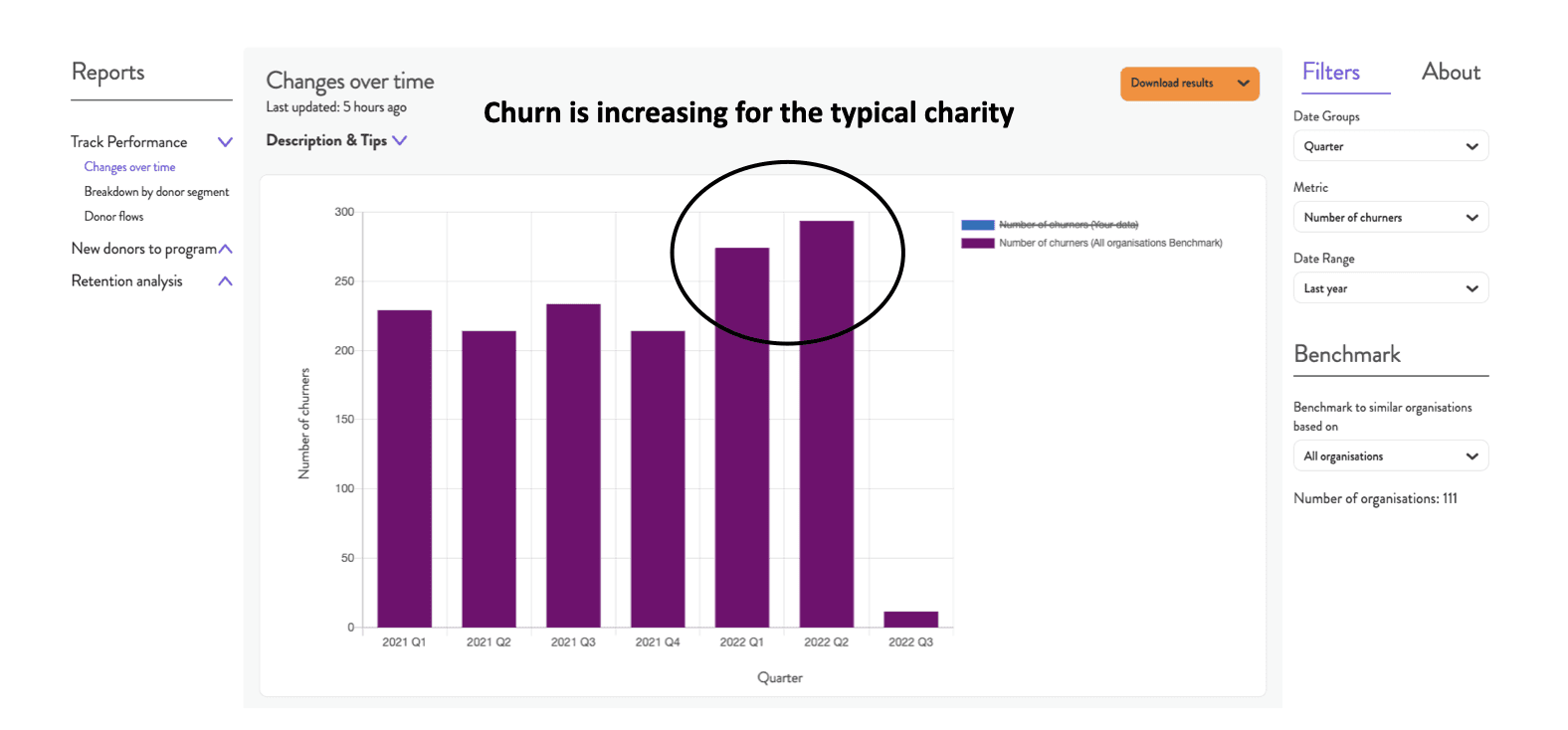
So what does that mean for charities – retention is going to become more challenging!
In uncertain times, fundraisers need to work smarter and utilise all of the donor data available to them to guide their fundraising strategies and give them the best chance of success. Dataro’s Fundraising Intelligence tool assists fundraisers in identifying key trends in their data (and the sector) as they occur. This can help give them a head start to enhance donor retention and mitigate the effects of inflation.
Using Fundraising Intelligence charities can proactively measure their regular giving KPIs against live industry benchmark data from over 100 global charities to better understand their performance and help identify trends and performance gaps and discover new opportunities.
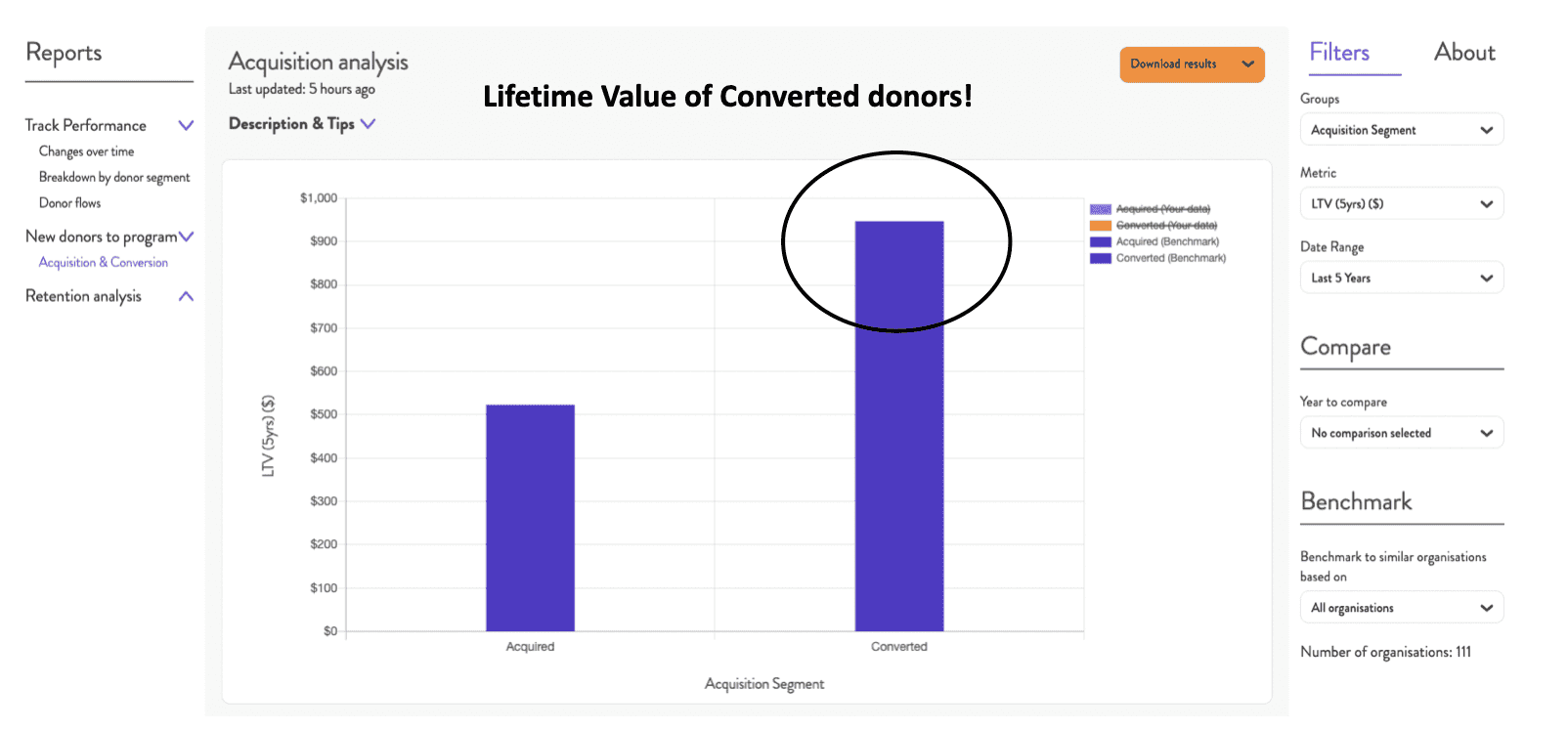
Cash donors who convert to regular givers are retained longer, with twice the higher LTV
Dataro’s analytics reveal that newly acquired and converted regular givers typically have the same average gift size. However, regular givers converted from other fundraising activities have almost double the lifetime value (LTV) of newly acquired givers, as they are retained for longer.
While acquisition plays a role in growing your giving programme, converted donors have a much higher ROI because they are less costly to acquire, have higher retention, and deliver a greater LTV.
Unlike the set-and-forget segmentation approach, Dataro’s donor propensities are updated weekly in the charity’s CRM, as our machine learning models analyse all of the data and identify new changes that are occurring live in your donor database. Plus, we add new ML models regularly. That means your campaigns are based on the most recent data and most current donation history.
So as fundraising costs continue to rise, conversion is the most cost-effective strategy for building stability in your regular giving.
Using Fundraising Intelligence fundraisers can compare their regular giving results against live benchmarks to understand how their conversion strategies are performing against other similar organisations and which conversion channels deliver the best response rate. To learn more about reducing acquisition through conversion and reactivations read our previous regular giving blog – Why acquisition isn’t your only strategy for growing your regular giving.
Improving your conversion and retention campaign targeting is crucial
Knowing that regular giving conversion has the strongest ROI and LTV but retention might be challenging in the coming months, the key to successful conversion and retention campaigns lies in improving your campaign targeting.
The issue today with many fundraising campaigns is that they aren’t as targeted as they should be.
That’s because charities are still using traditional segmentation processes based on the recency, frequency, and value (RFV) of donors that considers past behaviour only and doesn’t account for all other interactions a donor has had with your organisation that could indicate their engagement and likelihood to give.
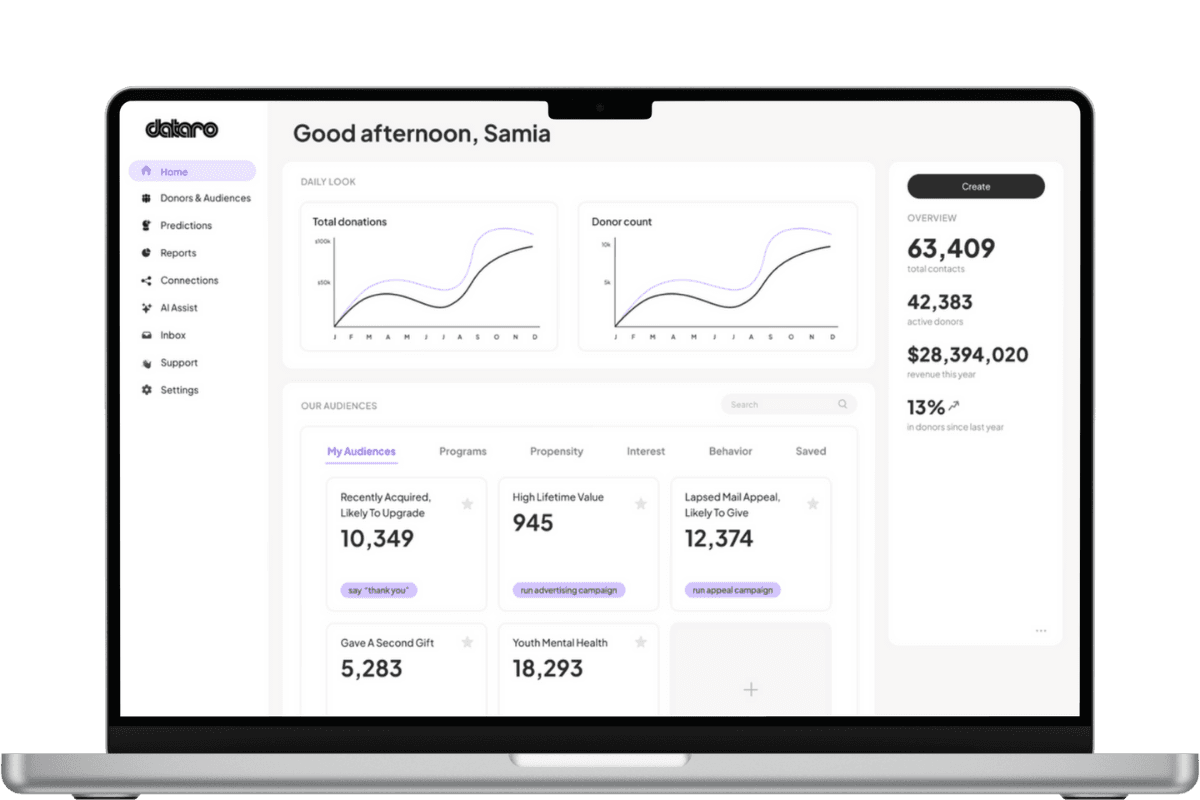
Dataro’s AI-powered donor predictions assist fundraisers in identifying the right donors to include in their campaigns based on where they are in their own unique donor journey. This approach utilises deep machine learning to analyse thousands of donor data points in your CRM to predict accurately how each donor is likely to behave next, considering all of the touch points the donor has had with your organisation. Dataro’s donor predictions are then laid out neatly within the charity's CRM, providing predictions across a range of fundraising programmes and activities to make data selections in your CRM speedy and effective.
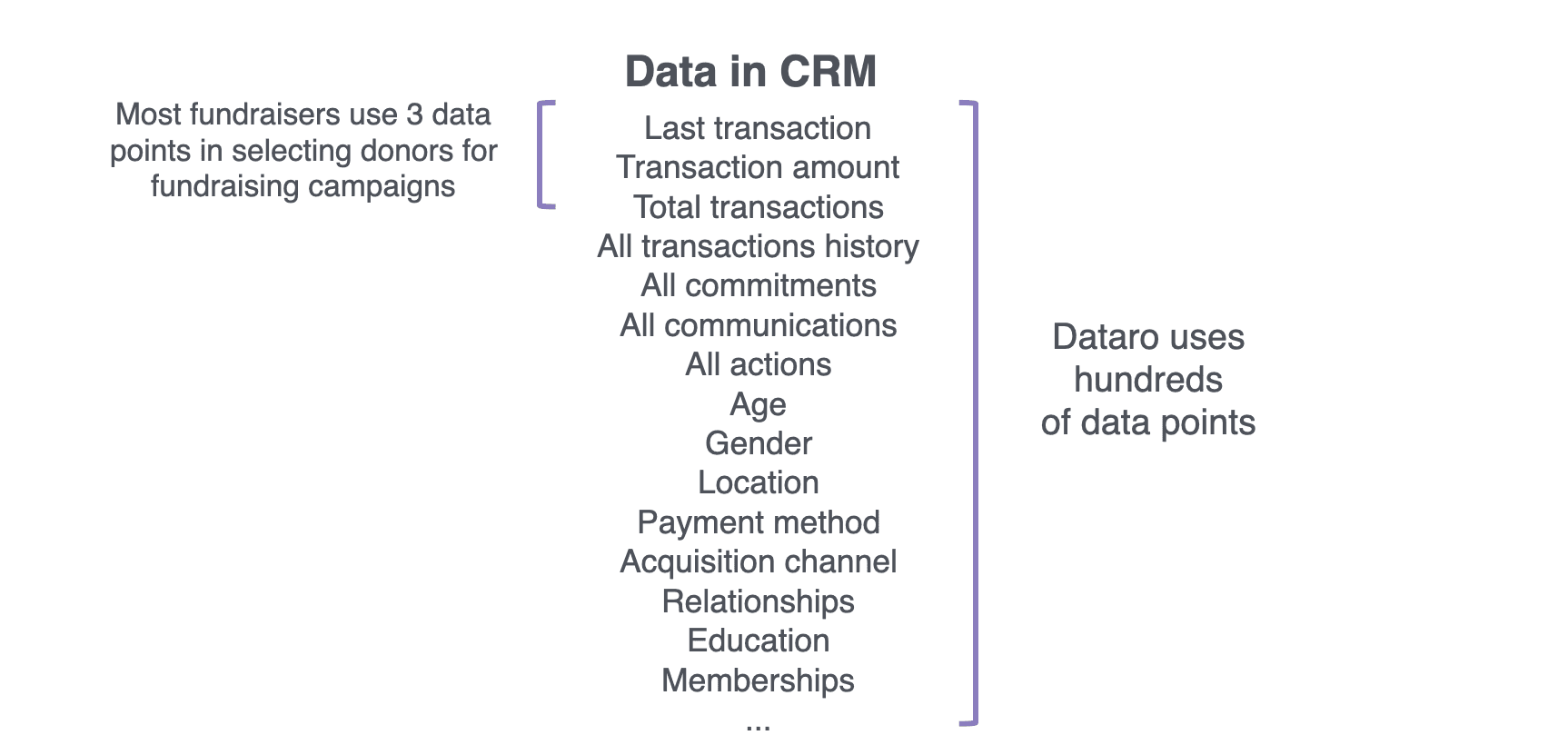
Unlike the set-and-forget segmentation approach, Dataro’s donor propensities are updated weekly in the charity’s CRM, as new machine learning models are added and analyse all of the data and identify new changes that are occurring live in your donor database. That means your campaigns are based on the most recent data and most current donation history.
Want an in-depth explanation of how Dataro’s ML works – read here.
Using AI-powered predictions to reduce regular giving churn
Dataro’s Fundraising Intelligence data indicates that, on average, charities lose just under 50% of their new regular giving cohorts in the first year. And the average regular giver makes 16 – 17 gifts before they churn, according to our data pool. So by proactively identifying the donors at risk and engaging them with a thank you call, you have a better chance of preventing them from churning.
Dataro’s RG Churn donor predictions help charities to identify those regular givers most likely to churn – so you can better target your intervention campaigns and enhance donor retention.
So what does moving away from a segmented targeting approach based on historical data to predictive targeting look like?
In the peak of COVID, Victor Chang Cardiac Research Institute saved 296 regular givers in 3 months using Dataro's churn propensities to call the most at-risk donors – generating an estimated £57,311 in continued monthly gifts.
In 2021, the Fred Hollows Foundation NZ also joined forces with Dataro to improve their regular giving campaign targeting using machine learning. In their thank you intervention calling campaign, Fred Hollows Foundation NZ stopped 211 regular givers from churning, retaining an estimated £104,005 in net income through secured monthly gifts.
Fundraising expert Andrew Jung also recently shared his top tips for planning better regular giving retention calls – read the blog to maximise the effectiveness of your targeted calls.
Want to enhance your retention strategies even further – read our step-by-step guide to retaining more donors here.
Using machine learning to convert more regular givers in tough times
An obvious source of potential new regular givers are a charity's existing one-off donors. Conversion to regular giving programmes can yield lower acquisition costs and double the LTV compared to newly acquired donors. That’s because these donors are already engaged with your cause and have a desire to increase their impact.
In 2021, the Wilderness Society collaborated with Dataro to improve their regular giving conversion campaign targeting using machine learning and found AI-driven donor predictions increased response rates in their calling campaigns (compared to their normal data selection methods).
Over 5 months, the Wilderness Society converted 48 new regular givers by calling those most likely to give a monthly gift, securing an estimated £14,172 in net income through monthly gifts.
Related articles
Discover more insights into nonprofit fundraising and data from the Dataro team.