How to prioritise donors for your next fundraising appeal
General

Predictive rankings let fundraising teams focus on fewer, higher-value donors and defend where they draw the line.
How to prioritise donors for your next fundraising appeal
To prioritise donors for an appeal, rank every record on the file by its predicted likelihood to give, set a cutoff you can defend to stakeholders and assign a clear next action to each donor. This replaces manual segmentation and gut feel with a repeatable rhythm you can run every campaign.
Most teams still build appeal lists the way they did last year: reuse old segments, add a wide safety margin and hope the numbers hold. That approach is expensive. It burns budget on donors who were never going to respond and tires the donors who matter most.
What does it mean to prioritise donors?
Prioritising donors means deciding who deserves your attention before you spend budget or staff time. It answers one question: who should we focus on in this appeal, and why?
Good prioritisation produces two things:
A short, ranked list the team can act on
A cutoff line that leaders can approve without a long debate
When those two outputs are clear, planning gets faster and approvals get easier.
Why do old targeting rules stop working?
Rules and segments built last year assume donor behaviour stays the same. It rarely does. Costs rise, donor patterns shift and yesterday's cutoffs start to feel like guesses.
That uncertainty pushes teams in one of two directions:
Over-mail to feel safe, which drives up cost and donor fatigue
Under-mail out of caution, which leaves revenue on the table
Both are symptoms of the same problem: targeting that isn't grounded in reliable signals.
How predictive rankings work
A predictive model scores each donor on how likely they are to take a specific action, such as give to a particular appeal. Those propensity scores turn your file into a ranked list, from most to least likely to respond.
The workflow is simple:
Read your CRM data and history
Score every donor for the appeal
Rank the file from highest to lowest propensity
Set a cutoff based on budget, goal and capacity
Return the list and next action into your CRM
Because the ranking is built on signals rather than static rules, you can explain why a donor is highly ranked or lowly ranked. That makes the cutoff easier to justify internally.
Predictive rankings vs. manual segmentation
Both methods aim to focus effort, but they differ in cost, speed and confidence.
Factor | Manual segmentation | Predictive rankings |
|---|---|---|
Basis | Last year's rules and gut feel | Signals from your own data |
List building | Hours of pulling and negotiating exclusions | Ranked list generated for each appeal |
Cutoff | Hard to defend | Clear line tied to goal and budget |
Mail volume | Padded for safety | Fewer, better-targeted contacts |
Approvals | Slow, debate-heavy | Faster, explainable |
The trade-off: manual segmentation feels familiar and needs no new tooling, but it scales poorly and hides waste. Predictive rankings take an upfront setup, then compound in value each campaign.
Practical steps to prioritise your next appeal
Start with the goal. Know your revenue target and mail budget before you draw a line.
Rank the whole file, not just recent donors. Some of your best prospects may not be on the current list.
Set the cutoff against capacity. Mail as far down the ranking as your budget and team can support.
Attach a next action to each donor. A ranked list is only useful if the team knows what to do with it.
Measure lift after the appeal. Compare results to your previous approach so the next cycle gets sharper.
What happens if you don't prioritise
Without clear prioritisation, the safe default becomes "send more." That means higher print and postage costs, more donor fatigue and slower approvals because no one can explain the cutoff. Over time, the team spends more to raise the same or less.
With prioritisation, the picture changes. You contact fewer people with more confidence, protect team capacity and run appeals that are easier to execute and easier to justify.
Key takeaways
Prioritising donors means ranking the file, setting a defensible cutoff and assigning a next action.
Old segments and gut feel lead to over-mailing or under-mailing.
Predictive rankings use your own data to show who to focus on and why.
Fewer, better-targeted contacts protect both revenue and donor relationships.
Conclusion
Prioritisation is the difference between guessing and deciding. Rank your file, set a cutoff you can defend and give the team a clear next step for each donor. Done well, it turns appeal planning from a debate into a rhythm you can repeat every campaign.
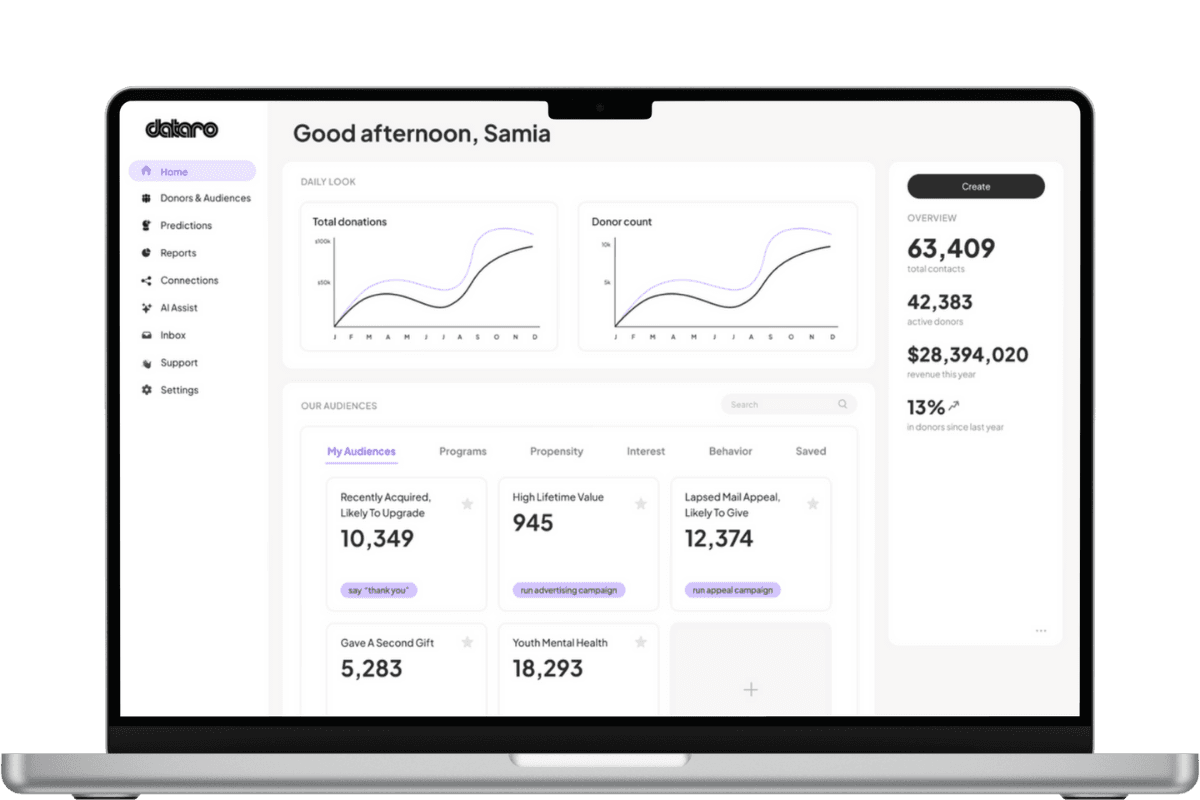
Dataro sits on top of your CRM and turns your data into ranked lists, clear cutoffs and next actions, so you can decide who to focus on and what to do next.
Related articles
Discover more insights into nonprofit fundraising and data from the Dataro team.