The Focus and Act framework: how to decide who to prioritise and what to do next
Strategy & Frameworks

Fundraising performance improves when teams answer two questions each week: whom to focus on and what to do next.
The two decisions every fundraising team has to make
Most fundraising work comes down to two questions: who deserves attention right now, and what should happen next for each of those people? If a tool disappeared tomorrow, these decisions would still land on your desk.
The problem is capacity. Teams are flat, goals keep rising and channels keep multiplying. Under that pressure, the safe default becomes "send to more people" or "reuse last year's segments," even when everyone suspects it isn't precise.
This guide lays out a practical framework for making both decisions well. We call it Focus and Act.
What is the Focus and Act framework?
Focus and Act is a decision framework for fundraising teams. Focus answers who to prioritise before you spend budget or staff time. Act answers what to do next for each person, across every programme.
It is deliberately simple. The goal is fewer, better choices the whole team can explain, not another dashboard to argue about.
Decision 1: Focus — who should we prioritise?
Focus is about drawing a clear line before money goes out the door. Which donors, prospects or segments are worth prioritising this week?
This is hard because rules from last year no longer feel predictive. Guessing at a cutoff is stressful, and it is hard to justify when a manager asks why the line sits where it does.
Good Focus looks like a ranked list and a clear cutoff. You can point to the reasoning, get it approved quickly and move on.
Practical takeaways for Focus:
Rank donors by likelihood to give rather than sorting on recency and gift size alone
Set a cutoff you can explain in one sentence
Mail fewer people with confidence instead of expanding the list to feel safe
Decision 2: Act — what should we do next?
Focus tells you who. Act tells you what to do for each person so activity compounds instead of resetting every campaign.
The next step is not always an appeal. It might be an upgrade ask, a stewardship touch, a move to a recurring programme or a suppression. The trick is matching the action to the person and handing it to an owner.
This breaks down when programmes run in silos. Appeals, retention, mid-value and stewardship each optimise alone, and donors fall through the gaps between them.
Practical takeaways for Act:
Assign a next-best action to every priority record
Give each action an owner and a workflow, not just a report
Coordinate across programmes so a donor isn't asked and stewarded in conflicting ways
Focus vs. Act: how the two decisions differ
Focus | Act | |
|---|---|---|
Buyer question | Who should we prioritise? | What should we do next? |
Output | Ranked list and a clear cutoff | Next-best action per record |
Main risk | Over-mailing or under-mailing | Silos and dropped handoffs |
What good looks like | An approved short list | Actions with owners and workflows |
The trade-off is sequence, not either-or. Focus without Act produces a clean list nobody executes. Act without Focus spreads effort too thin. Run them in order.
How to put the framework into practice
A repeatable rhythm keeps both decisions sharp over time.
Predict: turn your CRM data into a ranked list so priorities are clear
Act: attach a next-best action to each record and route it to an owner
Measure: track what changed so the next cycle gets sharper
Repeat: run the loop on a weekly or campaign cadence
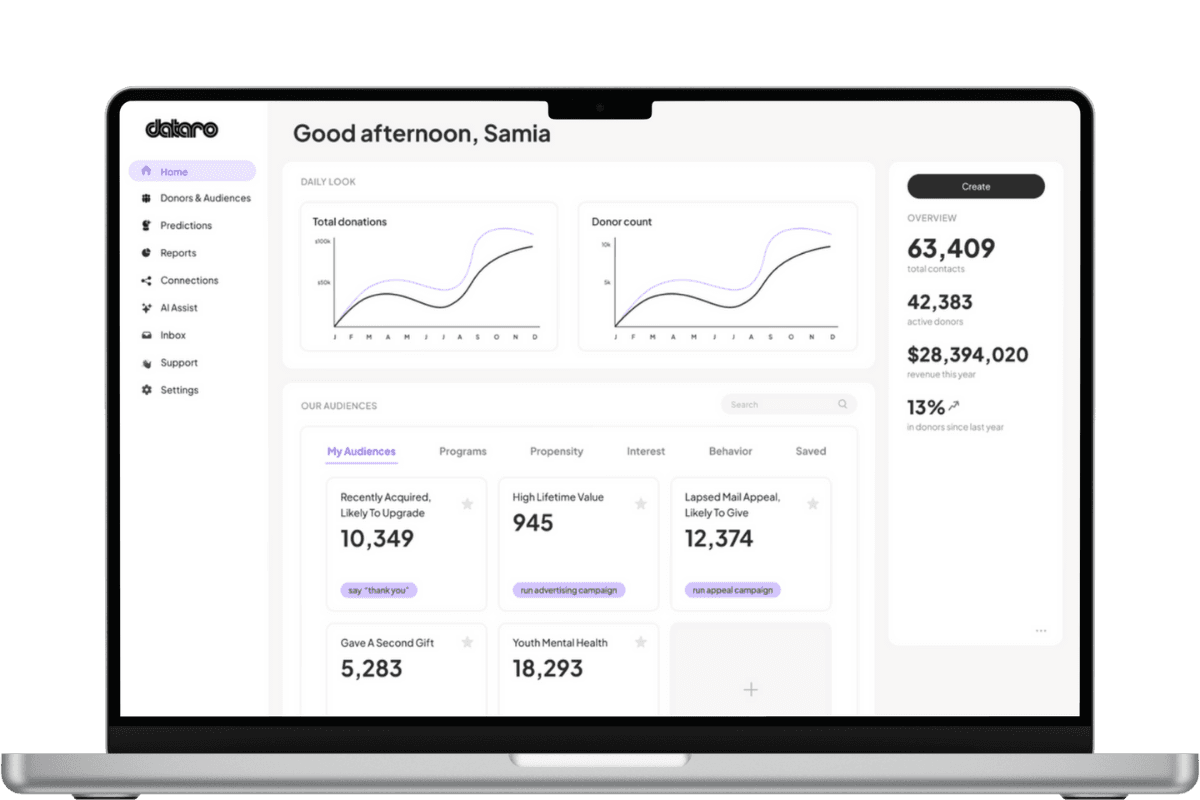
This works on top of the systems you already use. Dataro sits on top of your CRM, reads your data and returns ranked actions into your workflow, so outputs land as audiences, tasks and lists your team can run next week. It adds a predictive layer. It does not replace your CRM, reporting or marketing tools.
Why the framework matters
Rising costs make waste visible. Postage, paid media and staff hours all get scrutinised, so a defensible cutoff and a clear next step are worth more than raw volume.
The payoff isn't more activity. It's fewer, better decisions: sharper targeting, protected team capacity and programmes that are easier to run and easier to justify internally.
Conclusion
Fundraising rarely fails for lack of effort. It stalls when teams can't confidently answer who to focus on and what to do next. The Focus and Act framework gives you a simple, repeatable way to answer both, mail fewer people with confidence and keep every programme pulling in the same direction.
Start small. Rank one campaign, set one cutoff you can explain and assign a next-best action to each record. Then run the loop again.
Related articles
Discover more insights into nonprofit fundraising and data from the Dataro team.