Fundraising analytics: 20 essential metrics & how to utilise them

Analytics and the concept of "data-driven strategy" have transformed our perception of fundraising and donor engagement over the past decade. Charities of all sizes now recognise the importance of collecting data on their donors and campaigns.
The challenge is that actually putting that data to work for their mission is something that many organisations aren’t properly prepared to manage effectively. A lack of expertise and time can create a disconnect between gathering data and then using it to drive outreach and appeal strategies.
Artificial intelligence and machine learning tools for charities have significantly bridged that gap, making it easier for charities to begin fully leveraging their data to enhance fundraising results. However, to use these new tools to their fullest potential, you'll need a solid foundation of data.
In this crash course, we'll cover all the essentials of fundraising analytics, including:
Types and examples of fundraising analytics
How to collect fundraising metrics
How to use fundraising metrics
Fundraising analytics FAQ
The future of fundraising analytics
Charities should carefully plan which metrics they’d like to track and how they intend to use them to prevent overwhelming their teams or losing focus.
However, once you have a firm grasp on what you’re looking for in your data and strategies for acting on those insights, the sky is the limit. Let’s get started.


Types and examples of fundraising analytics
Fundraising metrics can be broken down into three general categories based on what they describe and how they’re used:

Descriptive fundraising analytics describes and summarises what you already know about your strategies and donors. This helps you understand your current performance at the individual, campaign-specific, and organisation-wide levels.
Diagnostic fundraising analytics involves examining the performance of past campaigns and appeals to diagnose their strengths and weaknesses. This helps you identify where things went well or fell short so that you can adapt accordingly.
Predictive fundraising analytics (also known as propensity modelling) involves identifying trends in your historical data to make predictions about future donor behaviour. This can involve simply comparing performance metrics over time to infer how trends are likely to continue. Charities are also increasingly using AI software to generate deeper, personalised predictive insights—more on this below.
There are as many different fundraising metrics as there are ways to interact with your donors, so there can be some overlap between these categories. However, even if various metrics essentially measure the same thing, they can each provide a different descriptive, diagnostic, or predictive perspective through which to study those donor interactions.
Examples of fundraising metrics
Let’s explore some of the most common fundraising metrics that charities regularly collect and analyse. As you review this list, consider how each metric might be used on its own or in combination with others to uncover descriptive, diagnostic, and predictive insights.
Donation volume
The number of individual donations received during a specific campaign or timeframe
Gift recency
How recently an individual made a donation
Gift frequency
How often an individual makes donations
Average gift size
The average value of an individual donation from a particular donor or during a specific campaign or timeframe
Donor lifetime value (LTV)
The total amount of revenue that a single donor generates for your charity from the start of your relationship to the time they lapse or disengage
Likelihood to upgrade or reactivate
The likelihood of a donor to upgrade their recurring donation or reactivate after lapsing, determined by studying previous engagement markers leading up to upgrades or reactivations.
Other individual predictive metrics
Machine learning software like Dataro can analyse your complete database to uncover a range of predictive metrics that indicate individuals’ likelihood to donate to a particular appeal, disengage, reactivate, or upgrade their regular giving.
Demographic metrics
Characteristics such as age and location that you can learn about individual donors
Wealth and affinity markers
Wealth and philanthropic indicators that indicate how able and willing individual donors might be to make a major donation
Preferred giving methods
The way that an individual or a group of donors prefers to donate, such as making online donations or sending cheques etc.
Preferred contact methods
The way that an individual or a group of donors prefers to communicate with your charity, such as via email, phone call, text message etc.
Conversion rate
The number of times donors completed a targeted action (such as making a donation) versus the total number of donors who were asked to complete the targeted action. You can track and analyse conversion rates by appeal, donor segment, specific marketing outlet, and/or any other relevant factors.
Contacted conversion rate
The number of donors who both responded to your outreach and took the targeted action you asked them to. For example, you may call 100 donors and have 50 of them pick up the phone (contact rate). Of those 50 donors, 5 of them actually made a donation once you asked (contacted conversion rate).
Donor acquisition cost
The number of new donors you acquire during a specific timeframe over the total cost to make that appeal. You can calculate donor acquisition cost by campaign, event, appeal, or engagement channel.
Repeat giving rate
The number of individual donors who donate more than one gift during a specific timeframe versus one-time donors during that same time
Retention rate
The number of donors you retain from one specific date or campaign to another versus those who disengage during that same time
Churn rate
The number of donors who disengage from your regular giving programme versus the total number of donors currently enrolled over a specific timeframe
Donor acquisition or growth rate
The number of new donors you’ve acquired over the total number of active donors in your base during a specific timeframe. An unsustainable ratio of acquisition to retention can signal strategic issues that should be addressed.
Cost-per-dollar-raised
The total expenses of a campaign, event, or appeal over the revenue that it generated. This metric is useful for determining the overall effectiveness or impact of your strategies.
Return on investment (ROI)
The total revenue generated by a campaign, event, or appeal over its total expenses. This metric is the counterpart of cost-per-dollar-raised and is useful for determining the efficiency of your fundraising strategies.
All these metrics can be used in a variety of descriptive, diagnostic, and predictive contexts. And as you generate more engagement data, you’ll be able to make more comparisons and draw more insights at different scales.
For instance, descriptive metrics about an individual’s gift amounts, recency, and frequency are useful for understanding that donor’s engagement with your organisation. As you collect this data for all of your donors, some broader patterns can emerge across your entire donor base.
RFM (recency, frequency, monetary value) segmentation involves comparing these individual-level metrics to sort donors into discrete groups or segments—such as donors who gave recently, tend to donate twice a year, and donate between £50 to £100 each time. This is a foundational analytics strategy for charities as it helps you focus your appeals with data-backed assumptions for each segment. This will ideally save you time and money whilst enhancing the overall effectiveness of your campaigns.
Nonetheless, RFM segmentation does have its limitations, especially when it comes to predictive analytics. That’s where machine learning comes in. Jump ahead to discover the future of fundraising analytics.


How to collect fundraising metrics
You can collect fundraising metrics any time donors engage with your charity’s fundraising strategies. Monitoring these interactions allows you to study how effectively your fundraising and outreach tactics perform, but you need to have a robust data infrastructure in place first.
Follow these best practices to build a reliable data pipeline for your charity:
1. Use a dedicated CRM platform or database.
This solution will be the central repository for your fundraising data and should anchor your entire tech stack.
2. Choose fundraising software that provides performance data.
Your organisation is likely already working with a range of online fundraising tools, but check that all of them are providing you with the data you need.
Reports on all donor interactions should be easily accessible, ideally flowing directly to your CRM. Naturally, non-digital forms of engagement like direct mail can (and should) be monitored, too, but they’ll require a bit more manual input into your database.
3. Integrate your software into your CRM whenever possible.
Integrations between your CRM and your fundraising software are essential. These connections allow your tools to automatically report new donations to your database—no manual entry required.
Customisable CRMs like Salesforce and Blackbaud platforms have become top choices for precisely this reason. With a full ecosystem of nonprofit Salesforce apps and Blackbaud partners, you can create a highly connected toolkit that actively contributes to your analytics efforts.
4. Follow standardised data entry protocols.
You'll need to ensure that the data flowing into your CRM is being stored and reported exactly how you want it.
Start by configuring incoming data to be tagged with appropriate features, like donor name, date, amount, and the particular campaign or source of that donation. All data should also follow the same entry protocols to ensure nothing falls through the cracks.
5. Configure your CRM to provide customised data reports.
Next, set up custom reports to pull data that matches a set of specific features. For instance, you could pull reports of all donations made to a particular campaign or all donors who gave an average amount in the previous year.
6. Use machine learning software to analyse your data and run predictive analytics.
To optimise your data infrastructure and generate as much value as possible, use integrated AI and machine learning tools to handle the predictions.
Predictive analytics can be extremely intricate and is difficult to get just right. AI technology simplifies the process by generating lists of ideal donors for appeals or those who may be at risk of disengagement, amongst other things.
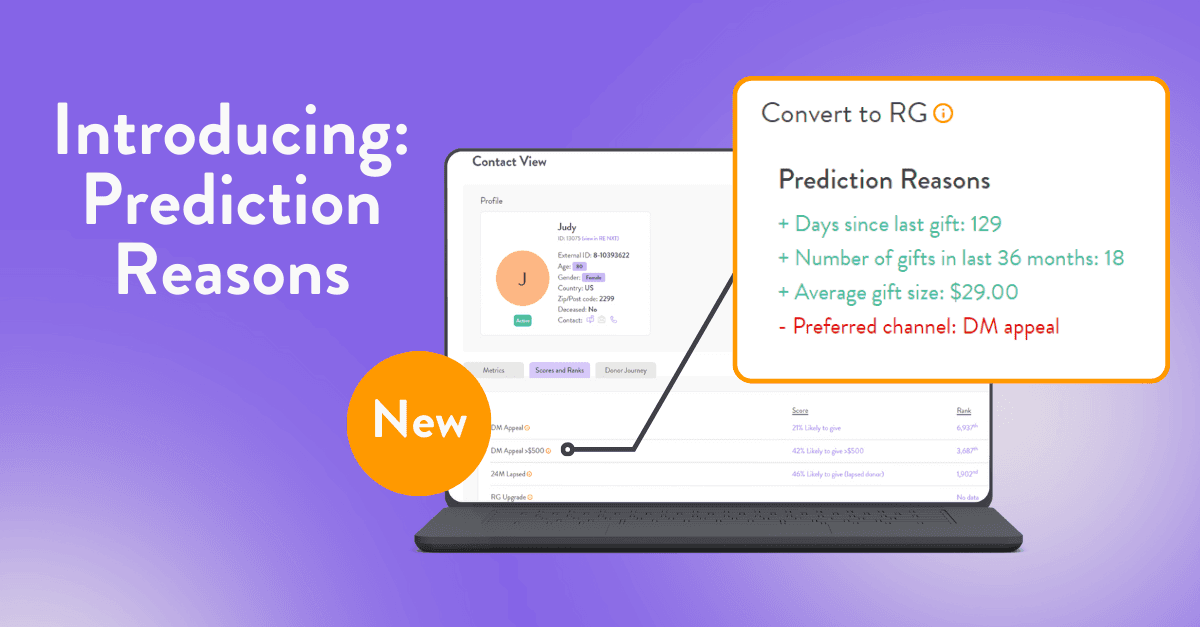
Dataro’s solution uses AI to assign each of your donors a propensity score and rank (showing you how likely each individual is to take a particular action). With these insights reported directly to your CRM, you can then easily sort donors by their propensity markers to generate a targeted campaign list—no need for complex filters and confusing reports.

How to use fundraising metrics
How do you use and maintain your analytics toolkit on an ongoing basis? We have a few tips:

Have a concrete process in place for collecting the metrics you need.
In order to continually learn from your fundraising metrics, you have to actively collect data. As mentioned above, software integrations and standardised data entry protocols are essential today. Always remember to keep data collection in mind for any new fundraising or outreach initiative you launch. You've put in the hard work to plan the campaign, so don’t let your valuable insights fall by the wayside!
Regularly review your performance data.
Always take time during and after your campaigns to study the results, but don't stop there. Your data needs to be actively maintained. Data hygiene ensures the long-term value and usefulness of your charity's data, and it should be built into your routine activities. Many organisations schedule regular data reviews to check for technical issues and data entry mistakes. If you use integrated AI tools like Dataro, you’ll receive new rounds of predictive insights on a weekly basis.
Actively use your analytics when planning campaigns and appeals.
Whenever you plan a new appeal or campaign, begin by delving into your data. This will guide your strategies based on what's been proven to work in the past or what needs additional attention. For instance:
If you’re planning a new email appeal, start by analysing how your last email appeals performed. If you notice low conversion rates, you can drill down to see where the issue may have occurred. You may be targeting the wrong audience or using donor segments that are too broad, in which case it’d be a good idea to review your segmentation strategy or employ AI to generate a more targeted list of recipients.
If you’re looking to boost retention in your regular giving programme, start by using your historical data to understand who is disengaging and when. Again, machine learning software can take the guesswork out of this process by studying all of the engagement patterns that lead to disengagement and proactively flagging individuals at risk.
In future campaigns and appeals, set goals tied to specific fundraising KPIs.
Integrate analytics into your fundraising process by proactively tying future fundraising goals to specific metrics. This provides you a clear frame of reference for evaluating your success and identifying issues.
Remember that the value of your data increases over time as your database grows. As long as you’re shaping it and maintaining it in ways that are truly valuable for your charity’s goals, you’re on the right track.

Fundraising analytics FAQ
If your charity is starting its data strategy from scratch (or just looking to make an update), review the essentials. Here are some frequently asked questions about fundraising analytics:
What is fundraising analytics for charities?
Fundraising analytics for charities is the process of analysing your fundraising data to find trends and measure your performance.
How much did your last campaign raise? How often do donors contribute to your cause? How effective are your different types of fundraising appeals? Where are you doing well, and where are your strategies underperforming? Fundraising analytics helps you answer these questions in ways that can be concretely acted upon.
What are fundraising metrics or KPIs?
Fundraising metrics or key performance indicators (KPIs) are the individual types or pieces of data that you use to measure your fundraising performance through analytics. There are plenty of different metrics or KPIs that you can use to analyse your fundraising strategies, like those listed above.
Why is fundraising analytics valuable for charities?
Effective fundraising analytics will allow you to:
Measure the effectiveness of your fundraising tactics in quantifiable terms
Identify the strengths and weaknesses of your strategies
Develop new strategies based on your actual performance, not just qualitative insights or vague assumptions
Better communicate your effectiveness and impact to leadership, stakeholders, and donors
Continuously refine your appeal and outreach strategies based on performance
Simply put, analytics is what enables charities to create "data-driven strategies". Machine learning tools can enhance these benefits even further, providing you AI-driven analytic insights down to the individual level.
What tools can charities use to generate fundraising analytics?
You can generate fundraising analytics and metrics any time donors interact with your charity’s fundraising strategies. You’ll just need a way to measure that engagement and then store it in your constituent relationship management system (CRM).

Wrapping up: The future of fundraising analytics
The future of fundraising analytics will require tools that remove the guesswork from the process and replace outdated segmentation strategies.
Although it’s useful as a foundational tactic, traditional analytics strategies like RFM segmentation can be limiting, especially when it comes to predictive analytics. The process of analysing all possible data to make accurate predictions is extremely complex, if not infeasible, to manage on your own. After all, numerous factors influence a donor’s final decision to give (or not give)—simply grouping donors based on high-level RFM markers will still leave you open to surprises.
The bottom line is that traditional segmentation and prediction strategies are inefficient, time-consuming, and often inaccurate.
That’s where machine learning comes in. AI and machine learning tools can make analytics predictions that would be incredibly complicated to generate otherwise. They analyse your data to find trends and make predictions down to the individual level—no more clustering donors into vague RFM segments.
Here’s how the process works with Dataro’s machine learning tools:
The machine learning software analyses your fundraising data, splitting it into hundreds of discrete “features” such as gift recency and donor age.
The artificial intelligence then combs through these features to find trends, patterns, and relationships. It uses these insights to begin training algorithmic models that can predict the specific propensity you’re looking for, such as disengagement likelihood.
The software evaluates its trained models to identify the one that performs most accurately based on all the complex relationships in your historical data.
This model is then used to generate propensity scores and ranks for each individual donor, showing you how likely they are to behave in a certain way and how they compare against the rest of the donors in your database.
These scores and ranks are exported back to your CRM for easy use as analytic metrics in your next campaign or appeal, providing you a real-time, AI-driven list of the ideal donors who should be contacted.
Machine learning can make accurate predictions and completely replace the time-consuming process of analysing your data to develop targeted campaign lists. This helps you raise more funds for your mission without depleting your team’s time and attention along the way.
To learn more about the world of fundraising analytics and machine learning, continue exploring with these additional resources:
Artificial intelligence for charities: Complete explainer. AI and machine learning have entirely changed the analytics landscape in recent years. Learn how charities can and are utilising this technology to fundraise more effectively.
How to calculate ROI in a fundraising campaign. Return on investment is the most important metric for determining your fundraising efficiency. Take a deep dive into this fundraising metric with this guide.
Why machine learning is the best segmentation. Donor segmentation is an extremely useful but time-consuming method to put your analytic insights into action. Explore how AI can replace outdated or inefficient segmentation strategies.

Related articles
Discover more insights into nonprofit fundraising and data from the Dataro team.