Cross-department suppression coordination: a guide for fundraising teams
Strategy & Frameworks

Coordinated suppression keeps mass campaigns from disrupting major-gift prospects mid-cultivation.
Your major-gifts officer has spent four months cultivating a £250,000 prospect. Then the prospect gets a mass acquisition email addressed to "Friend," asking for £25. The relationship stalls. Nobody meant for it to happen, and no single person is at fault.
This is a suppression coordination failure. It happens when programmes run on separate lists, separate rules and separate calendars, with no shared way to say "do not contact this person right now."
This guide explains what cross-department suppression coordination is, why collisions happen and the governance, tooling and exclusion rules that prevent them.
What is cross-department suppression coordination?
Cross-department suppression coordination is the practice of managing donor exclusions across every fundraising programme so one programme's campaign cannot accidentally reach a donor another programme has flagged as off-limits. It combines shared rules, shared data and clear ownership so mass appeals, acquisition and reactivation efforts respect active cultivation, stewardship and other sensitive relationships.
In plain terms: it is how a team makes sure the right hand knows who the left hand is talking to.
Why do suppression collisions happen?
Collisions are rarely caused by carelessness. They come from structure.
Programmes operate in silos. Appeals, acquisition, retention, mid-value and major gifts each pull their own lists on their own schedule. Each list is reasonable on its own. Together they overlap.
Suppression lives in people's heads. A major-gifts officer knows a prospect is sensitive, but that knowledge never becomes a flag in the CRM that other programmes can see.
Timing is invisible. A donor may be fine to mail in general but not this week, while a solicitation is pending. Most exclusion setups capture "never contact," not "not right now."
Manual pulls drift. When exclusions are rebuilt by hand for every campaign, someone eventually forgets a filter. The bigger the file and the more programmes, the higher the odds.
The cost is real. A single mistimed touch can delay or shrink a major gift, trigger a complaint or burn donor trust that took months to build.
The three layers of suppression that prevent collisions
Strong coordination uses three layers together. Each catches what the others miss.
1. Do-not-contact flags
A do-not-contact flag is a record-level marker that removes a donor from some or all outreach. Use it for hard exclusions: opt-outs, deceased records, complaints and legal requests.
Keep flags specific. A blanket "do not contact" is easy to apply but blunt. Where your CRM allows, separate channel-level flags (no mail, no email, no phone) from programme-level ones so you suppress only what you need to.
2. Programme-level suppression
Programme-level suppression excludes a donor from one programme while leaving others open. This is the layer that protects mid-cultivation prospects.
A major-gifts officer flags a prospect as "in active cultivation." That flag automatically removes the prospect from mass appeals, acquisition and reactivation, but the stewardship team can still send a thank-you. The exclusion is scoped to the programmes that create risk, not the whole relationship.
Time-box these flags. A cultivation hold should have a review date so records do not sit suppressed forever after a solicitation closes.
3. Audit trails
An audit trail records who suppressed a record, when, why and for how long. It turns suppression from a black box into something the team can inspect.
Audit trails do two jobs. They let you trace a collision back to its cause and fix the rule, not just the symptom. And they make exclusions explainable when a board member or major-gifts officer asks why a donor was, or was not, contacted.
Manual vs. automated suppression: a comparison
Most teams start manual and hit a ceiling. Here is how the two approaches trade off.
Factor | Manual coordination | Automated coordination |
|---|---|---|
Setup effort | Low to start | Higher upfront |
Consistency | Drifts as staff and campaigns change | Rules apply the same way every time |
Speed at scale | Slows as the file and programme count grow | Holds up as volume rises |
Error risk | High; one missed filter causes a collision | Low; exclusions run automatically |
Audit trail | Often missing or in spreadsheets | Built in and inspectable |
Best fit | Small files, few programmes | Multi-programme teams, larger files |
Manual works when one person can hold the whole picture. Once several programmes mail the same file, shared rules and automation protect results better than memory and checklists.
A practical governance model
Tooling only works with clear ownership. This five-step model keeps coordination running.
Name an owner. Give one person or team, often operations, authority over the suppression framework. They set the rules and resolve conflicts between programmes.
Write a suppression policy. Document what each flag means, who can apply it and how long it lasts. Make cultivation holds and their review dates explicit.
Centralize the source of truth. Keep suppression logic in the CRM or a layer on top of it, not in campaign-specific spreadsheets. Every programme should read from the same rules.
Set a cross-programme calendar. Review upcoming campaigns together so teams see overlaps before lists are pulled, not after a donor complains.
Review the audit trail. Check suppression logs after major campaigns. Treat every collision as a rule to fix, not a person to blame.
How Dataro helps
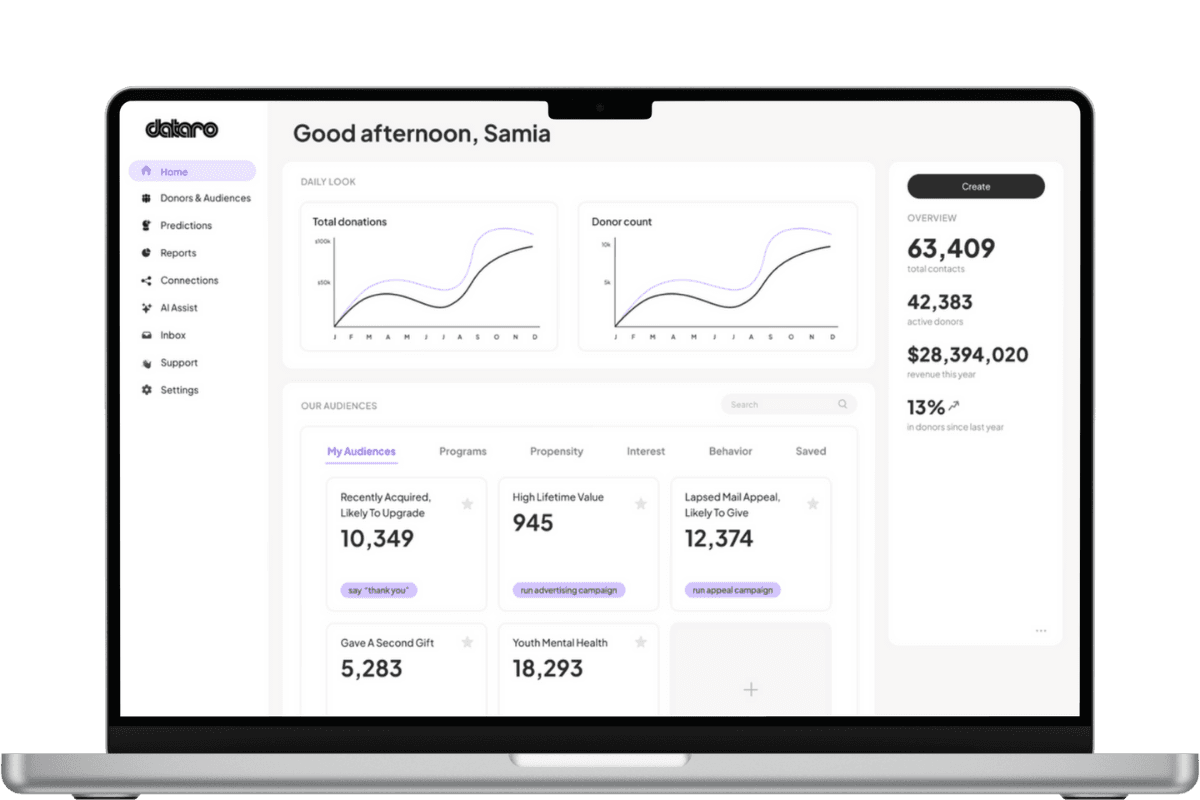
Dataro sits on top of your CRM and turns your data into ranked lists and clear next actions across every programme. Because appeals, retention, mid-value and major gifts draw on the same predictive layer, coordination stops being a manual reconciliation job.
When a prospect is prioritised for major-gift cultivation, that signal is visible to the programmes that would otherwise mail them. Teams can mail fewer people with confidence, apply exclusions consistently and keep outputs explainable, so a mistimed touch is far less likely to reach someone mid-cultivation.
The point is not more suppression. It is fewer, better touches that respect where each donor sits across your programmes.
Key takeaways
Suppression collisions come from silos and manual pulls, not carelessness.
Use three layers together: do-not-contact flags, programme-level suppression and audit trails.
Time-box cultivation holds so records do not stay suppressed after a solicitation closes.
Assign one owner and one source of truth for suppression rules.
Automate exclusions once several programmes mail the same file.
Conclusion
Protecting a major-gift prospect from a £25 mass appeal is not a data-hygiene chore. It is revenue protection. When programmes share rules, share data and share a calendar, the right hand always knows who the left hand is cultivating, and campaigns run cleaner because of it.
Start with the three layers, name an owner and review your audit trail after every major campaign. From there, coordination becomes something your team can run, not just hope for.
Related articles
Discover more insights into nonprofit fundraising and data from the Dataro team.