What Should I Do Today? A Working Guide for the Do-It-All Fundraiser

Tim Paris
Strategy & Frameworks

Stop guessing who to call—predictive scores turn a week of fundraising into one clear, ranked list.
Most fundraisers don't have a data problem. They have a decision problem.
You already know who gave last year. You can see who lapsed. There's a spreadsheet of major prospects somewhere on your desktop, a half-finished board report in another tab, and a stewardship list that hasn't moved in three weeks. The hard part isn't finding the data. The hard part is deciding what to do with the next hour.
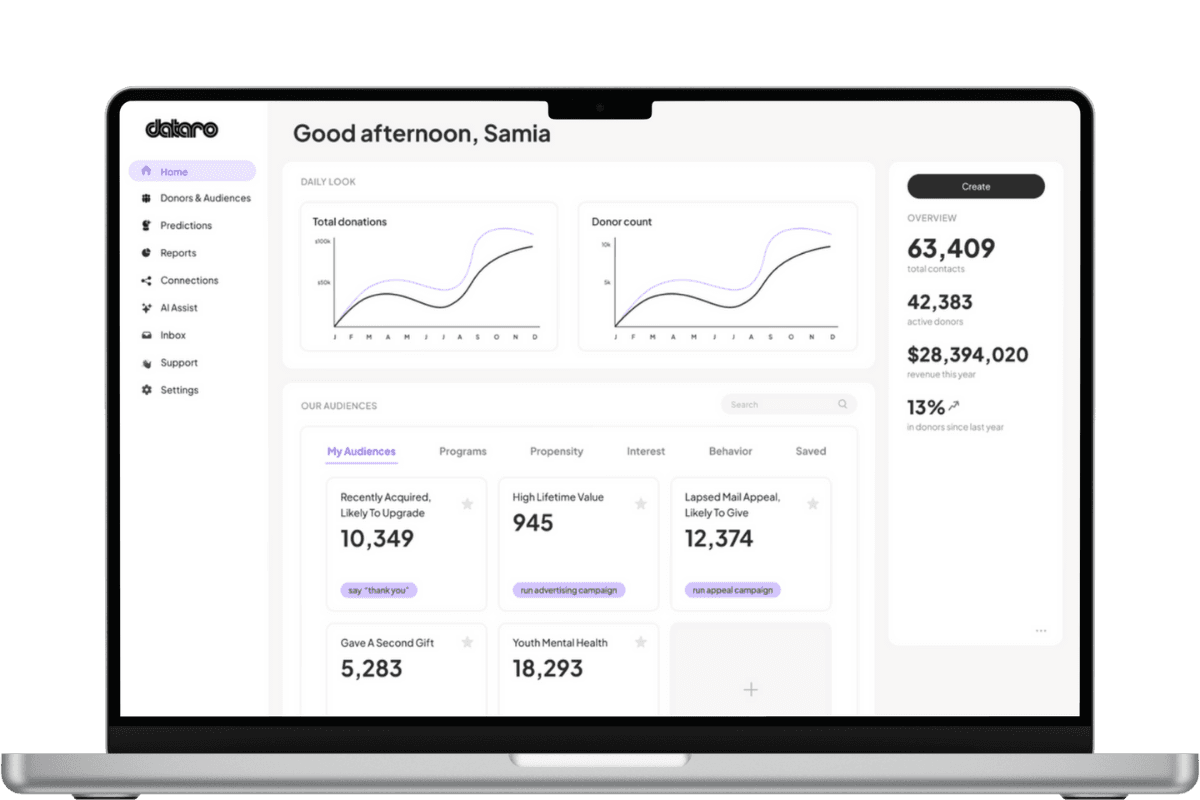
At GiveCon 2026, we ran a session built around that exact problem — what it looks like when a busy fundraiser opens Dataro inside Bloomerang on a Monday morning and lets the data tell them where to put their attention. This is the post-session version, written for everyone who couldn't be in the room.
The honest problem with AI in fundraising right now
A recent fundraising.ai survey found that 92% of non-profits say they're using AI in some way. Only 7% can name a single thing it's actually doing that's moving the needle.
That gap isn't a technology problem. It's a workflow problem.
Most fundraisers' first encounter with AI is ChatGPT in a separate tab. They use it to draft an appeal email, decide the result is fine, and never call their mum about it. It's siloed. It doesn't know your donors. It doesn't tell you who to call this afternoon. And after a week or two, it becomes one more tab in the graveyard of tabs you keep open as a monument to tasks you haven't finished.
The do-it-all fundraiser doesn't need more dashboards. They need fewer decisions on the plate.
The four decisions every fundraiser makes every week
When you run the whole program — appeals, monthly, mid-value, major, retention — you're really making the same four calls over and over:
Who do I ask now? Which donors get this appeal, in which channel, at what amount.
Who do I grow? Which single donors are ready to upgrade, and which are ready to convert to monthly.
Who do I save? Which monthly donors are about to silently lapse and worth a phone call to keep.
Who do I research? Which prospects deserve an hour of deep work before I reach out.
Those four collapse neatly into the weekly cadence we keep coming back to: Focus → Engage → Next. Focus is who deserves your capacity. Engage is who needs action right now. Next is what that action actually looks like.
You make all four every week. The question is whether you're guessing, segmenting in a spreadsheet, or letting the data score every donor for you.
What "donor-level prediction" actually means
Most fundraising programs default to RFM — recency, frequency, monetary value. It's fine. It gives you a fat list of "active donors" and a response rate that hasn't moved in years.
The problem with RFM is that it tells you nothing about where a donor is going. Johnny gave £50 last year, £100 the year before, £250 the year before that. RFM lumps him in with everyone else. A predictive model looks at the trajectory and says: this isn't an appeal target, this is a mid-level call.
Mary gave twice in six months at a steady cadence. RFM says keep mailing her. Predictive says ask her to go monthly. She'll give 12 gifts of £30 over the year and stay three times longer.
That's the unlock. Every donor in your database gets a set of live scores — likelihood to give, upgrade, convert to monthly, lapse, reactivate — plus an ask amount. The scores update as donors do things. You build your list based on what each person is about to do, not what their last 12 months looked like.
A simple Monday morning routine
When everything looks urgent, this is the order that works.
Start with one ranked list, not five tabs. Open the view that's already scored every donor and look at the people most likely to act this week. That's your universe for the day. Resist the urge to drop back into the spreadsheet.
Match the channel to the score. The top of the list, with a high predicted ask amount, is a phone call. The middle is a letter. The bottom is an email. The cost of the channel should match the likelihood of the response. Don't burn a phone slot on someone you'd happily email.
Spend the time you save on depth, not volume. If prospect research used to mean an hour with 20 tabs — LinkedIn, news, 990s, foundation databases, the local paper from 2014 — agentic AI can pull capacity, affinity, news, family connections, and giving history in a minute or two, with a citation under every claim. Use the hour you got back to research five more people, not to log off early. One of our favourite examples: a search that surfaced a £10,000 duck-conservation donation buried in a ten-year-old blog post, complete with a photo of the donor in wellies holding a giant cheque. That kind of detail changes the email you write.
Check the churn list before lunch. This is the move most do-it-all fundraisers skip. Reactivation is hard. Prevention is cheap, but only if you know who's about to leave before they leave. A phone call thanking a monthly donor for their support can save the gift months before the cancellation. Greenpeace Australia saved 531 monthly donors in a single campaign doing exactly this.
Four moves, one morning, the whole program covered.
Time-savers and traps
The wins we see across hundreds of small and mid-size programs are pretty consistent.
Smaller, predictive lists raise more than larger RFM ones. Every time we run the experiment, predictive wins. The mid-level program — the "forgotten middle" between mail and major — gets easier the moment you stop guessing who belongs in it and let a model surface the candidates. Converting an existing single donor to monthly is almost always better than buying a new monthly donor through paid acquisition. The lifetime value is meaningfully higher and you already have their trust.
The traps are equally consistent.
Researching everyone is the old reflex. It doesn't scale and it wastes the deepest work on people who weren't going to give anyway. Use predictions to decide who deserves the research, not the other way around. Treating AI as a separate tool is the other big one — anything in a different tab gets used twice and abandoned, which is the unglamorous reason native integration matters more than model quality. And confusing generative with predictive will burn you both ways. ChatGPT writes you an email. It will not tell you who to send it to. Different jobs.
What's next
Dataro launches natively inside Bloomerang on 1 July 2026. Predictions, prospect research, and a weekly recommendations layer we call Fundraising Brain all sit directly on the donor record and on the Bloomerang homepage. No separate logins, no exports, no extra tabs. Every prediction is based on anonymised training data. Every prospect research claim cites its source. You stay in control. The data just stops being the bottleneck.
If you want to be in the first cohort when it goes live, join the waitlist and we'll be in touch before launch.
In the meantime, even if you never use Dataro: pick one of the four decisions above this week, and stop guessing on it. The lift is bigger than you think.
Related articles
Discover more insights into nonprofit fundraising and data from the Dataro team.