Dataro vs competitors: how to choose a fundraising intelligence platform
General
The decision behind the comparison
Most fundraising leaders don't wake up wanting to buy software. They wake up needing to answer two questions: who should we focus on right now, and what should we do for each of them across every programme?
If you're comparing Dataro with other tools, that's the real test. Not feature counts. Not how many logos sit on a vendor's homepage. The question is simple: which tool turns your CRM data into ranked lists, clear cutoffs and a next action you can run next week?
This guide maps the landscape so you can compare the right tools and avoid comparing Dataro to products built for a different job.
Where most fundraising tools land
The market is crowded, and the labels overlap. Here's how the main categories typically work, and where they leave a gap.
CRMs (Salesforce, Blackbaud, Bloomerang, Virtuous, Bonterra): Systems of record with broad suites. They store your data and history. "AI" is often an add-on, not the core job.
Wealth screening and prospect research (iWave, Windfall, DonorSearch): Strong at major-gifts enrichment and capacity scoring. They tell you who has money, not who to prioritise this week or what to do next.
AI point solutions (Avid, Squark AI): Positioned as predictions plus automation, often for a single use case.
Digital fundraising platforms (Fundraise Up, Classy, Engaging Networks, Givebutter): Channel optimisers for forms, peer-to-peer and email.
Agencies (Moore, RKD, Pursuant): Services-led strategy and execution, paid per project or retainer.
Each does a real job. The gap is coordination: who to contact, when, and what to do next across appeals, retention, mid-value, major gifts and stewardship.
What Dataro does differently
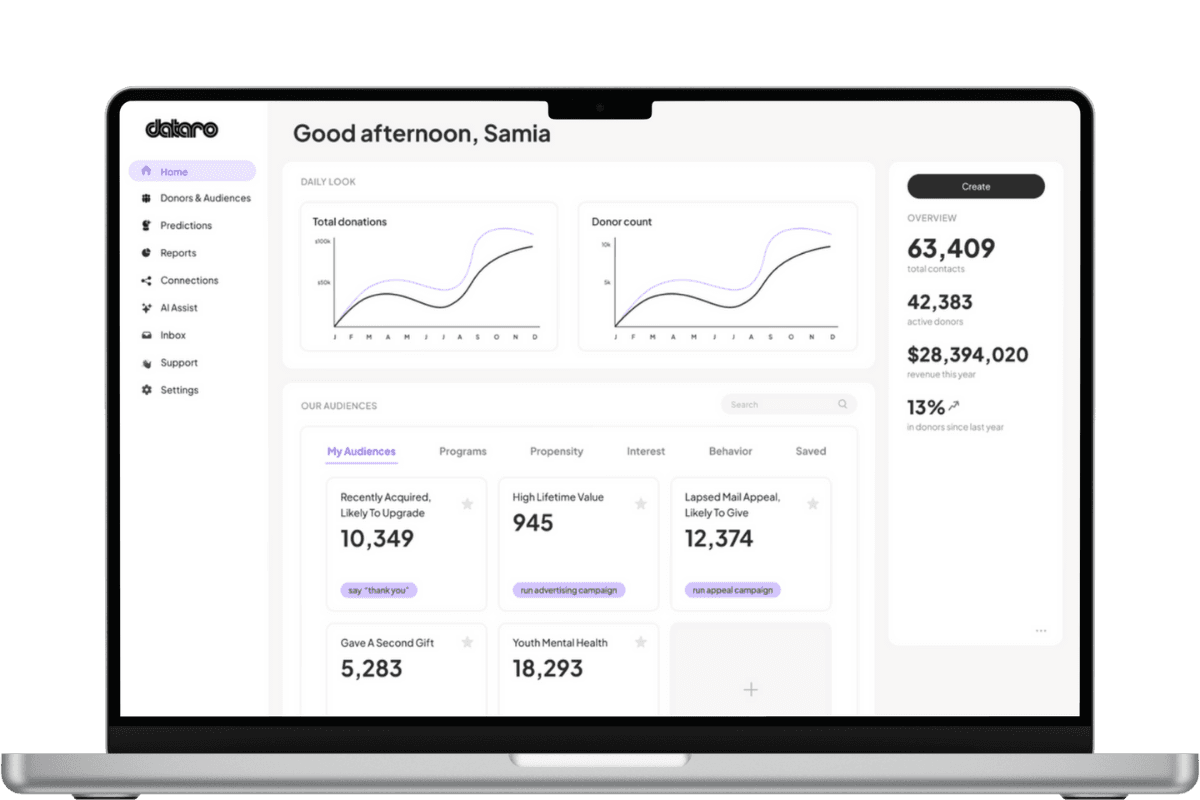
Dataro is a fundraising intelligence platform. It sits on top of your CRM, reads your data and returns ranked actions into your workflow. You don't change systems. You add a predictive layer.
The promise is plain: Dataro tells you what to do for every donor, right now. One level down, that's two decisions:
Focus: who to prioritise, with a clear, explainable cutoff your team can justify.
Act: the next-best action on each record, so the work compounds instead of resetting after every send.
Where a CRM stores data and a BI dashboard explains what happened, Dataro produces execution-ready outputs: audiences, tasks, tags and lists that land back in the tools you already use.
Dataro vs CRMs
Your CRM is the system of record, and it should stay that way. The problem isn't where your data lives. It's that raw data doesn't tell you who to mail, who to call or who's not on your list but should be.
Dataro doesn't replace your CRM. It sits on top of it and turns that data into ranked priorities and next actions, then writes them back. You keep your system. You lose the manual list pulls and the guesswork.
Dataro vs wealth screening
Wealth screening answers one question well: who has capacity to give? That's useful for major gifts. But capacity isn't priority.
A donor can have high capacity and low likelihood to act this quarter. Many fundraisers describe standalone wealth scores as feeling random because they aren't tied to behaviour or timing.
Dataro uses predictive propensity scores across programmes, not just major gifts. The output isn't "who is wealthy." It's who to prioritise, when, and what to do next, grounded in signals from your own file.
Dataro vs AI point solutions
Predictive point solutions often lead with model claims. The model may be sound, but a prediction you can't run is just a number.
Dataro is built to be:
Workflow-real: outputs your team can use next week, not a data science project.
Multi-programme: appeals, retention, mid-value, major, legacy and content, in one rhythm.
Measurable: lift tied to outcomes, not just accuracy scores.
Dataro vs digital platforms
Digital fundraising platforms optimise a channel: a donation form, an email, a peer-to-peer page. They make a single touch perform better.
Dataro works one layer up. It coordinates who to contact and what to do next across the whole donor file and every programme, then feeds the right audiences into those channels.
Dataro vs agencies
Agencies bring strategy and hands to execute. That's valuable, especially for teams stretched thin. The trade-off is that the capability often lives with the agency, not your team.
Dataro builds in-house capability with a repeatable decision rhythm and measurable outcomes. It can sit alongside an agency, sharpening targeting on both sides.
The shorthand
Most competitors market AI, data, automation or "all-in-one." Dataro leads with an operating loop:
Predict: produce a ranked list and cutoff your team can approve.
Act: make the next touch easy to execute.
Measure: show what changed so the next cycle gets sharper.
Repeat: results flow back as new signals.
Why trust matters in the comparison
A ranked action is only useful if you can justify it. Targeting that no one can explain gets debated, watered down or ignored. Approvals slow. Campaigns slip.
Dataro's outputs are inspectable and explainable. You can see why a donor is highly ranked or lowly ranked, set controls and stand behind the cutoff. That's the difference between a number on a screen and a plan your team will actually run.
What good looks like after you choose
The right tool changes how the week feels. Fewer debates about who to mail. A short list stakeholders can approve. A next-best action on each record, owned by someone, ready to run.
The payoff isn't more activity. It's fewer, better choices: mail fewer people with confidence, protect team capacity and run programmes that are easier to execute and easier to justify.
How to compare for your own team
When you evaluate any tool, ask three questions:
Does it tell me who to focus on, with a cutoff I can defend?
Does it tell me what to do next on each record, across every programme?
Can my team run the output next week without changing systems?
If a tool can't answer all three, it's solving a narrower job. That's fine, as long as you know which job you're buying.
The best next step is small and concrete: ask to see an example output on your data. A ranked list and a set of next actions will tell you more than any feature demo.
.
Related articles
Discover more insights into nonprofit fundraising and data from the Dataro team.