Dataro vs competitors: how to choose the right fundraising intelligence tool
General
Choosing fundraising technology is hard. Most tools look similar on a slide, but they solve different problems. If you're comparing Dataro to other options, the real question isn't "which has more features?" It's "which one helps my team make better decisions, faster, without changing systems?"
This guide breaks down where Dataro fits, where common alternatives land and how to compare them on the things that actually matter.
The decision you're really making
Fundraising teams face two universal decisions every week:
Focus: Who deserves our attention right now, and why?
Act: What's the right next step for each of them, across every programme?
These decisions exist whether or not you buy any software. The question is how confidently you can make them. Most teams still rely on manual segmentation and last year's rules, so they over-mail to feel safe or under-mail out of fear.
When you compare tools, judge them on how well they sharpen Focus and Act. A platform that produces dashboards but not decisions leaves the hard part to you.
What Dataro is
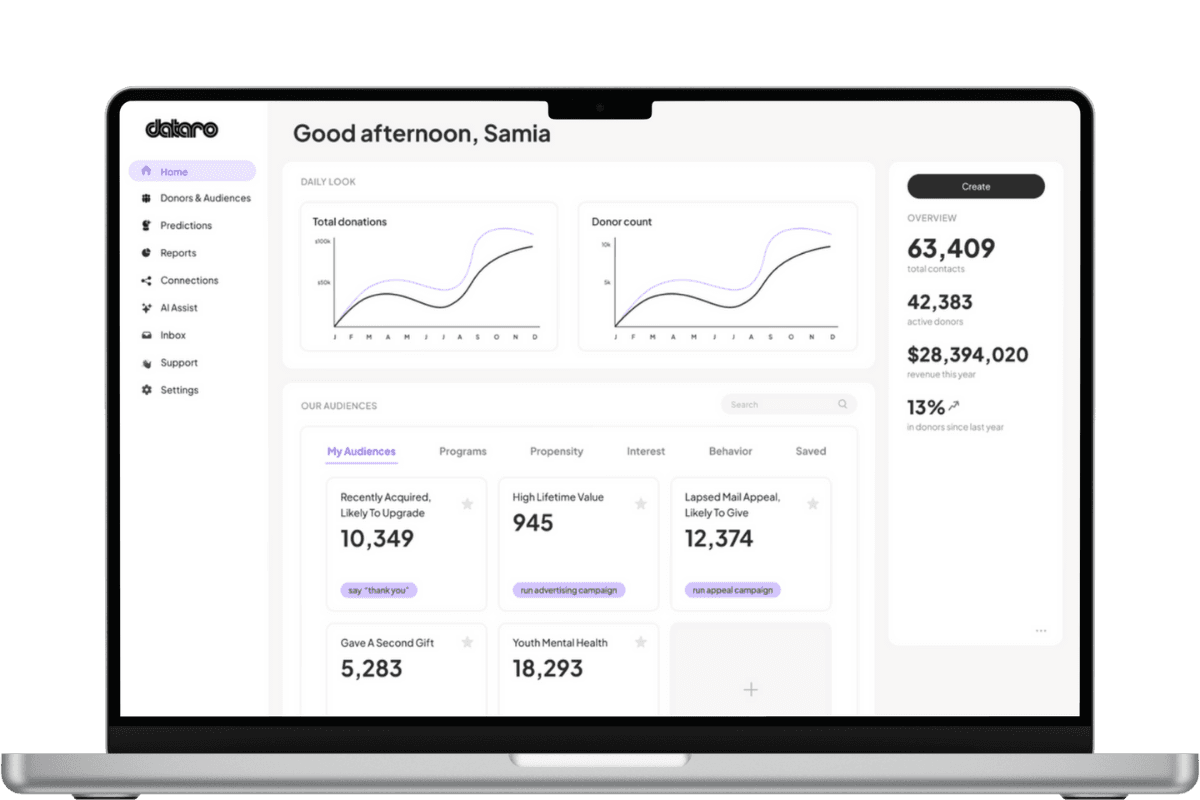
Dataro is a fundraising intelligence platform. It sits on top of your CRM, reads your data and returns ranked priorities and next-best actions into the tools you already use. The promise is simple: Dataro tells you what to do for every donor, right now.
The operating loop is predict, act, measure, repeat. You get a decision the team can approve, an action that's easy to run and a measurement that makes the next cycle sharper.
Just as important is what Dataro is not. It's not a CRM, a reporting tool or a marketing automation platform. It adds a decision layer. It doesn't replace your systems.
How the main alternatives compare
Most competitors fall into one of five buckets. Each is good at something, but they solve a narrower slice of the Focus and Act problem.
CRMs (Salesforce, Blackbaud, Bloomerang, Virtuous, Bonterra)
These are systems of record with broad suites. They store constituent data and history, and many now offer AI as an add-on.
Where Dataro differs: Dataro sits on top of the CRM and turns that stored data into decisions and actions across programmes. You don't change systems. You add the layer that tells you what to do next.
Wealth screening and prospect research (iWave, DonorSearch, Windfall, Hatch)
These tools enrich and screen records for major-gift work. They're strong at answering "who has capacity to give?"
Where Dataro differs: Capacity is one signal, not a plan. Dataro drives cross-programe predictive decisioning that moves beyond who has money into who to prioritise, when and what to do next.
Predictive point solutions and "AI operating systems" (Avid, Squark AI)
These are positioned as predictions plus automation. On paper they're closest to Dataro.
Where Dataro differs: Three things matter here. Dataro is workflow-real, with outputs teams can use next week. It's multi-programme, covering appeals, retention, mid-value, major, legacy and content. And it's measurable, with lift tied to outcomes rather than model claims alone.
Digital fundraising platforms (Fundraise Up, Classy, Givebutter, Engaging Networks)
These optimise channels: donation forms, peer-to-peer, email. They're built to convert traffic in the moment.
Where Dataro differs: Channel tools optimise a single touch. Dataro coordinates who to focus on and what to do next across the whole donor file and multiple programmes, so activity compounds instead of resetting.
Agencies (Moore, RKD, AGP/Pursuant)
Agencies deliver services-led strategy and execution. They bring people and expertise.
Where Dataro differs: Dataro builds in-house capability with a repeatable decision rhythm and measurable outcomes. The intelligence stays with your team rather than leaving when a contract ends.
A simple way to compare
When you evaluate any option, ask these questions:
Does it produce execution-ready actions, or just analysis and dashboards?
Does it work across programmes, or only one channel or gift type?
Can it run on top of our current CRM without a migration?
Are its recommendations explainable enough to defend to leadership?
Does it measure lift against real outcomes, not model accuracy alone?
If a tool can't answer most of these, it likely solves a piece of the problem rather than the decision itself.
Why trust and governance matter in the choice
For most leaders, trust is a buying criterion, not a nice-to-have. If you can't explain a targeting decision, you can't get it approved, and slow approvals stall campaigns.
Dataro's decisions are inspectable and defensible. You can see the definitions behind a recommendation, control how it's applied and document why a donor made the list. That matters when a board or a director asks how you set a cutoff.
Many point solutions treat the model as a black box. That's fine until someone needs to defend the spend. The safer comparison favours tools you can audit.
What "good" looks like after you choose
The goal isn't more activity. It's fewer, better decisions. A strong fit changes how the team operates:
A defensible cutoff and a short list stakeholders can approve
Next-best actions assigned to an owner and a workflow
Less manual list-pulling and fewer internal debates
Faster approvals because the logic is explainable
Programmes that compound, because what happens after a send is clear
That's the test. The right platform reduces decision debt and gives your team back time for judgment and execution.
The bottom line
CRMs store your data. BI tools explain what happened. Channel platforms convert a single touch. Wealth screening tells you who has capacity. Agencies lend expertise. Each is useful, and Dataro works alongside most of them.
Dataro's role is different. It turns your CRM data into clear, ranked actions across every programme, so you can decide who to focus on and what to do next, with confidence you can defend.
If you're comparing options, don't start with feature lists. Start with the decision. The tool that sharpens Focus and Act inside your real constraints is the one worth buying.
Want to see what that looks like with your data? Ask to see an example output or run a small pilot before you commit.
Related articles
Discover more insights into nonprofit fundraising and data from the Dataro team.