How to choose which donors to target: RFM, wealth screening, single-charity models and multi-charity predictive AI compared
Strategy & Frameworks

The four main donor targeting methods answer different questions, so matching the method to your question protects net revenue.
Every fundraising team faces the same question before a campaign: who should we focus on? The answer depends on the method you use. RFM, wealth screening, in-house models and multi-org predictive AI all sort your donors differently. Each one answers a different question, so the wrong method means spending budget on the wrong people. Here is how the four approaches compare, and how to decide between them.
The four methods answer four different questions
The first step is naming what each tool actually tells you, because they are not interchangeable.
RFM looks at recency, frequency and monetary value. It describes what your donors did in the past. Wealth screening appends income, assets and property data, so it estimates who could afford a large gift. A predictive model does something different again. It estimates who is likely to give next, learning either from your file alone or from many files at once.
Past behaviour, giving capacity and future likelihood are three separate things. The method you choose decides which one guides your list.
Want to see the difference rather than read about it? Our audience simulator ranks the same donors four ways, so you can watch who each method puts at the top of the list and who it leaves behind.
Rising costs make every wasted contact count
The economics behind every campaign are getting harder, which raises the cost of a poorly targeted list.
Giving USA 2026 put total US giving at $617.2 billion, up 5.7% in nominal terms but only 3.0% after inflation. Individual giving as a share of disposable income held at 1.7%, tied for the lowest in 40 years. The 2026 Fundraising Effectiveness Project reported dollars up 4.3% while donor numbers fell 0.8%, and donor counts have now dropped in four of the last five years. Mailing and media costs keep climbing, so every wasted contact shows up on the invoice.
Precision is no longer optional. It is how you protect net revenue when margins are this thin.
RFM shows what donors did, not what they will do
RFM is simple and transparent, which is its biggest strength. Anyone on your team can follow the logic, and that makes the results easy to defend in a meeting.
The weakness is that RFM is backward-looking. It scores people on past gifts rather than future intent. It also sorts donors into broad buckets, so a donor whose giving is changing can land in the wrong group. A lapsing major donor and a rising mid-level donor can share the same score, even though they need opposite treatment.
RFM is a reasonable starting point, but it struggles the moment donor behaviour starts to shift.
Wealth screening shows capacity, not willingness
Wealth screening answers one question well: who has the financial means to give more? That is genuinely useful when a major-gift team needs to build a prospect pool from scratch.
The catch is that capacity is not the same as propensity. Having money does not mean someone wants to give it to your cause. One study found that 68% of affluent donors give based on personal values rather than net worth. A high wealth score with no connection to your mission is a weak signal on its own. Wealth data is best used to size an ask, not to decide who actually cares.
For a deeper framework on using capacity and propensity together, see Wealth screening vs predictive modelling: how to target donors with confidence.
A single-org model learns only from your file
A predictive model built on your own data is a genuine step up from RFM, because it weighs many signals at once and ranks each donor by their likelihood to give.
Its limit is the data it can see. A single-org model only knows what your donors did with you, so it cannot detect that a lapsed donor just gave to three related causes, because that activity never touched your database. You get sharper rankings than RFM can produce, but only within the walls of your own file.
Multi-org AI sees signals your file cannot
A multi-org model learns from many charity files at once, which lets it spot patterns that any single file would hide. It can recognise a donor giving to related causes or responding to similar appeals elsewhere, and that wider view often improves rankings for donors who look quiet in your data but are active across the sector.
Bigger data is not automatically better, though. More records do not help if they are noisy or off-topic, so the benefit has to be tested on real campaigns rather than assumed from the size of the dataset.
Test the methods on the same campaign
The surest way to choose is to stop deciding on reputation and prove each method on your own data instead.
Run two or more approaches against the same campaign, hold out a control group, and have each one produce a ranked list. Then compare net revenue at the same mail volume rather than response rates alone. The method that raises the most money per donor contacted is the one worth keeping, because that is ultimately the only test that matters.
Lead with focus, then act
Start every campaign with a single question: who should we focus on? A strong ranked list gives you a clear cutoff you can explain to your board, which then frees you to answer the second question of what you should do for each donor.
Precision pays off at this stage. Bat Conservation International beat its appeal target by 160% and added about $48,000 in income while mailing 2,300 fewer letters. UNICEF Australia grew net appeal income 26% and lifted campaign ROI 35% while mailing 15,000 fewer donors, saving about $30,000. Both raised more by trusting the ranking and cutting the waste, instead of expanding the list to feel safe.
Match the method to the question you are asking
RFM, wealth screening, single-org models and multi-org AI are not rivals competing for the same job. They answer genuinely different questions about what donors did, who could give and who is likely to give next. Start with your question, then pick the method.
Want to understand past behaviour? RFM.
Want to gauge financial capacity for major gifts? Wealth screening.
Want to rank who is likely to act, from your own file? A single-org predictive model.
Want rankings that draw on patterns beyond your file? Multi-org predictive AI.
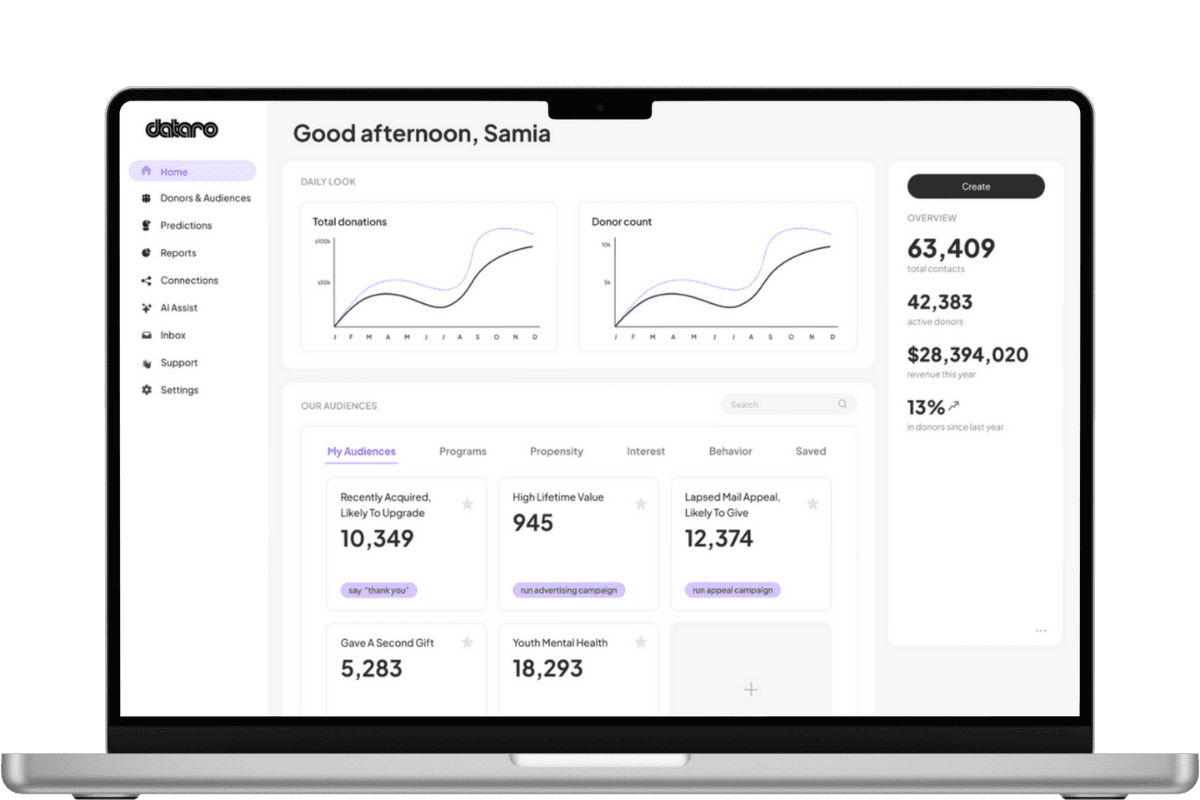
Most teams use more than one. Dataro sits on top of your CRM as a predictive layer. It reads your data and returns ranked actions that tell you who to focus on and what to do next, without replacing your CRM, your screening tools or your team.
The fastest way to see the difference is to try it. Run your scenario through the audience simulator to compare the four methods side by side, then test the winner on your own campaign and measure net revenue at a fixed volume. Lead with focus, resolve with action, and let the results decide which approach earns its place.
Related articles
Discover more insights into nonprofit fundraising and data from the Dataro team.