ChatGPT for nonprofit fundraising: Common errors to avoid
General
Nonprofits face immense time, resource, and budget constraints in their quest to create a better world. However, new advancements in artificial intelligence such as ChatGPT and AI Assistants mean time-strapped fundraisers now have a powerful suite of tools to enhance their productivity and drive more impact for their cause.
Despite the immense potential that GPT represents in nonprofit fundraising, we’ve observed fundraisers encountering some common pitfalls that hinder their ability to fully exploit its true capabilities.
In this blog, we explore the common mistakes made by fundraisers when using ChatGPT for content creation and examine the best practices and solutions for harnessing the real power of this new advancement in AI technology. The next frontier in the AI for fundraising revolution undoubtedly involves GPT, and we’re absolutely here for it.
(Read to the end of this blog to learn more about Dataro’s latest tool, a new fundraising-specific GPT writing assistant).
A cautionary caveat
Allowing ChatGPT’s generative AI to completely take over your fundraising communications will not end well for your nonprofit or your supporters. However, technology can still be put to good use in your nonprofit fundraising.
While ChatGPT is designed to mimic human communication and natural language, the outputs generated will almost always be enhanced with a human touch. Consider GPT as an effective tool for generating a first draft and aiding the creative process with copy that you can iterate and adapt to meet your specific goals.
Any AI writing tool requires your human input to produce the most impactful communications, so roll up your sleeves and let’s get started!
Mistake #1 – Not providing enough context when prompting
The most common mistake when using ChatGPT to create content is failing to provide sufficient context. While it might seem like engaging with ChatGPT is similar to conversing with a person, it’s crucial to remember that GPT models don’t have inherent knowledge or understanding. Thus, clearly establishing the context for the problem you want to solve or the content you wish to produce is key.
For instance, informing the chatbot it is “an expert fundraising copywriter” and defining who the target audience is and what channel you will be creating content for will help the model provide more relevant and accurate responses that better resonate with your supporters.
Mistake #2 – Not asking for explanations or justifications
Any GPT model’s output is almost always improved with a human touch and interrogation. When utilizing ChatGPT for creating fundraising content, most fundraisers don’t ask the model to justify its responses and outputs. Asking ChatGPT to explain its responses prompts deeper thinking and encourages fundraisers to critically analyse the generated content.
Questioning the accuracy or reasoning behind ChatGPT’s output also helps fundraisers uncover the underlying logic the model used, and will help to enhance the transparency of any content generated.
The iterative process of seeking justifications and making adjustments aids in improving the overall quality and effectiveness of the generated content, ensuring outputs are coherent, relevant and persuasive to your target audience.
When using GPT to solve other problems or calculations, it is even more crucial to ask the large language model to justify its answers or show all the steps and workings it took to generate a particular response.
Mistake #3 – Giving up too early
Using GPT technologies effectively requires time and some trial and error, particularly when learning how to prompt the model to deliver the best outcomes. Fundraisers using ChatGPT will typically prompt the chatbot using sentences or questions. But because GPT models are not fundraising experts and generate responses based on probability and sampling, the first response or output might not be what you were after.
If you encounter a less-than-satisfactory result using ChatGPT, don’t be disheartened. Instead, try again, altering your prompts. The iterative process of generating multiple outputs and refining the content can significantly enhance the quality of the content generated.
Mistake #4 – Underestimating GPT’s problem-solving capabilities
While GPT models excel in a wide range of tasks, many fundraisers have limited their usage to only a few tasks such as writing fundraising emails, appeal letters, or social media content. However, GPT models possess the potential to solve diverse challenges at a level resembling the abilities of an intelligent teenager.
A significant improvement of ChatGPT over GPT-3 has been an interface enhancement, allowing users to generate text output with headings and subheaders. The “Markdown” text generated can be fed into another app like markmaps.js.org to turn your GPT output into a mind map to help with your fundraising strategy work.
Exploring other applications with GPT can unlock new opportunities for leveraging this AI technology and driving innovation in other areas of fundraising work, such as strategy development.
Mistake #5 – Incorrectly assuming GPT accesses the internet
When using ChatGPT, nonprofits need to be aware that the free version of ChatGPT does not have live access to the internet. Instead, the ChatGPT model has been trained on large datasets from online sources available as of September 2021 and will not reference online sources after this knowledge cutoff date. Because of this inherent limitation, fundraisers should exercise caution when wishing to incorporate information on current affairs or time-sensitive topics in their content when using ChatGPT.
However, there is a paid ChatGPT subscription option available (£20/month) that enables users to access the internet through various plugins. The paid option also provides extra perks like faster response times, priority access during peak usage times, and access to models with more up-to-date data.
Some other large language models, like Google’s new AI chat service “Bard” do provide access to the internet, enabling the model to retrieve up-to-date information from the web. Despite ChatGPT’s free version lacking internet access, it consistently outperforms Google’s Bard in generating responses with higher reliability and accuracy.
Mistake #6 – Not being specific enough (or overloading questions)
To optimise the effectiveness of ChatGPT, it’s crucial to be specific in your requests and avoid asking multi-pronged questions or prompts. You’ll generate more accurate and relevant outputs if you give the chatbot concise, focused prompts in a “chained prompting” sequence. That means breaking up complex requests or tasks into multiple smaller, more specific steps.
If your prompts are overloaded or nonspecific, ChatGPT will sometimes ‘make an educated guess’ at what you are trying to achieve, which can lead to vague or irrelevant responses.
Mistake #7 – Failing to check responses for accuracy & bias
As with any content generation, it’s essential to conduct a human review to fact-check the answers provided by ChatGPT and ensure any biases are not being perpetuated. You’ll also want to use other online tools to detect any plagiarism in the content generated and alleviate any concerns about fraud.
While ChatGPT is a powerful tool to boost productivity and generate large volumes of content quickly, human oversight is always necessary to verify the outputs and maintain ethical standards.
In conclusion
AI technologies like GPT are incredibly helpful, time-saving tools that nonprofits can leverage to improve their operational efficiency and increase their impact.
If harnessed correctly, ChatGPT will help fundraisers to speed up their content process, enabling them to achieve more in their day-to-day work with fewer resources and time required to implement fundraising campaigns.
But it’s important to remember that ChatGPT is not, in itself, an ‘expert’. And while we’ve observed innovative nonprofits and fundraisers embracing its capabilities, ChatGPT’s implementation in fundraising content creation warrants careful consideration and requires a steep learning curve and time investment.
Introducing Dataro’s new GPT fundraising assistant
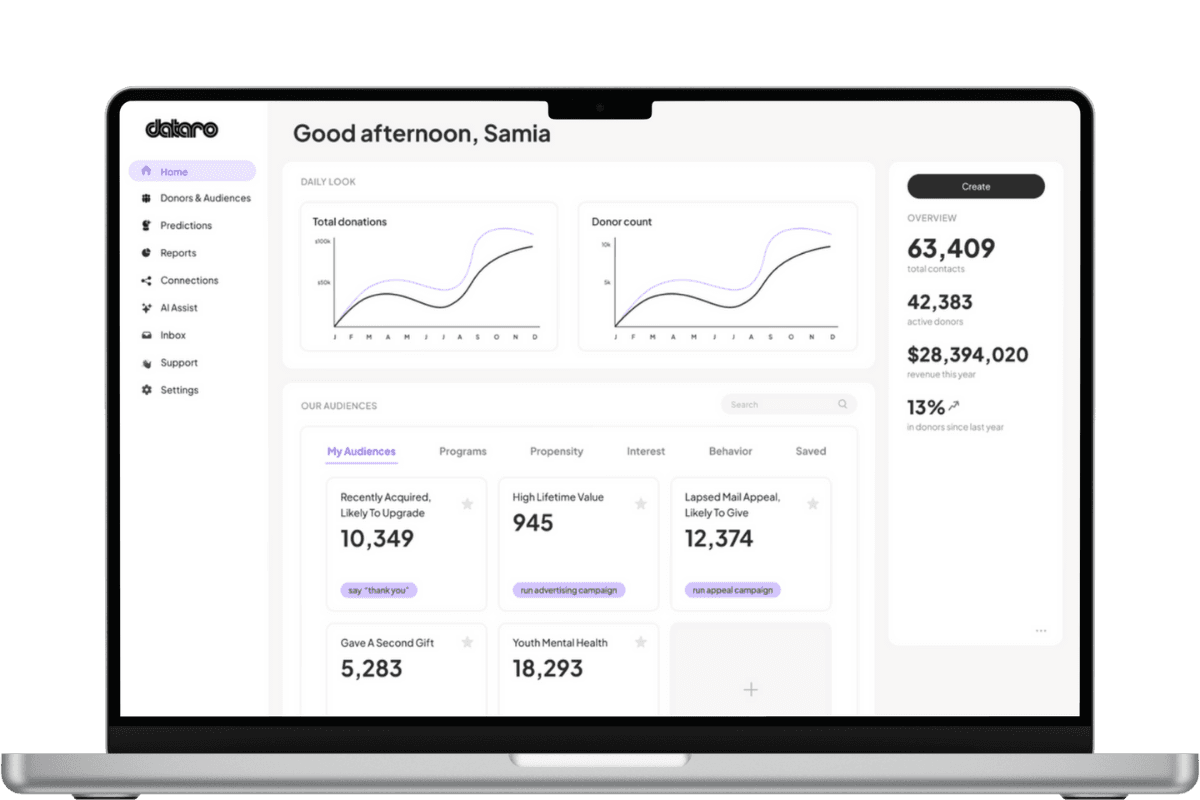
AI Assist is Dataro’s newest AI tool designed specifically for nonprofit fundraising.
Built with the latest GPT model (GPT-4), this new kind of AI writing assistant has been taught to be a fundraising communications expert capable of producing large volumes of fundraising-specific copy and content ideas in minutes.
AI Assist uses an intuitive chatbot interface (inside Dataro’s fundraising platform) to help fundraisers quickly generate large volumes of impactful fundraising content and personalised donor communications across multiple channels – from campaign ideas, fundraising letters, emails, text messages and social media content.
“We’ve essentially taught GPT-4 to be a fundraising communications specialist, so you don’t have to. This revolutionary new tool will help fundraisers to quickly generate new campaign ideas and content while needing less time to implement them, so they can do more fundraising and focus on the most meaningful work – like engaging donors” said Dr Tim Paris, Dataro CEO/Co-Founder.
AI Assist will be available from mid-June through Dataro’s SaaS platform via a free 7-day trial or premium paid subscription plan (unlimited content for £19 per month).
SIGN UP: to trial AI Assist for free (7 days).
Related articles
Discover more insights into nonprofit fundraising and data from the Dataro team.