How to set campaign audience size and exclusion rules
Strategy & Frameworks

Non-profits raise more by ranking donors and mailing fewer people with confidence, not by expanding the list.
How should nonprofits determine campaign audience size and exclusion rules?
Set audience size by ranking every donor by propensity to give, then draw the cutoff where the next name added stops covering its own cost. Apply exclusions on top of that ranking: recent givers, opt-outs, major donors in active stewardship and records with data-quality flags. Cap frequency across channels so no donor is over-contacted. The goal is fewer, better touches, not the largest possible list.
Most teams still do the opposite. They start from last year's segments, add everyone who looks vaguely qualified, then argue about where to cut. That guesswork is expensive. It burns postage, fatigues donors and slows approvals because no one can explain the line.
This guide sets out a clearer method: rank first, exclude second, cap third and cut at the point where revenue peaks.
What is campaign audience sizing?
Campaign audience sizing is the process of deciding how many donors to contact for a given appeal, and which ones. It answers a single question: who deserves attention for this campaign, and where should the list stop?
Good sizing produces a clear cutoff and a short list your team and leadership can approve without a debate. It is a targeting problem, not a volume target.
Predictive prioritisation vs static RFM rules
The first choice is how you rank donors before you cut the list.
Static RFM scores donors on recency, frequency and monetary value, then groups them into segments. It is simple and cheap to run in most CRMs. Its weakness is that it describes past behaviour and treats everyone in a segment the same. Last year's rules do not always predict this year's response.
Predictive prioritisation uses models to score each donor's propensity to give to this appeal, often paired with a recommended ask. It ranks donors individually rather than bucketing them, so the cutoff falls on expected value rather than a rule of thumb.
The practical difference: RFM tells you who gave before. Predictive rankings estimate who is likely to give next. When budget is tight, ranking by expected response lets you mail fewer people and protect results.
Approach | Best for | Trade-offs |
|---|---|---|
Static RFM | Small files, quick segments, limited data | Backward-looking, coarse segments, weaker at the margin where the cutoff matters most |
Predictive prioritisation | Sizing to a revenue-maximising cutoff | Needs clean data and a model layer, but ranks donors individually and improves each cycle |
What are the standard exclusion categories?
Exclusions, or suppressions, are the records you remove from an eligible list before it goes out. Four categories are standard for most campaigns.
Recent givers. Suppress donors who gave within a recent window, often 30 to 90 days, unless the appeal is designed as a fast follow-up. This prevents asking people who just said yes and protects the donor experience.
Opt-outs and consent limits. Remove anyone who has opted out of the channel or the appeal type. This is non-negotiable and tied to consent and compliance, not performance.
Major donors in stewardship. Pull major and principal gift prospects who are in an active, personal stewardship plan. A mass appeal can undercut a cultivation conversation, so hand these records to the relevant program instead.
Data-quality flags. Suppress records with bad addresses, hard email bounces, deceased flags, duplicates or missing consent. These cost money to contact and return nothing.
Keep exclusion logic written down and consistent across campaigns so the list is clear, explainable and easy to justify.
How does frequency capping work across channels?
Frequency capping limits how many times a single donor is contacted in a set period, across every channel rather than one at a time.
The common failure is channel silos. Direct mail, email and SMS each look reasonable alone, but a donor on all three lists can receive far more contact than anyone intended. Capping at the donor level, not the channel level, prevents this.
Practical steps:
Set a total contact cap per donor per period, for example no more than a set number of asks in a rolling 30 days
Prioritise the best channel per donor when several campaigns compete for the same person
Reconcile caps before send, not after, so overlap is removed while it still matters
Capping is precision, not restraint for its own sake. It keeps your best donors from being the most over-contacted.
How do you find the revenue-maximising cutoff?
Rank every donor by expected value for the campaign, then extend the list only while each added name is expected to raise more than it costs to reach. Stop at the point where net revenue peaks.
A simple way to find it:
Rank all eligible donors by predicted response and expected gift
Estimate expected revenue for each donor: probability of giving multiplied by expected gift
Subtract the cost to contact that donor for the channel
Add donors down the ranking until the next donor's expected revenue no longer covers the cost to reach them
That crossover point is your cutoff. Mailing past it adds cost without adding net revenue. Stopping short of it leaves money on the table. This is why the ranking matters: the cutoff is only as good as the order of the list.
Run the same logic per channel, since costs differ. A donor may be worth an email but not a mail pack.
Where do the tools fit: Klaviyo, CRM list tools and AI donor intelligence?
Teams usually reach for one of three tool types. They solve different parts of the problem.
Tool type | What it does well | Where it falls short for sizing |
|---|---|---|
Klaviyo and email platforms | Segmentation, sending and automation within email | Channel-specific, so it cannot cap frequency or size a list across mail, email and phone together |
CRM list tools | Pulling eligible lists and applying exclusion rules from the system of record | Relies on static rules and manual cutoffs; ranking is usually RFM, not predictive |
AI donor intelligence | Ranks donors by propensity and expected value, sets a revenue-maximising cutoff, coordinates across programmes | Sits on top of your CRM rather than replacing it, so it works alongside these tools |
The honest read: email platforms and CRM list tools are good at execution and record-keeping. They are weaker at the ranking and the cross-channel cutoff, which is where most revenue is won or lost. A predictive layer that sits on top of your CRM adds the ranking and returns audiences back into the tools you already use.
Practical takeaways
Rank before you cut. The cutoff is only as good as the order of the list
Prefer predictive rankings over static RFM when you need a precise, revenue-maximising cutoff
Apply the four standard exclusions every time: recent givers, opt-outs, major donors in stewardship and data-quality flags
Cap frequency at the donor level across all channels, not per channel
Find the cutoff where the next donor's expected revenue stops covering the cost to reach them
Write the rules down so the list is clear, explainable and easy to justify
Conclusion
Audience sizing is a Focus decision: who deserves attention for this campaign, and where the list stops. Teams that expand the list to feel safe pay for it in postage, donor fatigue and slow approvals. Teams that rank donors, apply consistent exclusions and cut at the revenue-maximising point mail fewer people with confidence and protect results.
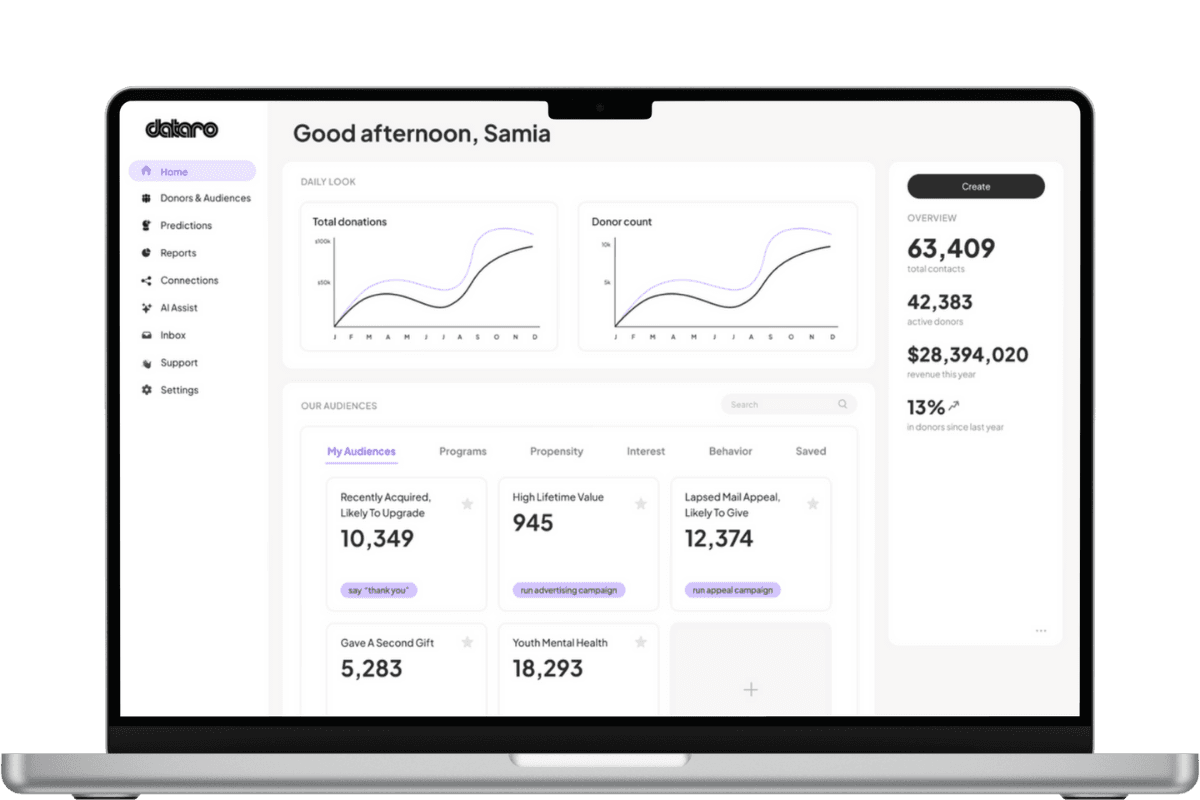
Dataro sits on top of your CRM and turns your data into ranked lists, clear cutoffs and a recommended next action per donor, so you can decide who to focus on and what to do next.
Related articles
Discover more insights into nonprofit fundraising and data from the Dataro team.