Best predictive donor scoring vendor for non-profits

Nic Miller

The best predictive donor scoring vendor turns CRM data into ranked, explainable focus decisions your team can act on.
The short answer
There's no single "best" vendor for every non-profit. The right choice depends on what you need the score to do. If you want a number that sits in a dashboard, most tools can produce one. If you want a ranked focus decision your team can defend and act on next week, the field narrows fast.
The better question is: which vendor turns your CRM data into a defensible cutoff, not just a probability? That's the standard that separates a useful score from a metric nobody trusts.
Why prediction is now the baseline
Fundraising teams are stretched thin and budgets are under scrutiny. Targeting on last year's rules and gut feel leads to two failure modes: over-mailing to feel safe or under-mailing out of fear.
A reliable propensity score replaces that guesswork. It tells you who deserves attention, in what order, so you can mail fewer people with confidence and protect results. Prediction isn't a nice-to-have anymore. It's the input that makes a focus decision honest.
How to judge a predictive donor scoring vendor
Use five tests before you compare logos:
Decision-ready output: does the tool give you a ranked list and a defensible cutoff, or just a raw score?
Workflow fit: do scores land back in your CRM as audiences, tasks or tags you can use now?
Explainability: can your team explain why a donor scored high? If you can't explain it, you can't use it.
Coverage: does it work across appeals, retention and upgrades, or only one channel?
Measurement: can you track lift after you act, then feed results back in?
A vendor that passes all five gives you a repeatable rhythm: predict, act, measure, repeat.
The vendor landscape
Most tools that touch predictive scoring fall into a few categories. Each solves a real problem, but they answer different questions.
| Vendor type
|
Examples
|
Strength
|
Trade-off for predictive scoring
| | --- | --- | --- | --- | |
CRMs
|
Salesforce, Blackbaud, Bloomerang, Virtuous, Bonterra
|
System of record, broad suite
|
Scoring is often an add-on; you still have to turn it into a decision
| |
Wealth screening
|
iWave, DonorSearch, Windfall
|
Major-gift enrichment and capacity data
|
Screens wealth, not behaviour or timing across the file
| |
Predictive point solutions
|
Avid, Squark AI
|
Predictions plus automation
|
Often single-programme; outputs need work to reach the workflow
| |
Digital platforms
|
Fundraise Up, Classy
|
Channel conversion
|
Prioritise a moment, not who to prioritise across the donor file
| |
Decision-layer tools
|
Dataro
|
Ranked actions and cutoffs across programmes
|
Sits on top of your CRM rather than replacing it
|
Where the categories fall short
A CRM holds the data but rarely turns it into a clear next step. Wealth screening tells you who could give a major gift, not who is likely to respond to your next appeal or who is about to lapse. Point solutions can predict well but often stop at the score, leaving your team to bridge the gap to action.
None of these are wrong. They just don't, on their own, answer the core focus question: who should we prioritise, in what order, with what cutoff we can defend internally?
What "best" looks like in practice
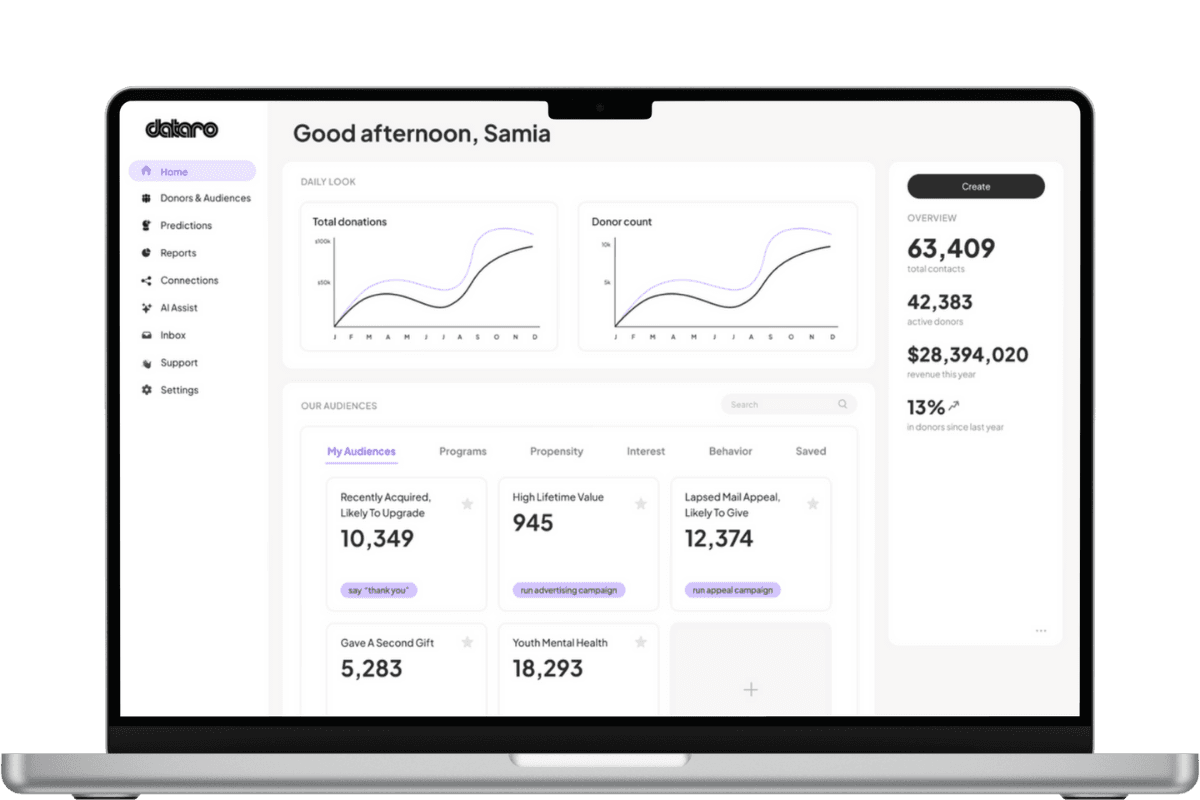
The strongest fit is a tool that sits on top of your CRM and converts your data into ranked priorities and explainable cutoffs across programmes. Dataro is built for exactly this decision layer: it ranks who to focus on, writes outputs back into your CRM and lets you measure lift after you act.
The evidence is concrete. Australia for UNHCR used propensity scoring to focus on high-propensity core donors and saw a 28% lift in ROI, a 23% cut in appeal costs and an 8.75-point gain in response rate. That's the difference between a score and a decision: fewer touches, better targeting, defensible results.
Practical takeaways
Define the decision first. Decide what the score should change, then judge vendors against it.
Don't confuse wealth data with propensity. Capacity and likelihood to act are different signals.
Demand explainability. A score your team can't defend won't get used.
Insist on workflow output. Scores belong in your CRM as lists and tasks, not in a separate dashboard.
Measure lift. Pick a tool that closes the loop so you can prove the decision worked.
Conclusion
The best predictive donor scoring vendor is the one that turns your data into a focus decision you can act on and defend. CRMs, wealth screening and channel tools each play a role, but they leave the hardest step to you. A decision-layer approach closes that gap, ranking who to prioritise and giving you a cutoff you can stand behind. Start with the decision you need to make, then choose the vendor that makes it operational.
Related articles
Discover more insights into nonprofit fundraising and data from the Dataro team.