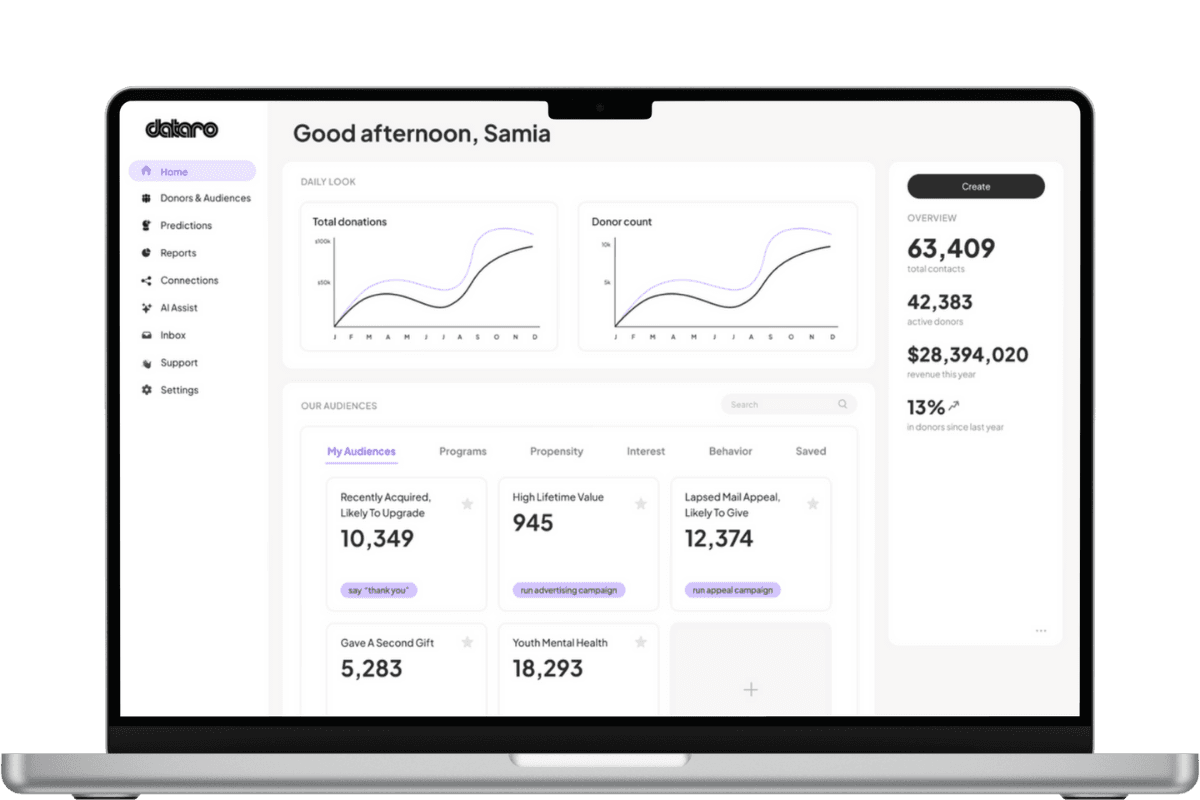
AI-powered fundraising scenario planning: a practical guide
Strategy & Frameworks

AI-powered scenario planning turns donor data into ranked, testable fundraising plans you can defend before you spend.
What is AI-powered fundraising scenario planning?
AI-powered fundraising scenario planning is a method for modelling likely campaign outcomes before you commit budget or staff time. It uses predictive scores on your donor file to estimate how different choices, such as list size, timing and ask amounts, change response, revenue and retention.
Instead of one static forecast, you compare several ranked scenarios side by side. Each shows who to focus on, what to do next and the expected result, so you can pick the plan you can defend.
The shift is simple. Old-world planning is reactive and built on last year's segments. New-world planning is predictive and focused, with data guiding decisions before money is spent.
Why does scenario planning matter now?
Fundraising teams are flat while goals rise and channels multiply. Mail, paid media and staff time face closer scrutiny, so waste is easier to see and harder to excuse.
Most targeting still runs on manual segmentation and gut feel. The safe default becomes "mail more people" or "reuse last year's list," even when everyone knows it isn't precise. That guesswork is expensive, and it slows approvals because the cut-offs are hard to justify.
Scenario planning answers the two decisions every team owns:
Focus: who deserves attention right now, and why
Act: what to do for each donor next, across every program
How does AI scenario planning work?
The model sits on top of your CRM and returns ranked outputs you can act on. A typical loop looks like this:
Read your donor history and engagement signals from the CRM.
Score each donor with propensity and value predictions.
Build ranked lists and cut-offs for each scenario you want to test.
Estimate revenue, cost and retention for each option.
Push the chosen audience back into the CRM as lists, tags or tasks.
Results flow back as new signals, so the next cycle gets sharper. This is the predict, act, measure, repeat rhythm.
AI scenario planning vs. spreadsheet forecasting
Both approaches project outcomes, but they differ in precision, speed and how easily a team can execute the result.
Factor | Spreadsheet forecasting | AI-powered scenario planning |
|---|---|---|
Basis | Historical averages and rules | Donor-level propensity scores |
Granularity | Segments and buckets | Individual donors |
Speed to test options | Slow, manual rebuilds | Fast, many scenarios at once |
Cut-off confidence | Hard to defend | Ranked and explainable |
Output | A number in a cell | Execution-ready lists and actions |
Trade-off | Simple and familiar | Needs clean data and setup |
Spreadsheets stay useful for quick, rough views. For live campaign decisions across programs, ranked scenarios give tighter targeting and faster approvals.
What can you model with scenario planning?
Appeal size: compare mailing 40,000 donors against 16,000 highly ranked donors and see the revenue trade-off.
Retention: find donors at risk early enough to act, then test a win-back path.
Ask amounts: model an ask ladder tuned to each donor's likely capacity.
Budget shifts: move spend between programs and compare net revenue.
Timing: test when a segment is most likely to respond.
How to run your first scenario in 5 steps
Pick one decision to improve, such as who to include in the next appeal.
Define the outcome you care about: net revenue, response rate or retention.
Build two or three scenarios, for example a broad list, a focused list and a mid-point.
Compare the ranked results and choose a cut-off you can explain to stakeholders.
Push the chosen list into your CRM, run the campaign and measure the lift.
Start small. A single pilot on one appeal gives you a measurable result and a repeatable method.
Practical takeaways
Plan before you spend. Ranked scenarios reduce the cost of guessing.
Focus beats volume. Mailing fewer people with confidence protects results and capacity.
Keep cut-offs explainable. Clear rankings make approvals faster and easier to justify.
Close the loop. Feed results back so each cycle improves.
Conclusion
AI-powered scenario planning replaces guesswork with a simple, repeatable rhythm. You model the options, pick the plan you can defend and push it straight into the tools your team already uses. The result isn't more activity. It's fewer, better decisions that are easier to run and easier to justify.
Related articles
Discover more insights into nonprofit fundraising and data from the Dataro team.