The Last Great Gift: How Smarter Prioritisation Is Changing Planned Giving
There is a particular kind of donor who has been quietly funding your mission for 15, 20, sometimes 30 years. They give modestly but consistently. They open your emails. They've volunteered, attended events, maybe brought their children along. They believe in what you do — deeply and personally.
They are also, in all likelihood, your strongest planned giving prospect. And most organisations have no idea.
This is the central tension in legacy fundraising. The donors most likely to leave a gift in their will are already in your file. They don't appear on wealth screening reports, and they may never have made a major gift. But they've done something far more telling: they've stayed. Research by Russell James at Texas Tech University consistently shows that loyalty — not wealth — is the strongest predictor of bequest intent.
The challenge has never been finding willing donors. It's been finding the right donors, at the right moment, and making the path to a legacy commitment as simple as it should be.
That challenge is now solvable.
The Problem With How Most Organisations Identify Legacy Prospects
For decades, planned giving programs have relied on intuition, wealth screening, and the occasional golden conversation with a long-tenured donor who happened to mention something to a gift officer. It works slowly, at small scale, and only when the right person is in the right role.
The consequences are real. Most organisations work from legacy prospect lists that are either too small — only the obvious high-wealth candidates — or too broad — everyone over 65 who's given more than twice. Donors who would have been honoured to be invited into a legacy conversation are never asked.
Meanwhile, cold bequest mailers reach donors who aren't the highest-quality intenders, and the signals that indicate genuine readiness go unread.
Fundraisers don't need more prospects. They need better ones.
This is a Focus decision. The first question in any fundraising program: who should we focus on? For most legacy programs, that decision is still made by guesswork.
Why Legacy Requires a Different Kind of Prioritisation
Standard segmentation tools weren't built for planned giving. Recency-frequency-monetary (RFM) models — the workhorses of direct response — are designed to predict transactional giving. They don't surface the latent intenders sitting in a mid-file loyalty cohort.
Legacy propensity depends on a different signal set: giving tenure, consistency over time, engagement breadth across programs, life-stage indicators, and patterns that suggest deepening identity with the organisation.
Dataro's Gift in Will model ranks the existing donor file against those signals. The result is a clear, prioritised view of the top 1–2% whose profile most closely matches what research tells us about people who make bequests.
These are not necessarily your wealthiest donors. Research consistently shows that ultra-high-net-worth individuals spread estate allocations across many organisations. A loyal mid-file donor who has concentrated their giving with one cause over 20 years is a stronger bequest prospect than a recent $10,000 donor with a $5 million net worth — yet RFM keeps surfacing the latter first.
The model's role isn't to replace fundraiser judgement. It's to make the "who should we focus on" decision reliable and repeatable, so fundraisers can spend their time on the conversations that actually matter.
The results speak for themselves. Amnesty International Australia used Dataro's ranked legacy targeting to prioritise bequest outreach from its existing file. In the first full year, confirmed bequests grew 60%, adding 72 new bequestors. By end of 2024, the program had confirmed an additional 140 supporters — representing an estimated $4.32 million in future income. RSPCA Western Australia's philanthropy officer called it "twice as good as anything we have done in the past to identify our best bequest prospects."
From Identification to Action: The Legacy Donor Journey
Getting identification right is the beginning. What happens next defines whether the program delivers.
Erskine, a Scottish veterans' charity, used ranked identification to uncover 96 new legacy prospects and achieved a 34% conversion rate from its telephone campaign. St Andrew's Hospice doubled its total legacy pipeline in a single campaign, securing 30 new pledgers and an estimated £367,000 in future revenue. Neither had a dedicated legacy team before starting.
The legacy donor journey doesn't move in campaign cycles — it moves in years. The arc runs from prospect identification through discovery, cultivation, disclosure, and stewardship, with realisation often a decade or more away. Every stage requires something different. Most programs aren't resourced to manage all of them well at once.
Dataro's framework maps three decisions every fundraising team faces: who to focus on, who to engage right now, and what to do next. Legacy programs need all three.
Discovery is the first unlock. A donor who has never been asked is invited into a legacy conversation. The best discovery conversations don't open with a legal vehicle or an estate planning pitch — they open with identity: What do you want your support of this cause to mean in the long run? Russell James's research shows that framing the conversation around who a donor is, not what legal action they might take, generates stronger engagement and higher conversion.
Cultivation is the long middle — relationship maintenance across a three-to-ten-year window between first conversation and written commitment. Most programs lose momentum here because cultivation is not linear, not easily reported against KPIs, and entirely relationship-dependent.
Disclosure is the moment a donor confirms they've included the organisation in their estate plan. This is the metric that matters: confirmed intents by count and estimated face value.
Stewardship runs from disclosure to realisation. Legacy society members should feel known, valued, and connected to the organisation's future — not simply filed and forgotten. The quality of stewardship directly affects whether donors maintain their commitment, increase it, and speak about it to others.
Each stage requires different touchpoints, different messages, and different support. Most organisations manage them through a patchwork approach: a spreadsheet here, a CRM note there, a gift officer's memory bridging the gaps.
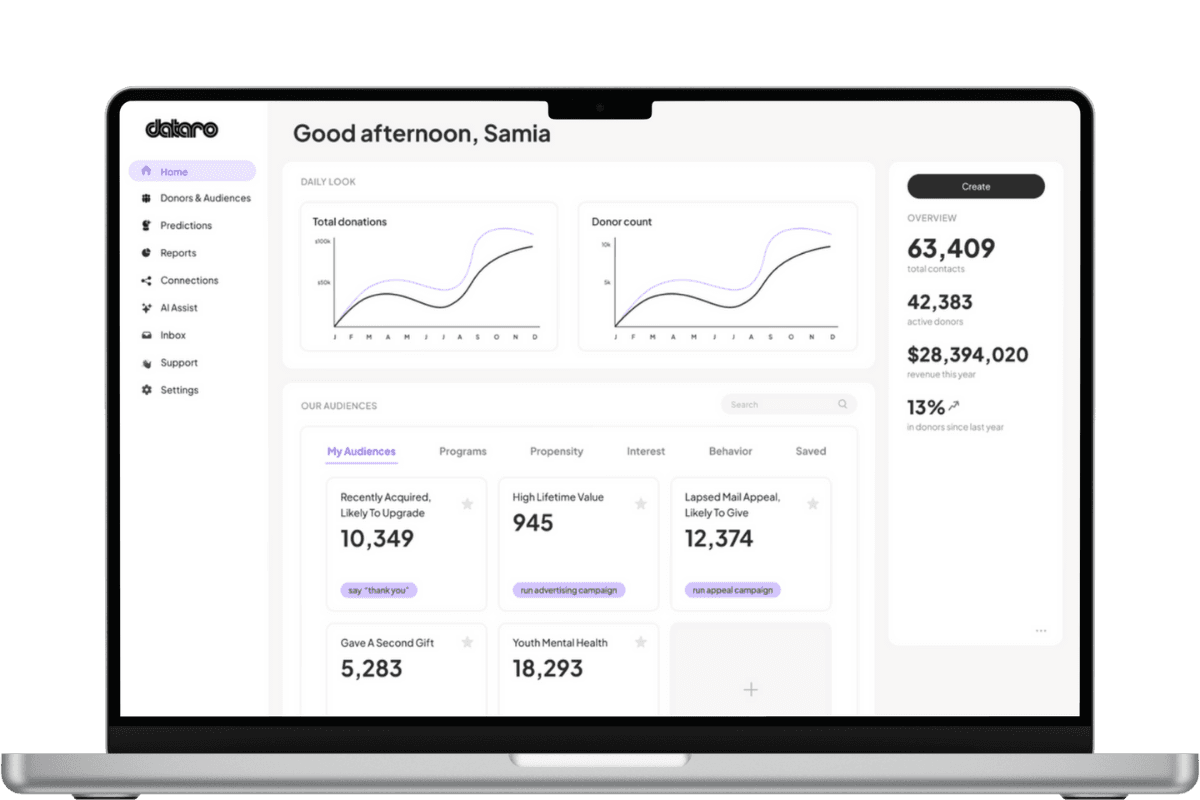
Dataro's ranked outputs live inside the CRM. That means the prioritisation, the timing signals, and the stewardship cues are available where your team already works. Naomi Vaughan, Gifts In Will Specialist at Amnesty International, puts it directly: "I don't know how I would do my job without Dataro's donor predictions. With Dataro I know exactly which donors are most likely to be interested in leaving a bequest gift so I know where to focus my efforts and who to nurture with our campaigns."
Removing Friction From Commitment: Where Giving Docs Comes In
Identifying the right donors and starting the right conversations is half the work. The other half is making the act of becoming a legacy donor as simple and as meaningful as it should be.
That's what Giving Docs does.
Once a discovery conversation has opened the door, donors need a clear path forward — one that isn't confusing, bureaucratic, or dependent on navigating the legal system alone before they've even decided what they want to leave.
Giving Docs lets US-based donors create a trust, a simple will, or update an existing one — with the organisation's details already included. It reduces the process from months to minutes. The experience removes friction without reducing meaning. It's warm, considered, and appropriately weighty.
Giving Docs isn't a will-writing widget. It's an onboarding experience for one of the most significant decisions a donor will make, built with behavioural science cues designed specifically to inspire legacy giving.
Best Friends Animal Society embedded Giving Docs into their stewardship workflows, enabling their planned giving team to identify "handraisers," support cultivation strategies, and give donors a simple, meaningful way to complete wills — which often resulted in larger legacy gifts. What began as a largely administrative program became a proactive, donor-centred strategy that expanded impact without increasing team size. The partnership added roughly 1,000 legacy society members annually and deepened long-term donor commitment through streamlined, accessible estate planning tools.
When Purpose-Built Tools Come Together for the Mission
Dataro and Giving Docs together address the two hardest problems in planned giving: who to talk to, and what happens after the conversation.
Dataro answers the first. A ranked legacy prospect list any organisation can act on immediately, regardless of team size or existing legacy infrastructure.
Giving Docs answers the second. It removes the practical barriers between a US donor's intent and a confirmed commitment.
The result is a complete donor journey — from identification, through cultivation, to confirmed legacy commitment.
Legacy programs have long depended on a small number of experienced planned giving officers carrying institutional knowledge. When a person leaves, the program suffers. At smaller organisations, legacy work often doesn't happen at all.
This model changes that. Ranked identification means organisations of any size can know who their best legacy prospects are. Streamlined onboarding means a team of two can manage what previously required far more. The human relationship stays central — but it's focused on the moments where it matters most, not diluted across manual list-building and administrative processes.
Related articles
Discover more insights into nonprofit fundraising and data from the Dataro team.