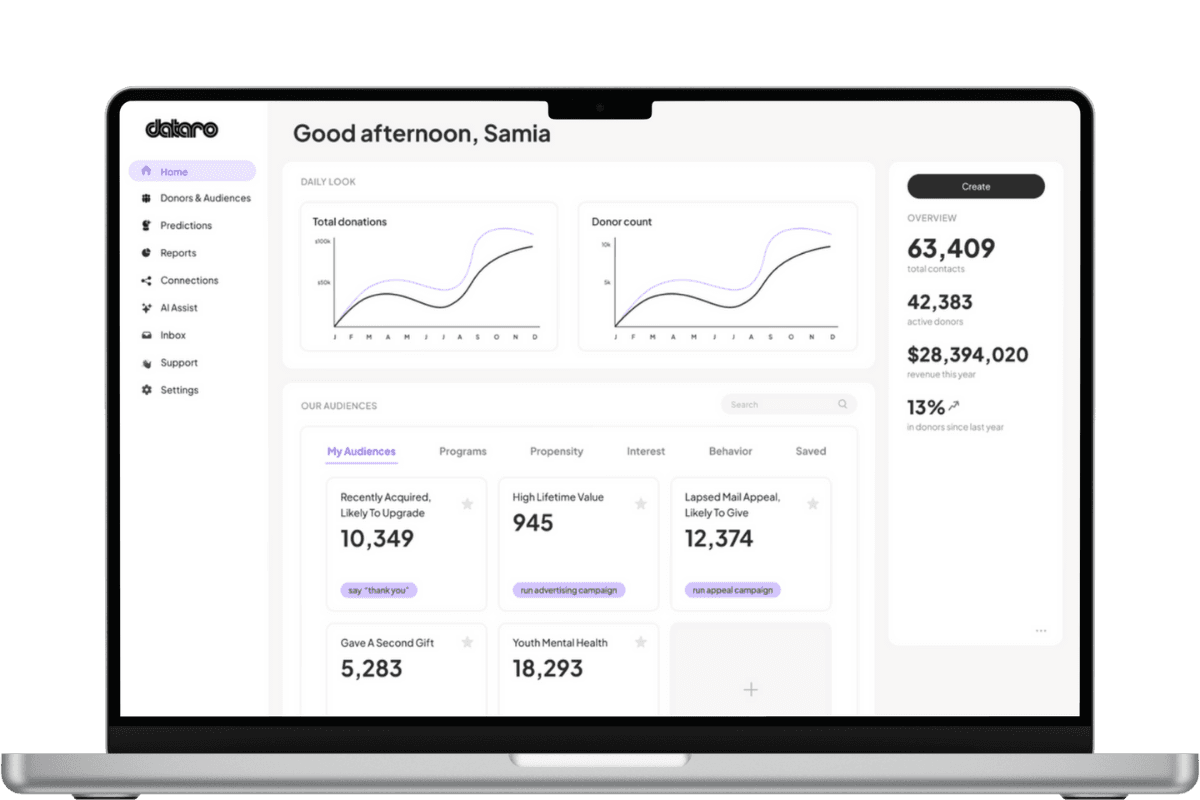
RFM can tell you what happened. Fundraising intelligence helps you decide what to do next.
Strategy & Frameworks

Moving beyond RFM starts with a better operating rhythm: use predictive scoring to decide who to focus on, who to engage right now, and what to do next, then write the right message with confidence.
Fundraising teams are dealing with a “leaky bucket” problem. Donor files are bigger than ever, but retention is still hard and teams have less time to fix it.
RFM segmentation and similar scoring methods help organize past behavior. The problem is not that RFM is “wrong.” It is that RFM is backward-looking. In a market where donor behavior is changing and capacity is tight, history alone does not tell you who needs attention now.
Dataro is a fundraising intelligence platform. It sits on top of your CRM and turns donor and prospect data into clear, ranked decisions:
Who to focus on
Who to engage right now
What to do next
Why RFM hits a ceiling
RFM treats value as something you earned in the past. That makes it easy to miss two realities:
Some “top” donors are quietly becoming churn risks while their RFM score still looks strong.
Some lower-value donors show the same engagement patterns as your best mid-value supporters, but never rise to the top of a monetary-based segment.
Predictive scoring helps because it shifts the question from “What did they do?” to “What are they likely to do next?” That shift matters most when you are making high-stakes decisions under constraint: how big to make a mailing, who to exclude, who to call, and where to spend stewardship time.
What this looks like in practice
Mid-value: Australia for UNHCR cut a program list from 8,000+ to 4,200 to focus stewardship time where it mattered. They converted 66 new mid-value donors and achieved a 28% conversion rate for high-propensity prospects.
Retention: Greenpeace Australia Pacific retained 531 monthly donors over nine months by prioritizing at-risk supporters early, with an estimated $235k in additional monthly gifts over eighteen months and an ROI of 10.58. Teams also consistently describe the shift in plain terms: being proactive in retention instead of reactive.
See predictive decisioning replace RFM
Predictive scoring is the “brain.” Generative AI is the “mouth.”
Generative AI can help teams write faster, but speed is not the same as effectiveness. If every nonprofit sends more generic content, donor fatigue gets worse.
The better approach is simple:
Use predictive scoring to decide who needs attention and what the next action should be.
Use generative AI to help create the message once that decision is made.
Without the decision layer, generative AI tends to produce one-size copy. With it, the copy gets more specific because the prompt has real direction: who the donor is, what the donor is likely to do, and what action the team is trying to drive.
This is also where adoption succeeds: when outputs land in real workflows as lists, tags, and audiences that teams can act on in the tools they already use.
The point is not more content. It is better decisions.
Fundraisers are not looking for another dashboard. They are trying to protect revenue, reduce waste, and make fewer decisions by guesswork. Fundraising intelligence helps teams do that with more precision and less risk.
Related articles
Find more nonprofit fundraising and data insights from the Dataro team.