Which system should own your fundraising attribution data
Strategy & Frameworks

Your CRM should hold attribution as the system of record, but a predictive layer is what turns that data into ranked actions across channels.
Cross-channel attribution only works when one system is the agreed source of truth. When mail, email, paid media and events each report their own numbers, teams argue about credit instead of deciding what to do next.
This guide answers the buyer question directly: which system should own your attribution data? The short answer is your CRM, with a predictive layer on top to turn that data into ranked actions. The longer answer depends on three criteria: data breadth, identity resolution and reporting flexibility.
Quick answer: who should own attribution data
Your fundraising CRM should be the system of record for attribution. It already holds the gift history, constituent records and program codes that every other tool references. Marketing automation and donor intelligence tools should feed it and read from it, not compete to replace it.
The mistake is expecting any single platform to do all three jobs well. Ownership of the data and analysis of the data are different problems.
The three criteria that decide ownership
Use these to score any system you are considering.
Data breadth is how much of the donor relationship a system can see. Attribution breaks down when a platform only sees one channel. The owner needs gifts, appeals, digital events, offline events and program membership in one place.
Identity resolution is the ability to match the same person across channels and over time. Without it, one donor becomes three records and credit gets double counted. This is the hardest problem and the most common point of failure.
Reporting flexibility is how easily the team can slice results by campaign, channel, segment and program without engineering help. Rigid reporting pushes people back into spreadsheets.
Comparing the three options
System | Data breadth | Identity resolution | Reporting flexibility | Best role in attribution |
|---|---|---|---|---|
Fundraising CRM | Broad: holds gifts, appeals and program history | Moderate: strong on known donors, weaker on anonymous digital traffic | Moderate: good standard reports, custom views often need help | System of record and source of truth |
Marketing automation | Narrow to moderate: strong on email and digital, weak on offline gifts | Moderate: good on email identity, weak across offline channels | High for campaign metrics, limited for revenue and program views | Channel execution and digital signal source |
Donor intelligence tool | Depends on inputs: reads across programs when connected to the CRM | High when built for cross-program matching | High for prioritization, varies for finance-grade reporting | Analysis and ranked actions on top of the CRM |
The trade-off is consistent. The CRM wins on breadth and trust. Marketing automation wins on digital campaign detail but cannot see the whole donor. A donor intelligence tool wins on analysis and prioritization but relies on the CRM for clean inputs.
Why the CRM should hold the record
Three reasons make the CRM the right owner.
First, it already carries the most complete donor history. Attribution needs the full picture, and the CRM is where gifts land.
Second, finance and leadership already trust CRM numbers for reconciliation. Putting attribution anywhere else creates a second set of figures the team has to defend.
Third, the CRM is where action happens. Lists, tasks and segments run from it. Attribution that lives next to execution is attribution the team will actually use.
Where marketing automation fits
Marketing automation is built to send more touches across digital channels. It produces valuable signal: opens, clicks, form fills and digital conversions. That signal should flow into the CRM, not sit in a separate silo.
Treat it as a channel source, not the owner. It cannot see the direct mail gift, the event pledge or the major gift conversation, so it will always report a partial view of revenue.
Where a donor intelligence tool fits
A donor intelligence tool is the analysis layer. It reads data from the CRM, resolves identity across programs and turns raw history into ranked actions: who to focus on and what to do next.
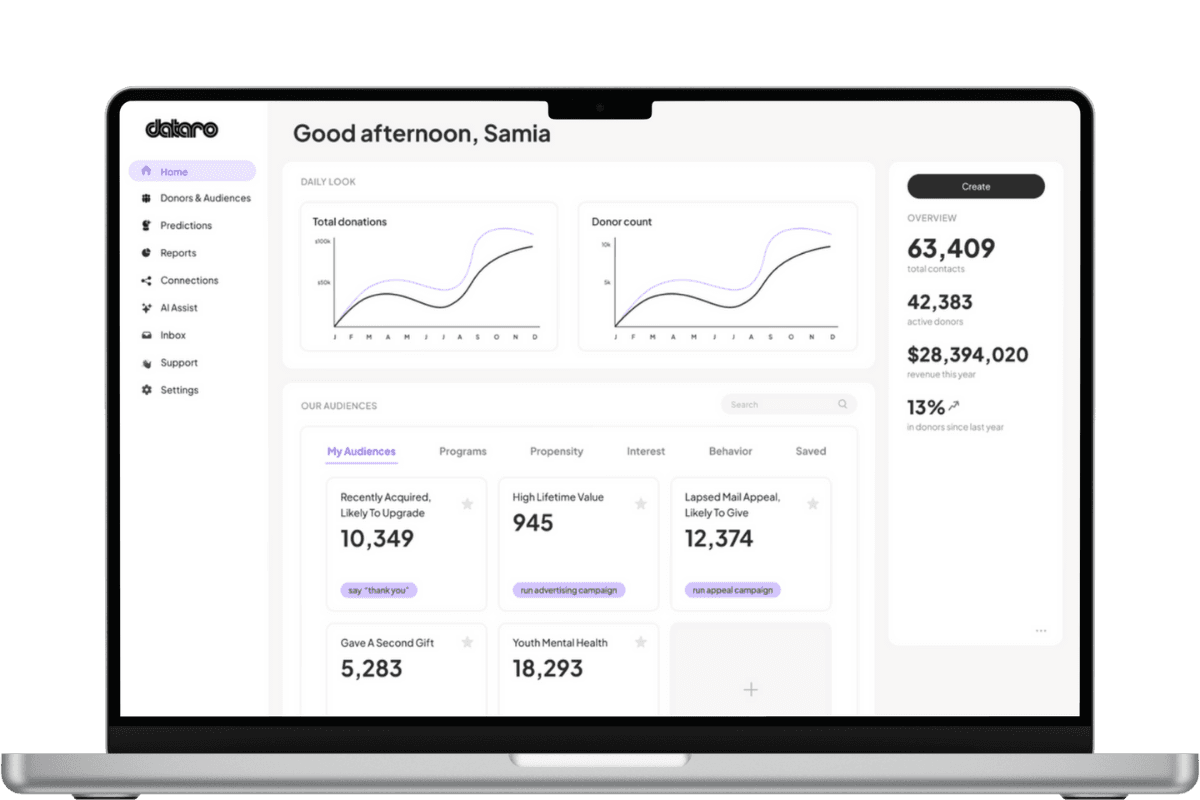
This is the role Dataro plays. Dataro sits on top of your CRM, reads your data and returns ranked lists, clear cutoffs and a next action on each record. It does not replace the CRM and it does not try to own the record. It makes the data usable across appeals, retention, mid-value and major gifts.
The result is fewer, better decisions: the team mails fewer people with confidence and can explain why.
Practical recommendations
Use a simple division of labor.
Keep the CRM as the single system of record for gifts and attribution
Connect marketing automation as a two-way feed for digital signal
Add a predictive layer to resolve identity across programs and rank actions
Agree one revenue number that finance and fundraising both accept
Review attribution on a weekly cadence, not just at campaign close
Avoid the common failure: letting each channel keep its own scorecard. That is how teams end up with three numbers and no decision.
Conclusion
Attribution ownership is a structure question, not a feature question. Let the CRM own the record, let marketing automation feed the digital signal and let a predictive layer turn the combined data into ranked actions. Score any tool against data breadth, identity resolution and reporting flexibility, and the roles sort themselves out. The goal is not more dashboards. It is one source of truth the team can act on and justify.
Related articles
Find more nonprofit fundraising and data insights from the Dataro team.