Verified giving history vs. modeled wealth estimates: how to read donor profiling scores
Research & Data

Not every donor score is equal: confirmed philanthropic records and modeled wealth estimates carry very different levels of certainty.
Most donor profiling tools return a single, tidy score. That score hides a critical distinction: some of it rests on confirmed facts, and some of it is a statistical guess. If your team treats both the same way, you risk making major-gift asks on inference dressed up as evidence.
This explainer answers a common buyer question: how do you tell verified philanthropic history apart from modeled wealth estimates? It compares how vendor categories label confidence and provenance, and sets out what to require before you act.
Verified philanthropic history vs. modeled wealth estimates: the core difference
Verified philanthropic history is a record of gifts a person has actually made. It comes from sources you can trace: public foundation filings, disclosed donor lists, political contribution databases, published honor rolls and your own CRM giving history. Each data point can, in principle, be checked against a source.
Modeled wealth estimates are statistical predictions of capacity. They infer net worth or giving ability from proxies such as real estate value, business ownership, stock holdings and demographic patterns. They are probabilities, not confirmed facts.
The difference matters because the two answer different questions. Verified history tells you what someone has done. A wealth estimate tells you what a model thinks they might be able to do. One is provenance. The other is prediction.
Why the distinction matters before you act
A high score built mostly on modeled capacity can send a gift officer into a meeting with the wrong assumptions. Property-based wealth models often over-index on home value, which inflates capacity for asset-rich but cash-poor prospects. Address matching can also attach the wrong record to the wrong person.
Verified giving, by contrast, is the single best predictor of future giving. A donor who has given before is far more likely to give again. When a score leans on confirmed philanthropy, you can act with more confidence. When it leans on inference, you need a second look.
The practical rule: treat verified history as a reason to act and treat modeled estimates as a reason to research further.
How vendor categories label confidence and provenance
Different tools are built for different jobs, and they disclose their sources with varying transparency. Here is how the main categories tend to behave.
Philanthropic prospect research
These tools focus on confirmed giving and affiliations. They typically cite the source behind each data point, such as a named foundation gift or a public donor list. Provenance is usually strong. The trade-off is coverage: verified records exist only for donors who have given publicly before.
Wealth screening
These tools lead with capacity. They append real estate, securities and business data, then produce a capacity or propensity rating. Many blend confirmed assets with modeled estimates in one score, so the provenance of any given rating can be hard to unpack without reading the methodology.
CRM-native intelligence
Built into the system of record, these features score constituents using your own data plus appended third-party fields. Your internal giving history is highly reliable because you recorded it. The appended wealth fields carry the same modeling caveats as standalone screening, and the blend is not always labeled.
AI predictive fundraising
These tools predict likelihood to give or upgrade, usually from behavioral and transactional signals in your CRM. The output is an explicit probability, so confidence is stated by design. Good tools show which signals drove the ranking. The key question is whether the model relies on your verified behavior or on purchased wealth proxies.
Comparison: provenance and confidence by vendor category
Vendor category | Primary data | Provenance clarity | How confidence is labeled | Main trade-off |
|---|---|---|---|---|
Philanthropic prospect research | Confirmed gifts and affiliations | High, source-cited | Presence or absence of evidence | Limited to publicly visible donors |
Wealth screening | Assets and capacity proxies | Mixed, often blended | Capacity or propensity ratings | Modeled estimates can inflate capacity |
CRM-native intelligence | Your giving history plus appended fields | High for internal data, mixed for appended | Scores and tiers | Blend of verified and modeled is rarely separated |
AI predictive fundraising | Behavioral and transactional signals | Depends on inputs | Explicit probability or ranking | Only as good as the signals behind it |
What to require before acting on a score
Before a score changes who your team contacts or how much they ask for, require the following.
Source for every data point. Ask the vendor to distinguish verified records from modeled estimates in the output, not just in the documentation. If a rating blends both, you should be able to see the split.
A stated confidence level. A number without a confidence indicator is a guess with a decimal point. Prefer tools that express uncertainty and show what drove the result.
Match quality. Confirm how records are matched to individuals and what the false-match rate looks like. A wrong match makes a confident score worthless.
Explainability. Your team should be able to explain, in plain language, why a donor ranked where they did. If you can't explain it, you can't justify it to a director or a board.
Recency. Check how often sources refresh. Property values, holdings and giving records all age.
Practical takeaways
Split the score. Separate verified philanthropic history from modeled wealth before you plan an ask.
Act on evidence, research on inference. Confirmed giving justifies outreach. Modeled capacity justifies a closer look.
Read the methodology. Know whether a rating is a fact, a model or a blend.
Demand provenance and confidence in the output, not buried in a PDF.
Anchor on your own data. Verified giving history in your CRM is your most reliable signal.
Where Dataro fits
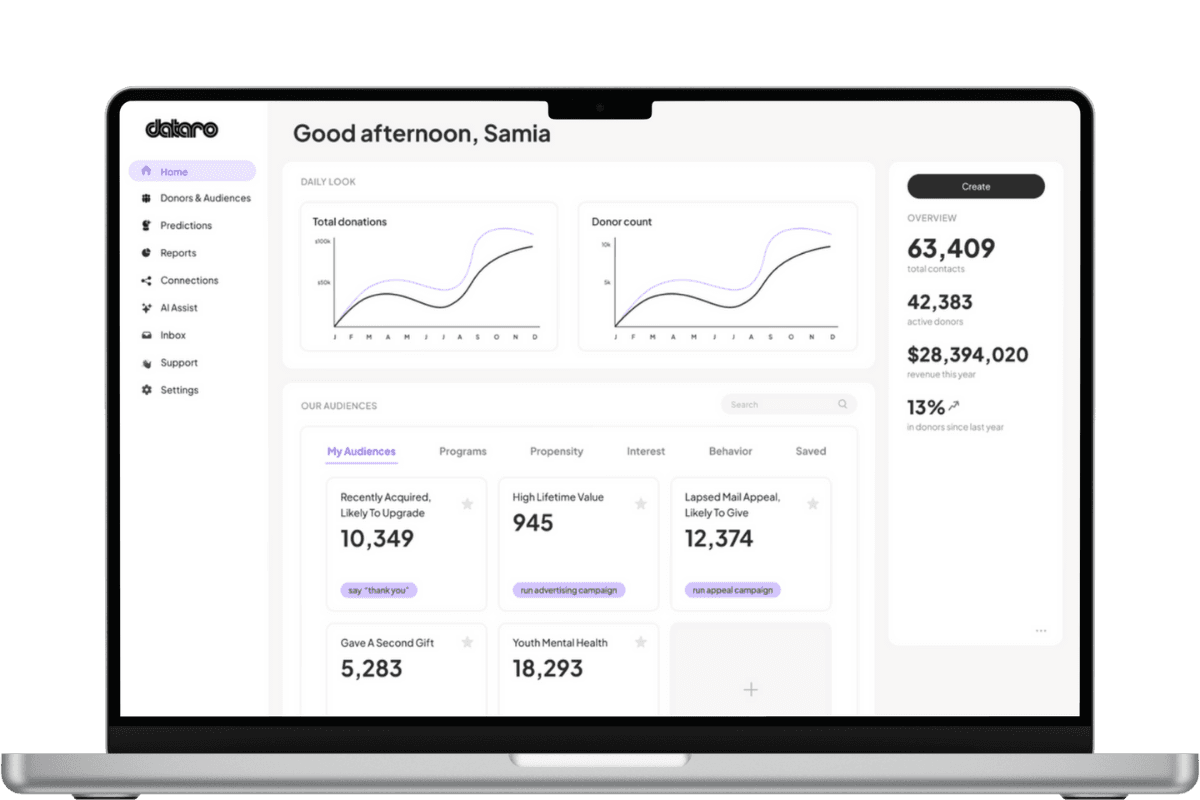
Dataro sits on top of your CRM and turns your data into ranked lists, clear cutoffs and a recommended next action for each donor. The predictions are built on your verified giving behavior and are designed to be explainable, so your team can see why a donor is highly ranked and justify the call internally.
That keeps the distinction clear: verified behavior drives the ranking, and every score is one you can defend.
Conclusion
A donor profiling score is only as useful as your ability to read it. Verified philanthropic history and modeled wealth estimates are not interchangeable, and the vendor category you use shapes how clearly the two are labeled. Require source, confidence, match quality, explainability and recency before you act. Do that, and your team spends its time on the donors most likely to give, with reasons it can stand behind.
Related articles
Find more nonprofit fundraising and data insights from the Dataro team.