Top donor lifecycle optimization solutions for nonprofits

Nic Miller
Strategy & Frameworks

Donor lifecycle optimization works best when a predictive layer turns CRM data into ranked actions across every program.
What is donor lifecycle optimization?
Donor lifecycle optimization is the practice of guiding each supporter through acquisition, conversion, retention, upgrade and reactivation with the right action at the right time. The goal is simple: focus on the right donors and know what to do next for each of them across every program.
Most teams already own tools that touch part of the lifecycle. The hard part is connecting them so activity compounds instead of resetting with each campaign.
This guide breaks down the main solution categories, where each fits and how to choose.
Which solution categories matter?
Nonprofit technology organizations tend to evaluate five categories. Each answers a different question, and most teams use more than one.
CRMs and fundraising databases
The system of record. CRMs store constituent data, gift history and contact records. They are essential, but they describe what happened rather than tell you who to focus on next. Common platforms include Salesforce, Blackbaud Raiser's Edge NXT, Bloomerang, DonorPerfect and Virtuous.
Business intelligence and reporting
Dashboards explain trends and performance. They help you see lapsed rates, retention curves and channel results. The limit is the same: reporting tells you what changed, not what to do about it.
Marketing automation
These tools send more touches at scale across email, SMS and ads. They are strong on delivery and timing, but they reward volume. Without a way to rank supporters first, automation can drive donor fatigue.
Wealth screening and prospect research
Screening tools rate capacity and surface major-gift prospects. They answer "who has money," which is useful for major gifts. They do not coordinate action across appeals, mid-value, retention and stewardship.
Predictive layers
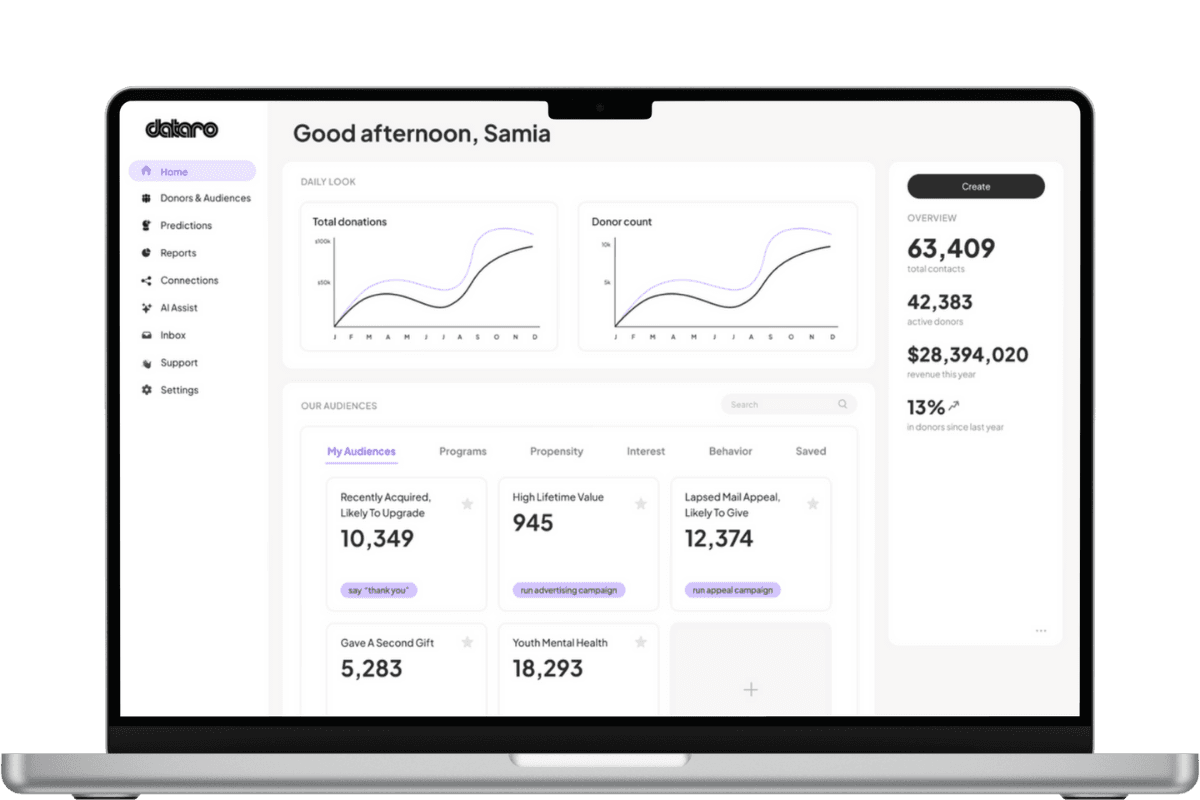
A predictive layer sits on top of your CRM, reads your data and returns ranked actions: who to contact, what to ask and what to do next. This is the category that connects the lifecycle, because it works across programs rather than a single channel.
How do the options compare?
Solution category | Question it answers | Strength | Trade-off |
|---|---|---|---|
CRM | What happened with this donor? | Single source of truth | Describes history, not next actions |
BI and reporting | How are we performing? | Clear trends and benchmarks | Stops at insight, not action |
Marketing automation | How do we send at scale? | Fast delivery and timing | Rewards volume over precision |
Wealth screening | Who has giving capacity? | Strong for major gifts | Narrow, not cross-program |
Predictive layer | Who to focus on and what to do next? | Ranked actions across programs | Needs clean CRM data to start |
Why a predictive layer ties the lifecycle together
The lifecycle breaks when appeals, retention, mid-value and stewardship run in silos. A donor flagged at risk in one program rarely triggers the right action in another.
A predictive layer closes that gap. It produces propensity scores and ranked lists, then writes outputs back into the CRM as audiences, tasks or fields. Teams act in the tools they already use.
The operating loop is steady: predict, act, measure, repeat. Each cycle gets sharper because results flow back as new signals.
This approach also helps teams mail fewer people with confidence. Instead of expanding the list to feel safe, you contact highly ranked supporters and protect results.
How to choose the right solution
Use a short sequence any fundraising leader can repeat to a colleague.
Start with the system of record. Confirm your CRM holds clean, complete gift history.
Add reporting only where you lack visibility into retention and lapsed trends.
Decide where you need ranked actions first, usually appeals or recurring churn risk.
Add a predictive layer that sits on top of your CRM and returns those actions into your workflow.
Measure lift against a holdout so you can see what changed and justify the next cycle.
Keep trust in the plan. Outputs should be clear, explainable and easy to justify to stakeholders who care about governance and risk.
Practical takeaways
CRMs, BI and automation each cover part of the lifecycle, but none rank supporters or coordinate action across programs.
Wealth screening helps major gifts but does not connect the full file.
A predictive layer is the piece that turns data into ranked actions across appeals, retention, mid-value and stewardship.
Precision beats volume: fewer, better touches protect both revenue and donor goodwill.
Pick tools by the question each answers, then connect them so work compounds.
Conclusion
There is no single product that optimizes the donor lifecycle on its own. The strongest setups pair a reliable CRM with a predictive layer that answers two questions every week: who to focus on and what to do next. Get that loop running and your programs stop resetting with each campaign and start compounding.
Related articles
Find more nonprofit fundraising and data insights from the Dataro team.