Best CRM with a donor insights workflow for nonprofit software teams

Nic Miller
Strategy & Frameworks

The right CRM stores donor data, but a predictive layer is what turns it into ranked actions teams can run.
The short answer
There is no single "best" CRM with a built-in donor insights workflow, because most CRMs are systems of record, not decision engines. They store and report on donor data well. Few tell a team who to focus on and what to do next.
For nonprofit software teams, the stronger pattern is to pick a CRM that fits your data model and integration needs, then add a predictive layer on top that turns stored data into ranked actions. That keeps your system of record stable while giving fundraisers clear, explainable priorities.
What a donor insights workflow actually means
A donor insights workflow is the path from raw CRM data to an action a fundraiser can take this week. A complete workflow answers two questions:
Focus: who deserves attention now, and why
Act: what to do for each donor next, across appeals, retention, mid-value and major gifts
Reporting and dashboards explain what already happened. A donor insights workflow goes further. It ranks records, sets clear cutoffs and pushes next actions back into the tools the team already uses.
Why most CRMs stop short
CRMs are built to hold constituent records, gifts and history. That is essential, but it is not the same as deciding what to do. Many platforms add wealth scores or basic segmentation, yet teams still rely on manual rules and gut feel to draw the line.
The result is familiar: over-mailing to feel safe, slow approvals because cutoffs are hard to justify, and software teams pulled into one-off list requests. The data exists. The workflow that turns it into ranked actions usually does not.
How to evaluate a CRM for donor insights
For software teams, the evaluation is mostly about data access and integration, not flashy features. Weigh these factors:
Data export and API quality: can you get clean, complete data in and out reliably
Custom field mapping: how much donor history and program data you can model
Two-way sync: whether insights and actions can flow back into the CRM as tasks, tags and lists
Multi-entity support: whether federated or multi-brand structures are handled
Security and compliance: SOC 2, GDPR, SSO and regional data residency
Native prediction: whether the platform ranks donors or only reports on them
CRM comparison for donor insights
The table below compares common nonprofit CRMs on the trade-offs that matter to software teams. All are systems of record first.
CRM | Strength | Donor insights trade-off |
|---|---|---|
Salesforce Nonprofit Cloud / NPSP | Highly customizable, strong API and ecosystem | Insight depends on configuration and add-ons; build cost is real |
Blackbaud Raiser's Edge NXT | Mature fundraising features, wide adoption | Predictive and ranking workflows often need external tooling |
Microsoft Dynamics 365 | Flexible platform, fits Microsoft-centric stacks | Fundraising-specific insight requires significant build |
Bloomerang | Approachable, good retention reporting | Reporting-led; limited donor-level ranking out of the box |
Virtuous | Engagement and automation focus | Channel and automation strength outpaces predictive ranking |
DonorPerfect | Solid mid-market fundraising features | Insight stays at the segment level, not donor-level actions |
The pattern holds across the list: each is a capable system of record, but the ranked-action workflow is rarely native.
The practical recommendation
Decouple the two jobs. Choose the CRM that best fits your data model, budget and team. Then add a predictive layer that sits on top of it and returns ranked actions.
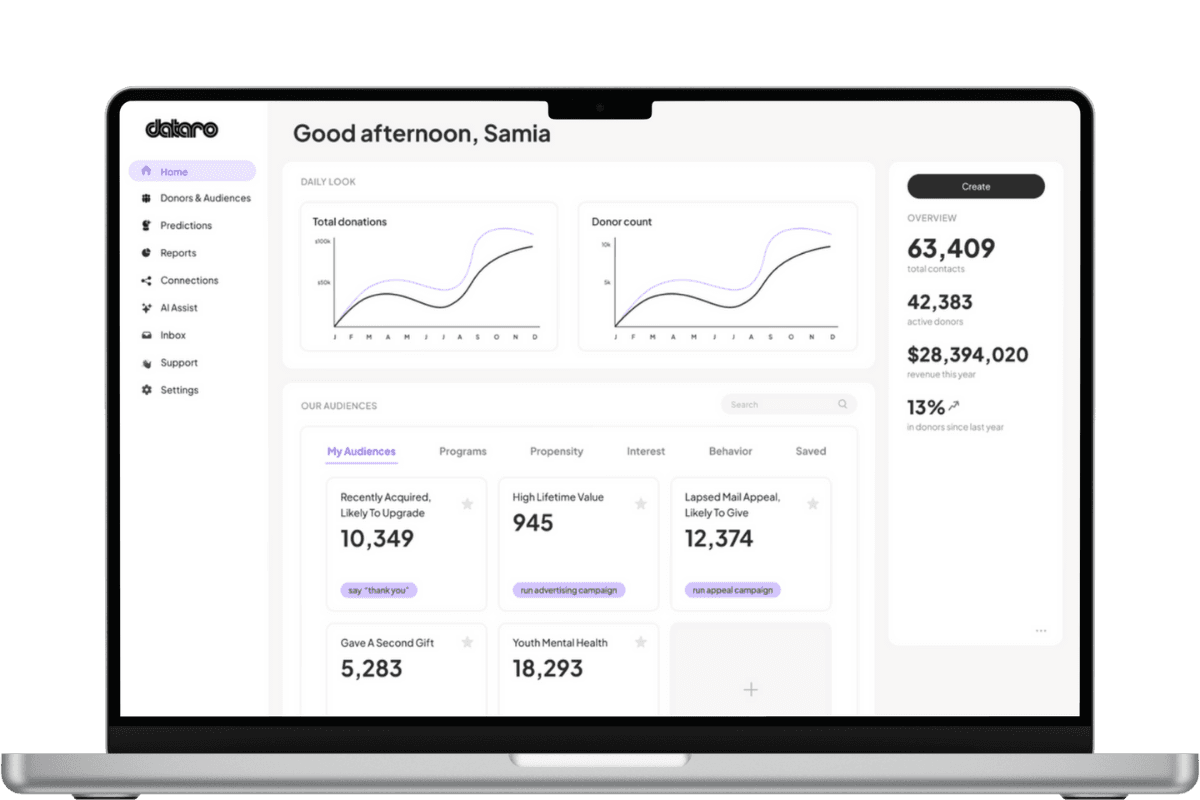
This is where Dataro fits. Dataro is not a CRM. It reads your donor data, ranks records with propensity scores and pushes next actions back into your CRM as audiences, tasks and fields. Your software team keeps one system of record and adds a workflow that fundraisers can run without changing tools.
Dataro is CRM-agnostic and works from a standard data export, so it supports Salesforce, Blackbaud, Dynamics, Bloomerang, Virtuous, DonorPerfect and most other fundraising databases. Outputs are inspectable and explainable, which keeps cutoffs easy to justify to stakeholders.
A simple workflow to put in place
Keep your CRM as the system of record
Connect a predictive layer that ranks every donor
Set clear cutoffs for who to focus on
Push next actions back into the CRM for the team to run
Measure lift, then repeat each cycle
Most teams can stand this up in weeks, not quarters, because it adds a layer rather than replacing a system.
Key takeaways
No CRM is truly "best" for donor insights on its own; most are systems of record
A real donor insights workflow ranks donors and assigns next actions, not just reports
Evaluate CRMs on data access, sync, security and integration quality
Pair your CRM with a predictive layer to get ranked actions without switching systems
Conclusion
Nonprofit software teams do not need to chase a CRM that promises to do everything. Pick the system of record that fits your data and integration needs, then add a predictive layer that turns that data into ranked actions. That split gives fundraisers clear priorities and keeps your stack stable and easy to maintain.
Related articles
Find more nonprofit fundraising and data insights from the Dataro team.