Dataro vs competitors: how the predictive layer changes fundraising
General
Every fundraising team faces the same two questions before a campaign goes out: who should we focus on, and what should we do for each of them? The tools you choose shape how confidently you answer both.
Most software helps with part of the picture. Your CRM stores the data. Your marketing platform sends the touches. Wealth screening tells you who has capacity. But none of them tell you what to do next, across every program, in a way your team can run this week.
That gap is where Dataro sits. This post walks through how Dataro compares to the tools fundraisers already use, and where a predictive layer changes the work.
The problem most tools leave unsolved
Fundraising has changed. Costs are up. Teams are flat. Donors are harder to predict. So the safe default becomes "send more people" or "use last year's segments," even when everyone knows it isn't precise.
That guesswork is expensive. Fundraisers spend hours pulling lists, negotiating exclusions and trying to defend where to draw the line. Approvals get slower because the cutoffs are hard to explain.
Most tools weren't built to fix this. They were built to store data, send touches or screen for wealth. The decision about who to prioritize and what to do next still falls back on manual segmentation and gut feel.
What Dataro does differently
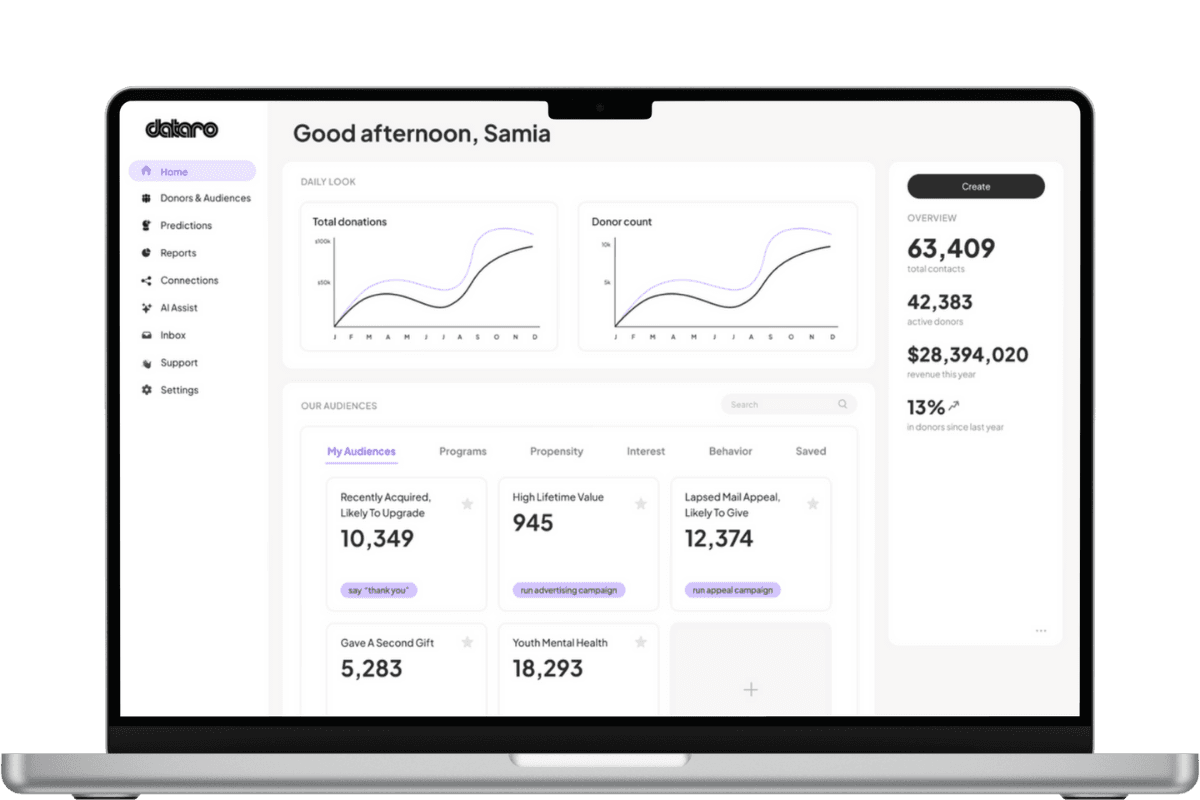
Dataro sits on top of your CRM and turns your data into ranked lists, clear cutoffs and a recommended next action on each record. It doesn't replace your systems. It adds a predictive layer that answers two questions:
Who should we focus on?
What should we do next, across every program?
The output isn't another dashboard to interpret. It's execution-ready: audiences, tasks, tags and lists that land back in the tools you already use. You predict, act, measure and repeat.
Dataro vs CRMs
CRMs like Salesforce, Blackbaud, Bloomerang and Virtuous are systems of record. They hold your constituent data and history. Many now offer AI as an add-on.
The difference is what happens with the data. A CRM stores it. Dataro reads it and returns ranked actions across programs, without asking your team to change systems. You keep your CRM. Dataro makes the data work harder.
Dataro vs wealth screening and prospect research
Tools like iWave, Windfall, DonorSearch and Hatch enrich records and screen for capacity. They answer one question well: who has the means to give.
But capacity isn't the same as propensity. A donor with high net worth may have no intention of giving to you. Automated wealth screening tells you who could give. Dataro's predictive scoring tells you who is likely to, when to reach them and what to do next.
Dataro drives cross-program decisioning. It moves beyond "who has capacity" into who to prioritize, in what order, with which ask. Wealth data becomes one signal among many, not the whole story.
Dataro vs predictive point solutions
Some tools position themselves as predictions plus automation. The models may be sound, but the outputs often stall before they reach the team.
Dataro is built to be workflow-real. The differences show up in three places:
Workflow fit: outputs your team can use next week, not model scores that need translating
Multi-program: appeals, retention, mid-value, major gifts, legacy and content, not a single use case
Measurable: lift tied to real outcomes, not model accuracy claims
A prediction only matters if someone acts on it. Dataro is designed to make the next step easy to run.
Dataro vs digital fundraising platforms
Platforms like Classy, Fundraise Up and Engaging Networks optimize channels. They improve forms, peer-to-peer pages and email performance.
They're good at making a single channel convert. Dataro works one level up. It coordinates who to contact and what to do next across your whole donor file and every program, then feeds those audiences into the channels you already run.
Dataro vs agencies
Agencies like Moore, RKD and Pursuant bring services-led strategy and execution. They can be valuable partners.
The difference is where the capability lives. Agency work often resets with each campaign. Dataro builds a repeatable decision rhythm inside your team, with measurable outcomes you own. It compounds in-house capability rather than renting it.
How Dataro handles the everyday work
Beyond the head-to-head comparisons, here's how the predictive layer shows up across common fundraising jobs:
Predictive donor scoring: propensity scores that rank your file, so you mail fewer people with confidence
Segmentation and audience building: donor-level prioritization instead of coarse buckets from last year
Personalized content and ask amounts: the right ask ladder for each record, not one message for a segment
Prospect research: wealth signals used alongside propensity, not in place of it
Next-best-action recommendations: a clear step on each record, assigned to an owner and a workflow
Recurring giving conversion: finding the single-gift donors most likely to become monthly supporters
Campaign ROI and targeting: tighter cutoffs that cut mail volume and protect net revenue
Data enrichment and profiling: richer records that sharpen every future decision
Each of these ladders back to the same two questions: who to focus on, and what to do next.
What changes when the guesswork goes
The goal isn't more activity. It's fewer, better decisions. When targeting runs on propensity scores instead of gut feel, three things shift.
You target with more precision. You mail fewer people and protect results, rather than over-mailing to feel safe. You free up capacity, because the manual list-pulling and exclusion debates shrink.
Approvals move faster too. When a cutoff is clear and easy to justify, leaders can sign off without a debate.
Choosing the right fit
Here's a simple way to think about it:
Need a system of record? That's your CRM.
Need to send touches at scale? That's marketing automation.
Need wealth data on major-gift prospects? That's screening.
Need to know who to focus on and what to do next, across every program? That's the predictive layer.
Most teams already have the first three. What's missing is the layer that turns all of it into ranked actions.
See it on your own data
Comparisons only go so far. The clearest test is running Dataro against your own file and seeing the ranked lists it returns.
Book a working session or run a small pilot. You'll see who's highly ranked, who's not on your list and what to do next, in outputs your team can act on right away.
Related articles
Find more nonprofit fundraising and data insights from the Dataro team.