The environmental co-benefit of precision fundraising: mailing fewer donors cuts paper and postage waste

Salvatore Salpietro
General

Precision targeting lets nonprofits mail fewer donors, protect appeal income and cut paper and postage waste in the process.
Most fundraising leaders already talk about cutting mail waste. But when they say it, they usually mean wasted budget: packs sent to donors who were never going to respond. That is the right instinct. There is also a second kind of waste sitting underneath it, and few teams have claimed it.
Every pack you didn't need to send is paper you didn't print and postage you didn't buy. Mail fewer people with confidence and you save money first. You cut physical waste second. For environmental-cause charities, whose mission and mailing habits can feel at odds, that second benefit matters more than most.
This is a case for precision, not for mailing less to feel virtuous. Lead with results and ROI. Treat the environmental win as the supporting benefit it is.
Over-mailing is the expensive default
Costs are up. Teams are flat. Donors are harder to predict than they were a few years ago. So when planning an appeal, the safe move becomes "send more people" or "use last year's segments," even when everyone knows the cutoff is a guess.
That guesswork is costly. Fundraisers spend hours pulling lists and negotiating exclusions. Approvals slow down because no one can defend where the line was drawn. And the file keeps growing, because adding names feels safer than trimming them.
The result is more paper, more print, more postage and more contact with donors who won't give. The waste is both financial and physical.
Precision is the strategy
The fix is not to mail less out of fear. It is to mail fewer people with more confidence, then protect the income you would otherwise put at risk.
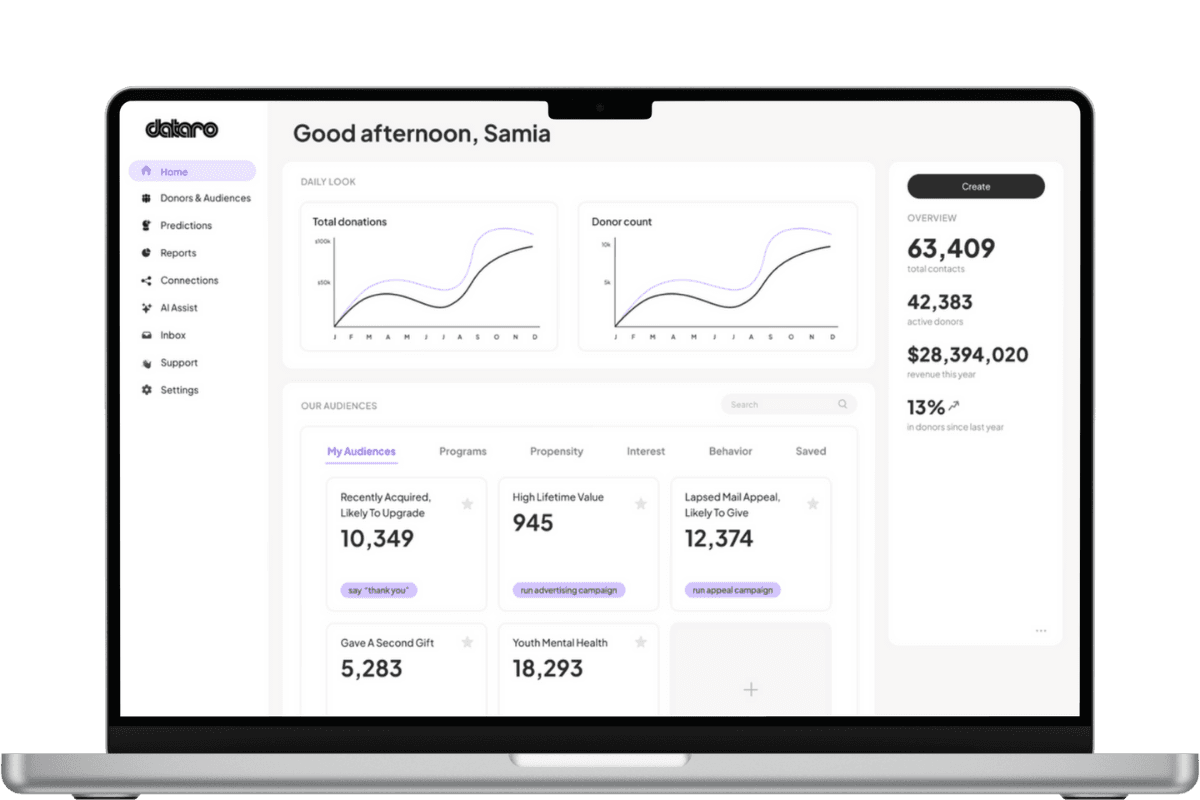
Dataro sits on top of your CRM and turns your data into ranked lists, clear cutoffs and a recommended next action on each record. Instead of arguing over segments, you work from propensity scores and expected mail ROI. That lets you set a cutoff you can explain and trim the file without guessing at what you're giving up.
Fewer, better touches. A shorter list your team can approve. And a smaller print run as a direct consequence.
The proof
Three campaigns show what happens when teams tighten the file instead of expanding it.
The Baker Institute mailed 8,000 fewer packs and raised $489,612, up 70% year over year. Fewer packs, more income.
UNICEF Australia mailed 15,000 fewer donors, saved $30,000 in mail costs and grew net appeal income 26%. The savings and the results moved in the same direction.
Bat Conservation International sent 2,300 fewer letters, saved $5,300 and beat its target by 160%. A smaller, sharper file outperformed the broad one.
In each case the headline is precision and income. The paper, print and postage those teams didn't spend is the co-benefit riding underneath.
Frame the environmental win correctly
For environmental-cause charities, the tension is real. It is hard to campaign on sustainability while mailing tens of thousands of packs that end up in the bin. Precision targeting eases that tension without asking you to trade away income.
Still, frame it in the right order. Lead with precision and ROI, because that is what protects the program and wins internal approval. Present the reduction in paper and postage as a secondary, supporting win. It is genuine, and it is easier to claim once the financial case is already made.
Practical takeaways
Start with ranked actions and expected mail ROI, not last year's segments. Let the data set the cutoff.
Set a cutoff you can explain to stakeholders, so approvals move faster and the trimmed file holds up under scrutiny.
Measure both outcomes: net income protected or grown, and packs, paper and postage saved. Report the financial result first and the environmental result alongside it.
Treat each appeal as a chance to sharpen the file further. Fewer, better touches compound over time.
The bottom line
Mailing fewer donors is not a sacrifice when the list is ranked. Baker, UNICEF Australia and Bat Conservation International all cut volume and protected or grew income. The paper and postage they saved came free with the strategy.
If you want to see how many fewer donors you could mail while protecting income, book a short data review or pilot scoping call. We'll look at your file and show you where a defensible cutoff sits.
Related articles
Find more nonprofit fundraising and data insights from the Dataro team.