Baker Institute
Baker Institute mailed 8,000 fewer packs and lifted tax appeal revenue 70% on a smaller file
Rising costs and an aging donor file forced a hard choice: keep mailing for volume, or get more precise about who to contact, when, and how.
Rising costs made “mail more to feel safe” harder to defend
Baker Heart and Diabetes Institute relies on public appeals to help fund research and prevention work.
By 2024, the appeal environment had tightened. Campaign costs were rising, and the donor file was aging. The old logic that a bigger mail file was a safer result was getting harder to justify.
The team needed a way to protect ROI without turning the appeal into a risky experiment.
The 2024 Tax Appeal shifted from volume-first to audience-first decisions
For the 2024 Tax Appeal, Baker Institute moved from a gross-revenue, high-volume mailout mindset to an audience-first approach.
Instead of treating the appeal as one campaign with one message, the team set out to:
Prioritize net return.
Match channel to supporter behavior.
Use targeted phone outreach to re-engage supporters most likely to come back.
Dataro supported the shift by helping the team make clearer decisions about who to focus on, who to engage right now, and what to do next.
The appeal ran as an omnichannel operating rhythm inside the existing stack
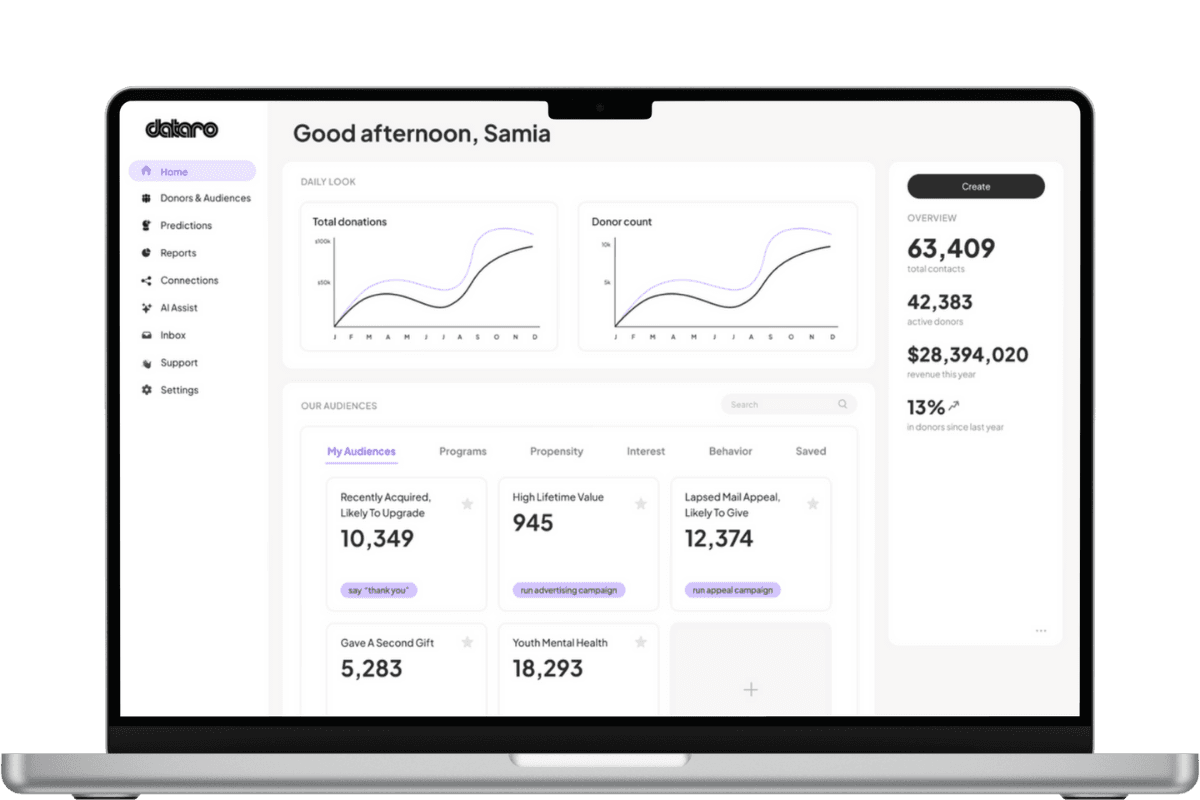
Baker Institute used Dataro as a decision layer on top of its CRM so the appeal could run as an operating rhythm, not a one-off list pull.
Where it lives:
On top of the existing CRM and fundraising stack.
What it produces:
Ranked donor audiences based on likelihood to give or reactivate.
Channel recommendations for mail, email, and phone.
Personalized ask guidance.
Campaign sizing guidance to find the point where extra volume starts to dilute ROI.
How teams act:
Focus: concentrate direct mail on higher-propensity supporters most likely to respond by mail.
Engage: move lower-propensity or email-engaged supporters into an email-only stream.
Next: run a targeted telemarketing program to re-activate lapsed and long-lapsed donors most likely to return.
This reduced wasted outreach while keeping the campaign multi-channel and supporter-centered.
Results improved because the team mailed less and acted with more confidence
The 2024 Tax Appeal became Baker Institute’s strongest ROI performance on record.
By using Dataro’s propensities, channel recommendations, ask amounts, and campaign size tools, we were able to reduce wasted outreach, re-engage high-propensity lapsed donors through telemarketing, and maximise the effectiveness of every touchpoint.

Braden Spencer
General Manager of Fundraising @ The Baker Institute
Appeal performance:
Raised $489,612, up from $273,588 the prior year (a 70% increase).
Reduced direct mail volume by 8,000 packs.
Increased direct mail average gift by $40.
Lifted direct mail response rate by 4%.
Reactivation results:
Reactivated 121 lapsed donors (4.7% response rate).
Reactivated 150 long-lapsed donors (7.55% response rate).
Replicate the precision playbook before your next appeal goes out the door
Set a precision goal, not a volume goal.
Define what “better” means (ROI, net return, response rate, or cost per response).Build a channel strategy around behavior.
Use channel recommendations to separate mail-first vs email-first audiences.Right-size the mail file.
Find the point where adding more names costs more than it returns, and cut confidently.Create a lapsed reactivation lane.
Treat reactivation as its own motion, with phone outreach reserved for highest-potential supporters.Close the loop post-campaign.
Use results to refine the next cycle’s thresholds, audiences, and asks.
See what precision could unlock in your next appeal
If your appeal costs are rising and your team is under capacity pressure, a short working session can map where precision will improve ROI fastest: audience size, channel mix, and reactivation.
About the charity
Organization Type
Health & Human Services
Region
Australia
Read our recent articles
Insights, case studies, and practical guides for nonprofit fundraising teams.