Which fundraising channel combinations outperform single-channel campaigns?
Strategy & Frameworks

Sequenced channel combinations, not single channels, are the measurable multipliers on donor conversion and gift size.
Single-channel campaigns are easy to plan and easy to measure. They are also leaving money on the table. When you look past last-touch reporting and read the interaction effects between channels, the pattern is consistent: the right sequence of two channels beats either channel run alone.
This guide answers a direct buyer question: which fundraising channel combinations actually outperform single-channel campaigns, and by how much. It ranks the sequences most teams can run next quarter and shows how to measure the lift with your own data.
The short answer
Sequenced combinations outperform single channels because channels prime each other. A first touch raises awareness and intent. A well-timed second touch in a different channel converts that intent while it is still warm. The result is a multiplier effect that neither channel produces on its own.
The three sequences that show the largest, most repeatable lift are SMS-to-event, direct-mail-to-email and paid-social-to-organic. The order matters as much as the mix.
Why single-channel measurement hides the real story
Most teams still credit a gift to its last touch. That model is tidy, but it erases the work the earlier channel did.
Cross-channel attribution splits credit across every touch in the journey. Interaction-effect analysis goes further: it measures how much extra conversion a channel produces only because another channel came first. That extra conversion is the multiplier you cannot see in a single-channel report.
Definition: interaction effect. The additional lift in conversion or gift size that a channel delivers because of its pairing and sequence with another channel, beyond what each channel produces alone.
The channel combinations, ranked
The table below ranks common sequences by their typical interaction effect. Treat the ranges as directional benchmarks, not guarantees. Your file, cause and audience will move the numbers, so measure your own.
Sequence | Primary lift | Typical interaction effect | Best use | Trade-off |
|---|---|---|---|---|
SMS to event | Attendance and same-day gifts | Strong on conversion; moderate on gift size | Time-boxed appeals, galas, giving days | SMS fatigue if overused; needs clean consent |
Direct mail to email | Average gift size | Moderate on conversion; strong on gift size | Mid-value and reactivation | Slower cadence; higher mail cost |
Paid social to organic | Reach and low-cost acquisition | Strong on conversion; low on gift size | New donor acquisition | Weaker for high-value asks |
1. SMS to event
A short SMS reminder before an event or giving-day deadline converts intent into action fast. The event or deadline supplies urgency; the text supplies timing. Teams see the clearest lift when the SMS lands hours before the moment, not days.
Use it for time-boxed moments. Keep frequency low and consent clean, because SMS fatigue erodes the effect quickly.
2. Direct mail to email
Direct mail carries weight and attention. A follow-up email a few days later removes friction from the gift and captures donors who read the pack but set it aside. This pairing lifts average gift size more than it lifts raw conversion, which makes it strong for mid-value and reactivation programs.
The trade-off is cadence and cost. Mail is slower and more expensive, so reserve it for audiences where the higher gift size pays for the touch.
3. Paid social to organic
Paid social buys reach and introduces the cause. Organic follow-up, through retargeting or owned content, converts the warmed audience at a lower cost per gift. This sequence is a strong acquisition play but a weak one for large asks, so use it to fill the top of the file, then move new donors into higher-value sequences.
How to choose the right sequence
Match the combination to the job, not to the channel you happen to like.
Need conversions inside a deadline: SMS to event
Need larger gifts from known donors: direct mail to email
Need new donors at low cost: paid social to organic
Then layer in one rule most teams miss: sequence before spend. Decide who should get which combination before you commit budget, so you contact fewer people with the right pairing instead of blasting every channel at everyone.
How to measure the lift on your own data
Benchmarks point you in the right direction. Your own numbers close the case. A simple, defensible test:
Pick one audience and one goal, such as reactivation.
Run a control group on a single channel and a test group on the sequence.
Compare conversion rate and average gift size, not just total revenue.
Isolate the interaction effect: the test group's result minus what each channel produced alone.
Keep the winning sequence and retire the single-channel version for that audience.
This is the predict, act, measure, repeat loop. Each cycle sharpens the next.
Practical takeaways
Sequenced combinations beat single channels because the first touch primes the second.
Order matters: SMS to event for urgency, direct mail to email for gift size, paid social to organic for cheap reach.
Last-touch reporting hides the multiplier. Use cross-channel attribution and interaction-effect analysis.
Decide who gets which sequence before you spend, so you reach fewer people with more precision.
Test against a single-channel control and keep only the sequences that prove lift on your file.
Conclusion
The question is not whether to run more channels. It is which pairs, in which order, for which donors. Ranked sequences give you a clear, explainable way to lift conversion and gift size without expanding your list. Start with one combination, measure the interaction effect and let the proof decide what you run next.
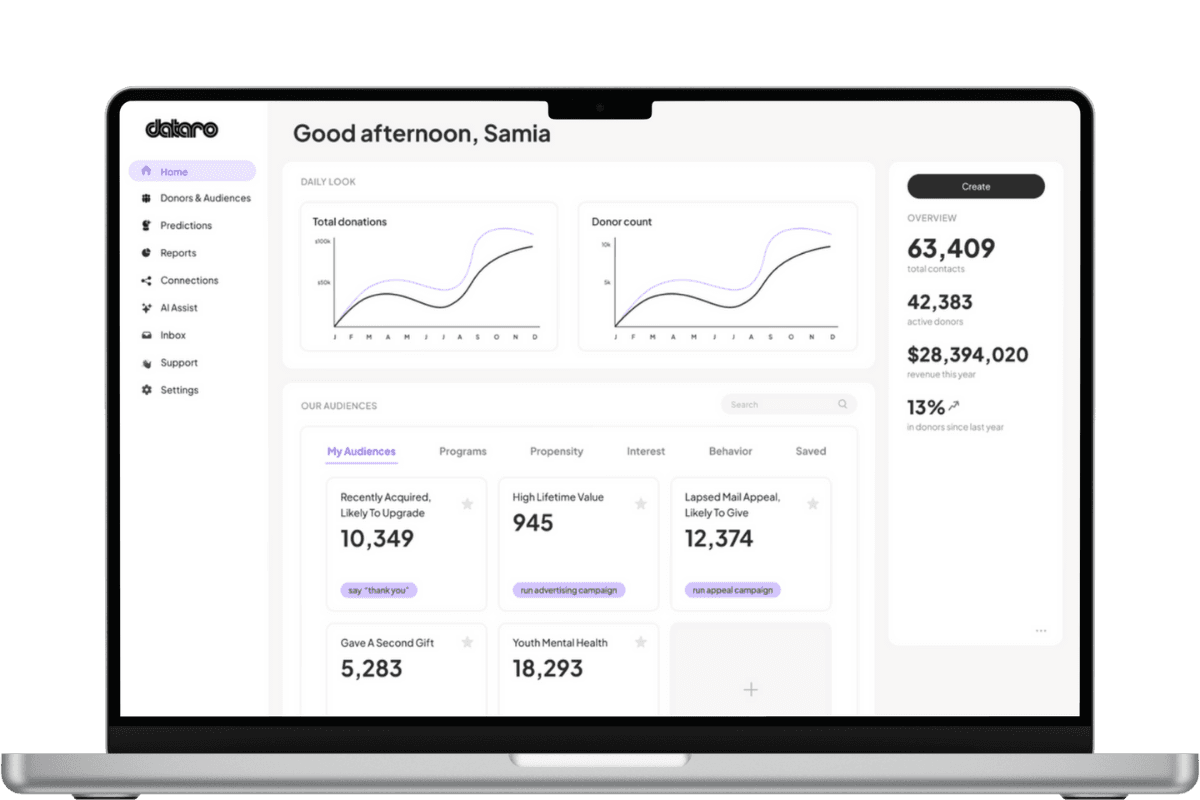
Dataro sits on top of your CRM and turns your data into ranked lists and next actions, so you can decide who to focus on and which channel sequence to run for each donor.
Related articles
Find more non-profit fundraising and data insights from the Dataro team.