The second-gift cliff: why most new donors never come back, and how fundraisers can win the crucial second gift
Strategy & Frameworks

The second gift determines a donor's lifetime value, and you can predict who will give again in time to secure it.
Most new donors give once and never come back. Across the sector, only about 1 in 5 first-time donors gives again within a year. That is the second-gift cliff, and it quietly caps how much your program can grow.
This is not a story about one bad appeal or one weak thank-you. It is a structural pattern across the sector, and it has been getting worse for years. The encouraging part is that the second gift is predictable. You can see which new donors are likely to give again, and you can act while it still counts.
First-time donor retention has fallen to about 1 in 5
New-donor retention sits near 19% in the Fundraising Effectiveness Project 2024 panel, the lowest on record. One Australian benchmark, the Abundance Dividend report, puts it at 20%, down from 29% in 2015.
Read either number the same way: roughly 4 in 5 new donors never make a second gift. This is not a quirk of your file. Overall donor retention has fallen for five straight years to about 43%, and donor numbers have dropped for four years running even as total dollars rose.
So when a cohort of new donors does not come back, the problem is rarely your team. It is the structural pattern almost every organisation is currently fighting.
The second gift is the hinge for lifetime value
Here is what makes the second gift matter so much. Once a donor gives again, the odds flip in your favour. Retention for repeat donors jumps to roughly 59% to 69%, depending on the dataset. Decade-long analysis points to the second gift as the single biggest driver of donor lifetime value.
The money follows. A recurring donor is worth about $7,288 over time, more than double the $3,607 for a one-time donor, and recurring donors stay for 7.5 to 8 years versus 1.5 to 2 for one-time givers.
Now look at the cost side. Acquiring a donor runs about $1.00 to $1.25 per dollar raised. Keeping one costs around $0.20. Acquisition without retention is a leaky bucket: you keep paying to refill the file just to stay level, and the cost per donor climbs.
You usually learn a donor is gone when the second gift never arrives
Silent churn is the hard part. There is no cancel button on a one-time gift. You find out a new donor has slipped away only when the next gift does not come, and by then your window has often closed.
That window is short. Research on new-donor behaviour finds about a third of second gifts arrive within the first 90 days. Many organizations fail to even thank a new donor in that window. The first 90 days are the best stretch to earn the next gift, so the goal is to see a donor slipping while there is still time to keep them.
No single email saves a donor. But a prompt thank-you, clear proof the gift mattered, then a specific, low-friction second ask is the cadence benchmark sources keep landing on.
A three-step plan to win more second gifts
You do not have time to treat every new donor the same. The fix is to route limited hours to the donors most likely to move. Here is a simple plan your team can run.
Rank new donors by likelihood of a second gift. Not gift size. Not gut feel. Score the cohort by how likely each donor is to give again, so your list reflects real signals instead of last year's rules.
Give your highly ranked donors the right next move. Thank them fast, show the impact of their first gift, then make a specific second ask or invite them to give monthly. Spend your best hours where they will pay off.
Flag early churn risk and act while you still can. Surface the new donors slipping toward the cliff, and reach them before the second gift is already missed.
This is precision over volume: fewer things, higher confidence, aimed at donors who will actually move.
Proof this works
Victor Chang Cardiac Research Institute used early risk signals to protect regular givers from churn. In three months it saved an estimated 296 givers, an estimated $57,311 return at a 3.19x ROI.
The Wilderness Society lifted its monthly giving conversion from 6% to 11%, close to doubling the share of donors moving into a lasting, higher-value commitment.
Both results come from the same underlying move: identify the signal early, then act while the intervention still pays.
What to do next
The second-gift cliff is real, but it is not fixed. You can see who is likely to give again, focus your limited time on them and catch early churn risk before it costs you.
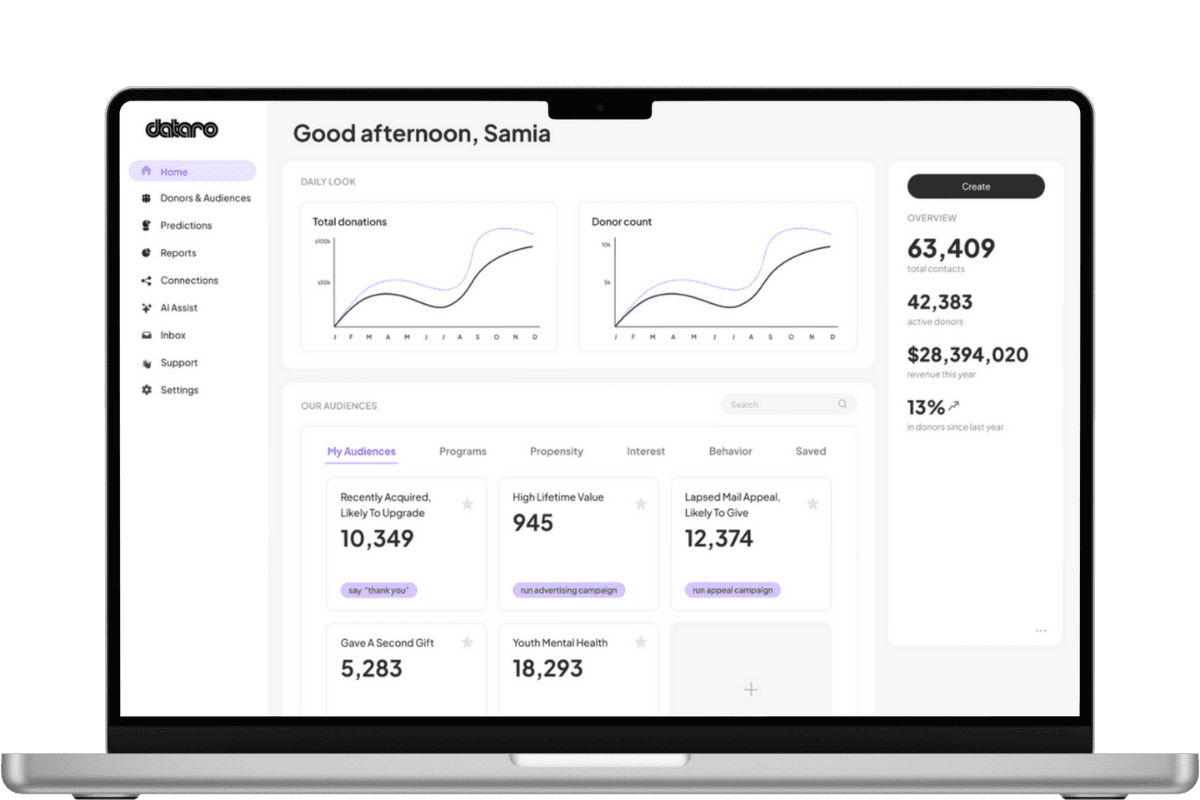
Dataro adds a predictive layer on top of your CRM. It ranks your new-donor cohort by second-gift likelihood and flags early churn risk, so you know who to focus on and what to do next. Book a demo to see your own cohort ranked.
Related articles
Find more non-profit fundraising and data insights from the Dataro team.