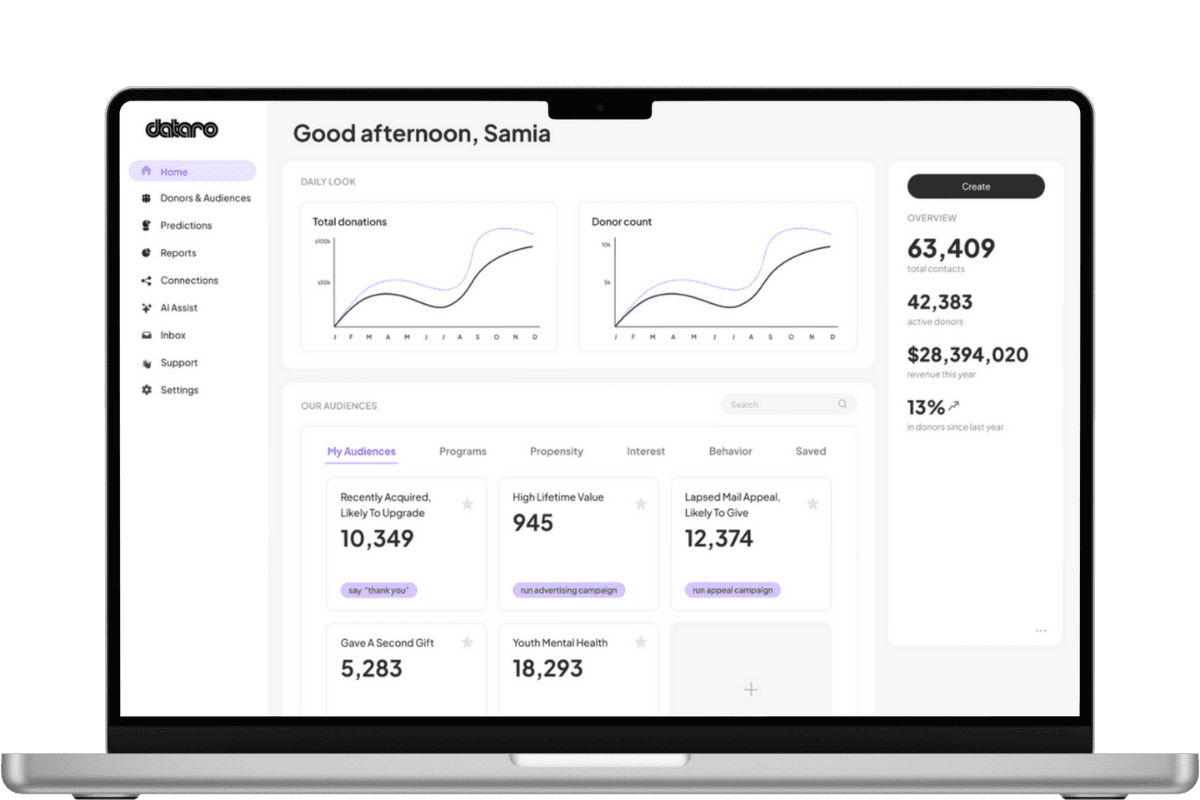
Audience Simulator
Traditional targeting leaves high-intent donors off the list.
Most targeting runs on wealth screening, RFM or a single org’s data. Try the models to see how Dataro ranks the same donors by propensity and intent, and who the old methods leave behind.
How to use the tool: Choose a model to compare rankings.
No model
Wealth screening
RFM
Single-org model
Dataro
The takeaway
The ranking method determines who makes the list.
The simulator holds contact volume steady and changes only the ranking method. That isolates the real targeting decision: which donors make the list when the budget cannot cover everyone.
Wealth screening estimates who has financial capacity. RFM summarizes who gave before. A single-org model learns from one organisation’s history. Dataro ranks who is most likely to act now by combining propensity and intent.
That ranking gives the team a smaller, higher-confidence audience. It turns the next campaign, appeal, or program into a clearer decision about who to focus on and what to do next.
Method comparison
Each method sees a different part of donor readiness.
Many teams already use RFM, wealth screening, or both. Those methods are useful.
The difference is the question each approach can answer and the donors it can still miss.
Wealth screening
Good at
Estimating financial capacity and identifying people who may be able to give more.
Where it falls short
Capacity is not the same as readiness. A wealthy donor may still have low interest in the next ask.
What it can miss
Donors with strong intent whose wealth signals are limited, old, or unavailable.
RFM
Good at
Summarising recent, frequent, and higher-value giving in a simple score.
Where it falls short
It describes past transactions and can over-rank donors whose previous behaviour has cooled.
What it can miss
People with current intent that is not visible in their last gifts alone.
Single-org models
Good at
Learning patterns specific to one organization’s file and fundraising history.
Where it falls short
It can only learn from the volume, variation, and outcomes in that one file.
What it can miss
Broader patterns that can improve confidence when local data is sparse.
Good at
Ranking each donor’s propensity to take a specific action and surfacing intent.
Where it falls short
It depends on connected donor data and a clearly defined fundraising objective.
What it can miss
No model removes uncertainty. The advantage is a clearer priority order, not a promise that every prediction converts.
Customer results
Sharper rankings help teams raise more while contacting fewer donors.
When the ranking gets sharper, teams can contact fewer people and still improve the result.
Bat Conservation International
UNICEF Australia
Integrations
Dataro adds predictive ranking without replacing your CRM.
Dataro sits on top of your CRM and existing donor data as a predictive layer. It adds ranked recommendations without asking your team to replace the systems or workflows already in place.
" height="75px" id="kZOQbh8_a" transform="translate(0 0)" width="94px"/></g></svg>)
" height="75px" id="p3jumYVH1" transform="translate(0 -0.5)" width="75.00000066765324px"/></svg>)
"/><stop offset="1" stop-color="rgb(109, 55, 205)"/></linearGradient><radialGradient cx="0.49924999999999997" cy="0.022522379840128195" gradient-transform="translate(0.49924999999999997, 0.022522379840128195) scale(1 1) translate(-0.49924999999999997, -0.022522379840128195)" id="ecA4NzQo9-2744717908-radial-gradient" r="0.7709490004958496"><stop offset="0" stop-color="rgba(87, 80, 226, 0)"/><stop offset="1" stop-color="rgb(75, 32, 160)"/></radialGradient><radialGradient cx="0.38125" cy="0.7152831246595098" gradient-transform="translate(0.38125, 0.7152831246595098) scale(1 1) translate(-0.38125, -0.7152831246595098)" id="RfO_XLuuK-2744717908-radial-gradient" r="0.7531266497329884"><stop offset="0" stop-color="rgba(39, 100, 231, 0)"/><stop offset="1" stop-color="rgb(172, 128, 255)"/></radialGradient><linearGradient id="prwVoTzFJ-2744717908-linear-gradient" x1="0.49748743718592964" x2="0.5025125628140703" y1="1" y2="0"><stop offset="0" stop-color="rgb(32, 82, 203)"/><stop offset="1" stop-color="rgb(189, 150, 255)"/></linearGradient><linearGradient id="w0jJ8u8rE-2744717908-linear-gradient" x1="0" x2="1" y1="0.4975124378109453" y2="0.5024875621890547"><stop offset="0" stop-color="rgba(54, 122, 242, 0)"/><stop offset="1" stop-color="rgb(111, 232, 245)"/></linearGradient><linearGradient id="X6RBhePrO-2744717908-linear-gradient" x1="0.49751243781094523" x2="0.5024875621890548" y1="0" y2="1"><stop offset="0" stop-color="rgb(206, 176, 255)"/><stop offset="1" stop-color="rgb(72, 148, 254)"/></linearGradient></defs><g fill="transparent" height="75px" id="bmb_PvC7S" width="75px"><path d="M 0 0 L 75 0 L 75 75 L 0 75 Z" fill="transparent" height="75px" id="gPe8n7dGi" width="75px"/><g fill="transparent" height="75px" id="WOUvmaNTT" width="75px"><path d="M 0 0 L 75 0 L 75 75 L 0 75 Z" fill="transparent" height="75px" id="XEvlEL2IC" width="75px"/><path d="M 0 6.756 C 0 1.16 3.745 -0.24 7.813 0.032 C 36.688 1.961 62.5 10.516 62.5 21.505 L 62.5 55.362 C 62.5 50.106 57.192 45.712 48.969 42.269 C 47.72 41.747 46.878 40.543 46.878 39.191 L 46.878 28.134 C 46.878 21.807 44.223 19.155 39.066 17.68 C 33.907 16.205 31.247 17.839 31.247 23.651 L 31.247 29.194 C 31.247 33.09 28.706 35.654 24.227 36.385 C 19.748 37.117 15.946 37.551 10.162 38.074 C 4.379 38.597 0 34.879 0 28.586 Z" fill="url(%23mQYpMxKHn-2744717908-linear-gradient)" height="55.36160072118171px" id="mQYpMxKHn" transform="translate(6.25 0)" width="62.5px"/><path d="M 0 6.756 C 0 1.16 3.745 -0.24 7.813 0.032 C 36.688 1.961 62.5 10.516 62.5 21.505 L 62.5 55.362 C 62.5 50.106 57.192 45.712 48.969 42.269 C 47.72 41.747 46.878 40.543 46.878 39.191 L 46.878 28.134 C 46.878 21.807 44.223 19.155 39.066 17.68 C 33.907 16.205 31.247 17.839 31.247 23.651 L 31.247 29.194 C 31.247 33.09 28.706 35.654 24.227 36.385 C 19.748 37.117 15.946 37.551 10.162 38.074 C 4.379 38.597 0 34.879 0 28.586 Z" fill="url(%23ecA4NzQo9-2744717908-radial-gradient)" height="55.36160072118171px" id="ecA4NzQo9" transform="translate(6.25 0)" width="62.5px"/><path d="M 0 6.756 C 0 1.16 3.745 -0.24 7.813 0.032 C 36.688 1.961 62.5 10.516 62.5 21.505 L 62.5 55.362 C 62.5 50.106 57.192 45.712 48.969 42.269 C 47.72 41.747 46.878 40.543 46.878 39.191 L 46.878 28.134 C 46.878 21.807 44.223 19.155 39.066 17.68 C 33.907 16.205 31.247 17.839 31.247 23.651 L 31.247 29.194 C 31.247 33.09 28.706 35.654 24.227 36.385 C 19.748 37.117 15.946 37.551 10.162 38.074 C 4.379 38.597 0 34.879 0 28.586 Z" fill="url(%23RfO_XLuuK-2744717908-radial-gradient)" height="55.36160072118171px" id="RfO_XLuuK" transform="translate(6.25 0)" width="62.5px"/><path d="M 46.875 0 C 46.875 9.011 30.334 16.017 9.375 19.477 C 4.1 20.347 0 22.814 0 28.32 L 0 45.137 C 0 53.112 4.8 54.162 10.936 53.112 C 32.965 49.342 46.875 41.596 46.875 33.828 Z" fill="url(%23prwVoTzFJ-2744717908-linear-gradient)" height="53.451964102424256px" id="prwVoTzFJ" transform="translate(21.875 21.505)" width="46.875px"/><path d="M 46.875 0 C 46.875 9.011 30.334 16.017 9.375 19.477 C 4.1 20.347 0 22.814 0 28.32 L 0 45.137 C 0 53.112 4.8 54.162 10.936 53.112 C 32.965 49.342 46.875 41.596 46.875 33.828 Z" fill="url(%23w0jJ8u8rE-2744717908-linear-gradient)" height="53.451964102424256px" id="w0jJ8u8rE" transform="translate(21.875 21.505)" width="46.875px"/><g opacity="0.5"><path d="M 15.625 13.343 C 15.625 19.892 13.337 22.212 7.816 23.786 C 2.993 25.161 0 24.632 0 17.812 L 0 4.442 C 5.783 3.234 11.09 1.741 15.625 0 L 15.625 13.344 Z" fill="url(%23X6RBhePrO-2744717908-linear-gradient)" height="24.397121249644105px" id="X6RBhePrO" transform="translate(37.5 35.373)" width="15.625px"/></g></g></g></svg>)
" height="75px" id="m0cdapsAH" transform="translate(-0.5 0)" width="71px"/></svg>)
"/><stop offset="1" stop-color="rgb(77, 209, 247)"/></linearGradient></defs><g fill="transparent" height="76px" id="ocYL3xNXn" transform="translate(0.5 0)" width="76px"><path d="M 37.998 76 C 16.986 76 0 59.016 0 38.002 C 0 16.984 16.986 0 37.998 0 C 59.014 0 76 16.984 76 38.002 C 76 59.016 59.014 76 37.998 76 Z" fill="url(%23MvfaMy9c5-3798141555-linear-gradient)" height="76px" id="MvfaMy9c5" width="76px"/><path d="M 0 28.088 L 0 0 L 4.954 0 L 4.954 11.774 C 6.403 10.741 8.464 9.709 10.946 9.503 C 19.415 9.087 24.369 15.282 24.369 22.304 C 24.369 29.326 19.415 35.316 11.152 35.316 C 2.888 35.316 0 28.088 0 28.088 Z M 10.74 30.359 C 15.9 30.98 19.826 26.64 19.826 22.51 C 19.826 18.174 16.316 13.633 10.53 14.455 C 8.053 14.871 5.987 16.315 4.954 17.969 L 4.954 26.85 C 6.193 28.499 8.258 30.153 10.74 30.359 Z M 31.183 22.304 C 31.183 20.239 28.706 16.315 28.706 16.315 C 28.088 15.489 28.295 15.284 29.328 15.698 L 38.619 21.688 C 39.445 22.099 39.445 22.511 38.619 22.926 L 29.328 28.915 C 28.295 29.532 28.089 29.121 28.706 28.294 C 31.183 24.575 31.183 22.304 31.183 22.304 Z" fill="rgb(255, 255, 255)" height="35.31593183131471px" id="W8DR7oj3X" transform="translate(21.892 20.445)" width="39.23853284950943px"/></g></svg>)
" height="75px" id="O2HhgW7Gs" width="107px"/><path d="M 0.024 8.746 C -0.043 8.922 0.049 8.958 0.07 8.989 C 0.271 9.135 0.475 9.241 0.681 9.358 C 1.772 9.938 2.803 10.108 3.881 10.108 C 6.075 10.108 7.438 8.939 7.438 7.056 L 7.438 7.02 C 7.438 5.28 5.9 4.648 4.457 4.191 L 4.269 4.13 C 3.181 3.776 2.242 3.471 2.242 2.754 L 2.242 2.716 C 2.242 2.102 2.791 1.65 3.641 1.65 C 4.586 1.65 5.708 1.965 6.431 2.364 C 6.431 2.364 6.642 2.502 6.72 2.296 C 6.763 2.186 7.129 1.2 7.167 1.093 C 7.208 0.977 7.135 0.891 7.06 0.846 C 6.236 0.343 5.095 0 3.916 0 L 3.696 0.002 C 1.687 0.002 0.285 1.217 0.285 2.958 L 0.285 2.995 C 0.285 4.831 1.832 5.426 3.282 5.841 L 3.515 5.913 C 4.571 6.238 5.481 6.518 5.481 7.263 L 5.481 7.299 C 5.481 7.98 4.89 8.487 3.936 8.487 C 3.565 8.487 2.384 8.479 1.108 7.671 C 0.954 7.581 0.864 7.516 0.745 7.444 C 0.683 7.404 0.526 7.336 0.457 7.543 Z M 32.156 8.746 C 32.089 8.922 32.181 8.958 32.202 8.989 C 32.403 9.135 32.607 9.241 32.813 9.358 C 33.904 9.938 34.935 10.108 36.012 10.108 C 38.207 10.108 39.57 8.939 39.57 7.056 L 39.57 7.02 C 39.57 5.28 38.032 4.648 36.588 4.191 L 36.401 4.13 C 35.313 3.776 34.374 3.471 34.374 2.754 L 34.374 2.716 C 34.374 2.102 34.922 1.65 35.773 1.65 C 36.718 1.65 37.84 1.965 38.562 2.364 C 38.562 2.364 38.774 2.502 38.852 2.296 C 38.895 2.186 39.26 1.2 39.299 1.093 C 39.34 0.977 39.266 0.891 39.192 0.846 C 38.367 0.343 37.227 0 36.047 0 L 35.828 0.002 C 33.819 0.002 32.417 1.217 32.417 2.958 L 32.417 2.995 C 32.417 4.831 33.964 5.426 35.413 5.841 L 35.646 5.913 C 36.703 6.238 37.614 6.518 37.614 7.263 L 37.614 7.299 C 37.614 7.98 37.021 8.487 36.067 8.487 C 35.697 8.487 34.516 8.479 33.24 7.671 C 33.086 7.581 32.995 7.519 32.879 7.444 C 32.839 7.418 32.653 7.346 32.589 7.543 Z M 54.092 5.06 C 54.092 6.124 53.894 6.962 53.503 7.554 C 53.118 8.14 52.534 8.425 51.72 8.425 C 50.905 8.425 50.324 8.142 49.944 7.554 C 49.56 6.963 49.365 6.124 49.365 5.06 C 49.365 3.997 49.56 3.161 49.944 2.575 C 50.324 1.995 50.905 1.712 51.72 1.712 C 52.534 1.712 53.118 1.995 53.505 2.575 C 53.894 3.161 54.092 3.997 54.092 5.06 M 55.924 3.088 C 55.744 2.479 55.464 1.941 55.09 1.494 C 54.717 1.045 54.244 0.685 53.683 0.423 C 53.124 0.162 52.462 0.029 51.72 0.029 C 50.976 0.029 50.315 0.162 49.755 0.423 C 49.194 0.685 48.722 1.045 48.347 1.494 C 47.975 1.943 47.695 2.48 47.513 3.088 C 47.335 3.694 47.245 4.356 47.245 5.06 C 47.245 5.763 47.335 6.427 47.513 7.032 C 47.695 7.639 47.974 8.177 48.349 8.625 C 48.722 9.074 49.196 9.433 49.755 9.688 C 50.316 9.943 50.976 10.072 51.72 10.072 C 52.463 10.072 53.123 9.943 53.683 9.688 C 54.243 9.433 54.717 9.074 55.09 8.625 C 55.464 8.178 55.744 7.641 55.924 7.032 C 56.104 6.426 56.194 5.762 56.194 5.06 C 56.194 4.358 56.104 3.694 55.924 3.088 M 70.969 8.141 C 70.908 7.963 70.736 8.03 70.736 8.03 C 70.469 8.132 70.185 8.227 69.884 8.274 C 69.577 8.321 69.24 8.346 68.879 8.346 C 67.992 8.346 67.288 8.082 66.783 7.56 C 66.277 7.038 65.994 6.194 65.997 5.052 C 66 4.012 66.25 3.231 66.7 2.636 C 67.146 2.044 67.826 1.74 68.733 1.74 C 69.489 1.74 70.065 1.827 70.669 2.017 C 70.669 2.017 70.813 2.08 70.882 1.891 C 71.042 1.445 71.161 1.126 71.332 0.636 C 71.38 0.497 71.262 0.438 71.219 0.421 C 70.981 0.328 70.42 0.177 69.996 0.113 C 69.6 0.051 69.137 0.019 68.622 0.019 C 67.852 0.019 67.166 0.151 66.579 0.413 C 65.994 0.674 65.497 1.034 65.104 1.483 C 64.71 1.932 64.412 2.469 64.212 3.077 C 64.014 3.683 63.913 4.348 63.913 5.052 C 63.913 6.574 64.323 7.804 65.133 8.705 C 65.944 9.608 67.161 10.068 68.75 10.068 C 69.689 10.068 70.652 9.877 71.344 9.604 C 71.344 9.604 71.477 9.539 71.419 9.385 Z M 74.175 4.041 C 74.261 3.45 74.425 2.958 74.676 2.575 C 75.056 1.994 75.635 1.675 76.449 1.675 C 77.263 1.675 77.801 1.995 78.186 2.575 C 78.442 2.958 78.554 3.471 78.598 4.041 Z M 80.343 2.742 C 80.188 2.154 79.802 1.56 79.549 1.288 C 79.15 0.858 78.759 0.557 78.372 0.389 C 77.866 0.173 77.26 0.029 76.595 0.029 C 75.821 0.029 75.118 0.159 74.548 0.428 C 73.976 0.696 73.496 1.063 73.12 1.519 C 72.743 1.974 72.46 2.516 72.28 3.131 C 72.099 3.743 72.007 4.41 72.007 5.113 C 72.007 5.829 72.102 6.496 72.289 7.096 C 72.478 7.701 72.78 8.233 73.188 8.674 C 73.595 9.119 74.12 9.467 74.748 9.709 C 75.371 9.951 76.129 10.076 76.999 10.074 C 78.79 10.068 79.733 9.668 80.122 9.453 C 80.191 9.415 80.256 9.348 80.174 9.155 L 79.768 8.018 C 79.708 7.849 79.535 7.911 79.535 7.911 C 79.092 8.076 78.461 8.372 76.99 8.369 C 76.028 8.368 75.315 8.084 74.868 7.64 C 74.409 7.185 74.185 6.516 74.146 5.573 L 80.348 5.579 C 80.348 5.579 80.511 5.576 80.527 5.417 C 80.534 5.35 80.741 4.141 80.343 2.742 M 24.505 4.041 C 24.594 3.45 24.755 2.958 25.007 2.575 C 25.386 1.994 25.965 1.675 26.779 1.675 C 27.593 1.675 28.131 1.995 28.518 2.575 C 28.773 2.958 28.884 3.471 28.928 4.041 Z M 30.672 2.742 C 30.517 2.154 30.133 1.56 29.88 1.288 C 29.48 0.858 29.09 0.557 28.703 0.389 C 28.197 0.173 27.59 0.029 26.926 0.029 C 26.153 0.029 25.449 0.159 24.879 0.428 C 24.307 0.696 23.827 1.063 23.451 1.519 C 23.074 1.974 22.791 2.516 22.611 3.131 C 22.431 3.743 22.338 4.41 22.338 5.113 C 22.338 5.829 22.432 6.496 22.62 7.096 C 22.809 7.701 23.111 8.233 23.519 8.674 C 23.926 9.119 24.45 9.467 25.078 9.709 C 25.702 9.951 26.459 10.076 27.33 10.074 C 29.121 10.068 30.064 9.668 30.453 9.453 C 30.522 9.415 30.587 9.348 30.505 9.155 L 30.101 8.018 C 30.038 7.849 29.866 7.911 29.866 7.911 C 29.423 8.076 28.793 8.372 27.319 8.369 C 26.359 8.368 25.646 8.084 25.199 7.64 C 24.74 7.185 24.516 6.516 24.476 5.573 L 30.678 5.579 C 30.678 5.579 30.841 5.576 30.858 5.417 C 30.864 5.35 31.071 4.141 30.672 2.742 M 11.1 8.107 C 10.857 7.913 10.824 7.865 10.741 7.739 C 10.619 7.549 10.557 7.277 10.557 6.932 C 10.557 6.385 10.737 5.993 11.11 5.729 C 11.106 5.731 11.644 5.264 12.909 5.28 C 13.797 5.293 14.591 5.424 14.591 5.424 L 14.591 8.248 L 14.593 8.248 C 14.593 8.248 13.805 8.417 12.918 8.47 C 11.656 8.547 11.095 8.106 11.1 8.107 M 13.567 3.743 C 13.316 3.725 12.989 3.714 12.599 3.714 C 12.067 3.714 11.554 3.781 11.072 3.911 C 10.587 4.041 10.151 4.244 9.776 4.512 C 9.402 4.78 9.094 5.131 8.877 5.537 C 8.658 5.946 8.546 6.428 8.546 6.969 C 8.546 7.518 8.641 7.996 8.83 8.387 C 9.019 8.779 9.292 9.105 9.639 9.357 C 9.984 9.609 10.409 9.794 10.903 9.905 C 11.389 10.017 11.941 10.073 12.544 10.073 C 13.18 10.073 13.814 10.021 14.428 9.916 C 15.037 9.812 15.783 9.661 15.991 9.614 C 16.136 9.579 16.281 9.542 16.425 9.502 C 16.579 9.464 16.567 9.299 16.567 9.299 L 16.564 3.62 C 16.564 2.374 16.232 1.451 15.578 0.878 C 14.927 0.307 13.968 0.019 12.729 0.019 C 12.264 0.019 11.516 0.083 11.067 0.173 C 11.067 0.173 9.712 0.436 9.155 0.872 C 9.155 0.872 9.033 0.948 9.1 1.119 L 9.539 2.301 C 9.594 2.454 9.741 2.402 9.741 2.402 C 9.741 2.402 9.789 2.383 9.844 2.351 C 11.037 1.701 12.546 1.721 12.546 1.721 C 13.217 1.721 13.732 1.855 14.079 2.122 C 14.418 2.382 14.59 2.774 14.59 3.601 L 14.59 3.864 C 14.25 3.816 13.909 3.776 13.567 3.743 M 63.589 0.543 C 63.636 0.403 63.538 0.336 63.496 0.32 C 63.391 0.279 62.864 0.168 62.457 0.142 C 61.678 0.094 61.245 0.226 60.858 0.4 C 60.474 0.574 60.047 0.854 59.809 1.174 L 59.809 0.418 C 59.809 0.313 59.735 0.229 59.631 0.229 L 58.041 0.229 C 57.938 0.229 57.863 0.313 57.863 0.418 L 57.863 9.682 C 57.863 9.785 57.948 9.871 58.052 9.871 L 59.681 9.871 C 59.785 9.87 59.869 9.786 59.869 9.682 L 59.869 5.054 C 59.869 4.432 59.937 3.813 60.075 3.423 C 60.209 3.039 60.392 2.73 60.617 2.509 C 60.844 2.289 61.102 2.135 61.384 2.048 C 61.672 1.96 61.99 1.931 62.216 1.931 C 62.541 1.931 62.897 2.015 62.897 2.015 C 63.016 2.028 63.083 1.955 63.123 1.847 C 63.23 1.563 63.531 0.713 63.589 0.543" fill="rgb(255, 255, 255)" height="10.107673892120193px" id="oTysaGpg7" transform="translate(15.477 30.14)" width="80.58688445288391px"/><path d="M 29.706 0.211 C 29.508 0.15 29.328 0.108 29.094 0.064 C 28.856 0.021 28.572 0 28.251 0 C 27.129 0 26.245 0.317 25.624 0.943 C 25.007 1.566 24.588 2.514 24.377 3.761 L 24.301 4.181 L 22.893 4.181 C 22.893 4.181 22.722 4.175 22.686 4.361 L 22.456 5.654 C 22.439 5.776 22.492 5.854 22.657 5.854 L 24.027 5.854 L 22.637 13.626 C 22.529 14.252 22.404 14.766 22.265 15.157 C 22.129 15.542 21.997 15.83 21.832 16.041 C 21.674 16.242 21.524 16.392 21.265 16.479 C 21.052 16.551 20.805 16.584 20.535 16.584 C 20.385 16.584 20.186 16.56 20.038 16.529 C 19.892 16.5 19.814 16.468 19.703 16.421 C 19.703 16.421 19.543 16.36 19.479 16.52 C 19.428 16.653 19.062 17.659 19.018 17.782 C 18.976 17.906 19.037 18.002 19.114 18.031 C 19.297 18.095 19.433 18.138 19.681 18.197 C 20.026 18.278 20.317 18.283 20.59 18.283 C 21.16 18.283 21.681 18.202 22.112 18.046 C 22.545 17.889 22.923 17.616 23.259 17.247 C 23.62 16.847 23.847 16.428 24.063 15.856 C 24.278 15.291 24.463 14.589 24.609 13.771 L 26.007 5.854 L 28.049 5.854 C 28.049 5.854 28.221 5.86 28.257 5.672 L 28.488 4.381 C 28.503 4.257 28.452 4.181 28.285 4.181 L 26.302 4.181 C 26.313 4.137 26.403 3.437 26.63 2.78 C 26.728 2.5 26.911 2.273 27.065 2.117 C 27.217 1.965 27.392 1.856 27.584 1.794 C 27.781 1.729 28.005 1.699 28.251 1.699 C 28.437 1.699 28.621 1.72 28.76 1.749 C 28.952 1.791 29.026 1.812 29.077 1.827 C 29.279 1.888 29.307 1.829 29.346 1.731 L 29.821 0.428 C 29.869 0.287 29.749 0.227 29.706 0.211 M 2 13.643 C 2 13.747 1.925 13.831 1.821 13.831 L 0.177 13.831 C 0.073 13.831 0 13.747 0 13.643 L 0 0.388 C 0 0.284 0.073 0.2 0.177 0.2 L 1.821 0.2 C 1.925 0.2 2 0.284 2 0.388 Z" fill="rgb(255, 255, 255)" height="18.282859557720453px" id="txdzBzLaX" transform="translate(34.06 26.171)" width="29.831965304529817px"/></g></svg>)
" height="74.0000010250919px" id="LhEasuP_S" transform="translate(1 0.5)" width="77.99999711739179px"/></svg>)
" height="75px" id="BoVsTyuMs" transform="translate(-0.5 0)" width="70.66509955317883px"/></svg>)
" height="28.71547399132058px" id="Gfqh__JDJ" transform="translate(1.013 0)" width="27.803660147407896px"/><path d="M 15.793 42.85 C 14.889 42.785 14.141 42.126 13.97 41.243 L 8.143 13.948 C 7.775 12.225 6.964 10.625 5.788 9.305 L 0.52 3.393 C -0.07 2.737 -0.168 1.78 0.277 1.019 C 0.686 0.364 1.417 -0.024 2.194 0.001 L 30.965 0.001 C 31.638 0.002 32.267 0.334 32.643 0.887 C 33.022 1.442 33.105 2.146 32.864 2.772 L 17.87 41.553 C 17.582 42.338 16.827 42.859 15.984 42.854 C 15.92 42.857 15.857 42.855 15.793 42.85 Z" fill="rgb(0, 15, 80)" height="42.85539399338424px" id="Js7IthkKF" transform="translate(0 32.145)" width="33px"/></g></svg>)
Dataro complements the targeting tools teams already use.
Answers about how Dataro compares with wealth screening, RFM, and single-org models.
How is Dataro different from wealth screening?
Wealth screening estimates financial capacity. Dataro ranks each donor’s likelihood to take a specific action using propensity and intent. Capacity helps explain who could give, while propensity helps decide who to contact now.
Does Dataro replace RFM?
No. Many teams use RFM, and it remains useful for summarising recency, frequency, and monetary value. Dataro adds a predictive ranking across more signals, which can surface ready donors that historical scoring alone can miss.
How is Dataro different from a model trained on one organization’s data?
A single-org model learns only from the volume, variation and outcomes in that organization’s history. Dataro adds a broader predictive layer to the organization’s own data so the ranking can be more confident when local signals are limited.
Can I use Dataro with my CRM?
Yes. Dataro sits on top of your existing CRM and donor data. It returns ranked recommendations, so your team can keep its current systems and workflows.
What do propensity and intent mean in this simulator?
Propensity is the likelihood that a donor will take a specific action. Intent is evidence that the donor is ready to act now. Dataro uses both to rank who should move to the top of the audience.