Donor Data Enrichment Cost: A Buyer's Guide
Strategy & Frameworks

The true cost of donor data enrichment comes from labour, refresh cadence and integration, not the licence fee alone.
Donor data enrichment looks affordable at signup and gets expensive over time. The advertised price is only one line item. The real bill combines licensing, the labour to match records accurately, how often you refresh the data and the cost to integrate everything into your CRM.
This guide breaks down the complete cost over time across four tool categories: CRM-native add-ons, wealth-screening providers, data-enrichment vendors and predictive platforms. The goal is to help you decide who to focus on and what to do next with a limited data budget.
Donor data enrichment is the work of filling gaps in your donor records
Donor data enrichment adds or corrects information about the people already in your CRM. That can mean appending contact details, giving capacity, age, interests or wealth markers. It also means cleaning duplicate records and fixing information that has gone stale.
Enrichment is not the same as prediction. Enrichment tells you more about a donor, while a predictive layer uses that data to rank who to contact and what to do next.
Four cost drivers shape the real price over time
Most buyers compare license fees and stop there, but four separate drivers determine what you actually pay year after year.
Licensing: the annual fee for the tool, often tied to record count or credits.
Identity-resolution labour: staff time to match, merge and clean records so the data lands on the right donor.
Refresh cadence: how often data is re-run, because data decays and one-time appends go stale.
Integration: the cost to move enriched data into your CRM and keep it in sync.
The first driver is easy to see on an invoice, but the other three are where enrichment budgets quietly expand.
Why does enrichment cost more in year two than year one?
Data decays. People move, change jobs, change phone numbers and pass away. Studies of contact data often cite decay rates near 30% a year, which means a one-time append is worth less each quarter until you pay to refresh it.
Identity resolution is the second hidden cost. When a vendor returns new fields, someone has to confirm the match is correct and merge it without creating duplicates. On a large donor file, that becomes real staff hours during every refresh cycle.
Integration is the third driver. A one-time import is inexpensive, but a two-way sync that keeps records accurate as they change is a continuing cost, paid either in tooling or in labour.
How the four tool types compare on cost over time
Each tool type solves a different problem, so the cost pattern differs too. The table below shows the trade-offs.
Tool type | Licensing | Identity-resolution labour | Refresh cadence | Integration | Best fit |
|---|---|---|---|---|---|
CRM-native add-ons | Low to moderate, bundled with the CRM | Low, matching runs inside the CRM | Varies, often manual | Lowest, data stays in one system | Teams wanting basic cleanup with little setup |
Wealth-screening providers | High, often per record or per batch | High, scores need review and merge | Low, many screen once or once a year | Moderate, results often land as files | Major-gift teams sizing capacity |
Data-enrichment vendors | Moderate, credit or record based | Moderate to high at each append | Moderate, you pay per refresh | Moderate to high, depends on connectors | Teams filling contact and demographic gaps |
Predictive platforms | Moderate, platform fee plus per-donor rate | Low, scoring is automated | High, models re-run on a schedule | Built in, two-way CRM sync | Teams that want ranked actions, not just data |
CRM-native tools keep costs low but often limit what you can append. Wealth screening is powerful for major gifts, yet it carries high labour costs and goes stale quickly. Enrichment vendors fill gaps effectively but bill you for each refresh. Predictive platforms cost more upfront, though they fold refresh and synchronization into a single fee.
What does donor data enrichment actually cost over time?
There is no single number, because pricing depends on your file size and tool mix. You can estimate the real cost, however, with a simple formula.
Total cost over time equals licensing, plus staff hours for identity resolution, plus the cost of each refresh, plus integration and ongoing sync. Calculate that across three years rather than one.
A one-time append may look inexpensive at $0.10 to $0.50 a record. Re-run it yearly to counter decay and the cost roughly triples over three years, before you even count the staff time required to merge it. Wealth screening can run higher per record and still needs a person to interpret and act on the result.
How to control enrichment costs
Price the three-year cost, not the signup fee. Include refresh and labour.
Match the tool to the job. Do not buy wealth screening to fix phone numbers.
Favour automated matching over manual merges to protect staff capacity.
Count integration early. A sync you build once beats files you clean every month.
Enrich fewer records with more value. Precision beats volume here too.
Where prediction changes the math
Enriched data is only valuable if it leads to action, and richer records alone do not tell you who to mail this week or who is about to lapse.
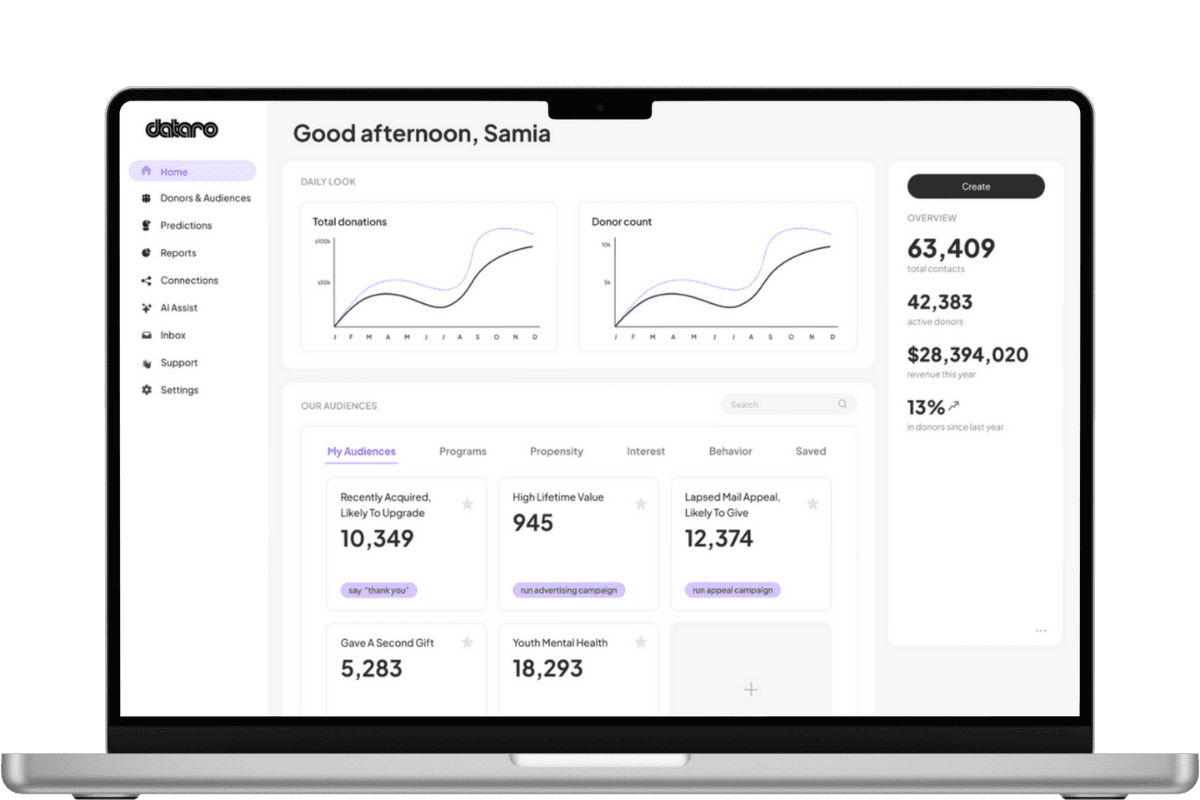
This is where Dataro fits. Dataro is a predictive layer that sits on top of your CRM. It reads your data and returns ranked actions: who to focus on and what to do next. Refresh and two-way sync are part of the platform fee, so you are not paying separately to keep scores current.
Dataro pricing combines an annual platform fee with a per active donor rate. At scale that can be as little as $0.20 per donor a year to rank your whole file, less than the postage on one appeal letter. The point is precision: mail fewer people with confidence and protect results.
The takeaway: measure the full cost, then buy for action
Donor data enrichment is rarely a one-time purchase, and licensing is usually the smallest part. Identity-resolution labour, refresh cadence and integration determine the real cost over the years you use the tool.
Price all four drivers across three years. Match each tool to the job it does best. Then ask the harder question: once the data is clean, what helps your team act on it? That is where a predictive layer earns its place.
Related articles
Find more non-profit fundraising and data insights from the Dataro team.