Continuous prospect scoring vs wealth screening for major gifts
Strategy & Frameworks

AI continuous prospect scoring finds major gift donors who are ready to give, not just the ones who look wealthy.
Major gift teams have long started the same way. They run a wealth screen, get a list of wealthy names and start calling. The problem is simple. Wealth tells you who is rich, but it does not tell you who is actually ready to give to you.
AI-powered continuous prospect scoring takes a different path. It evaluates giving behaviour and capacity together, updates as new data arrives and ranks who to prioritize right now. This guide compares the two approaches and answers the six questions fundraisers ask most often when they evaluate them.
Continuous prospect scoring is a predictive method that ranks donors and prospects by their likelihood to give a major gift. It combines capacity signals with behaviour signals, then refreshes the ranking as new data flows in from your CRM.
One-time wealth screening is a point-in-time scan that matches your file against external wealth and asset data. It estimates giving capacity on the day it runs, and the result ages from there.
Here is the short version before we go question by question.
Factor | One-time wealth screening | AI continuous prospect scoring |
|---|---|---|
Core signal | Capacity and wealth | Capacity plus giving behaviour |
Timing | Point-in-time snapshot | Refreshes as data changes |
Output | A static list of rich names | A ranked list of who to contact now |
Hidden prospects | Misses low-wealth, high-affinity donors | Surfaces engaged donors a screen skips |
Next step | You decide what to do | Comes with a suggested next action |
Upkeep | Re-run and re-pay each time | Updates on an ongoing basis |
The trade-off is real. A wealth screen is cheap, familiar and easy to brief. Continuous scoring asks for a data connection and a shift in habit. What you get back is a list that stays current and points to action, not just names.
Which major gift prospects does wealth screening miss?
A wealth screen ranks people by assets. So it rewards the donors who look rich and quietly skips the ones who act generous.
That is the gap. Many of your best future major donors are already on your file, giving often, responding to appeals and quietly climbing the giving ladder. A screen built on wealth alone can rate them low because their visible assets do not stand out.
Continuous scoring evaluates behaviour first, then applies the capacity lens. It surfaces the engaged mid-level donor who is ready to be asked, not just the stranger with an impressive property. That is where overlooked pipeline tends to hide.
Practical takeaway: if your major gift list looks a lot like a rich list, you are probably missing ready donors who are already giving to you.
Capacity or affinity: which signal should lead?
Both matter. The order matters more.
Capacity tells you how much someone could give, while affinity, read through giving behaviour, tells you how likely they are to support your cause. A name with high capacity and no affinity is essentially a cold call. A name with proven affinity and genuine capacity is a warm, fundable prospect.
Wealth screening leads with capacity and often stops there. Continuous scoring leads with behaviour, then layers capacity on top. The result is a shorter, warmer list your team can actually work.
Practical takeaway: screen for capacity, but let behaviour decide who gets your finite time first.
How accurate are the scores, and can you explain them?
A score is only useful if your team trusts it and your board can follow it.
Wealth screen outputs are easy to read but hard to act on. A capacity band tells you someone could give, not whether they will. The match rates and asset data also carry errors that are tough to inspect.
Good continuous scoring is built to be clear and explainable. Each ranking should reveal the signals behind it, so a gift officer can understand why a donor ranks highly and defend that judgment to a manager. Accuracy is proven by measured lift over time, not asserted in a brochure. Ask any vendor to demonstrate results tied to real gifts, not model claims.
Practical takeaway: pick the tool whose scores you can explain in one sentence to someone who was not in the room.
Does it work with your CRM?
Integration is the gate. If the scores do not reach the systems your team already uses, they will not get used.
A wealth screen usually lands as a file you import once. Keeping it current means another import, and another invoice.
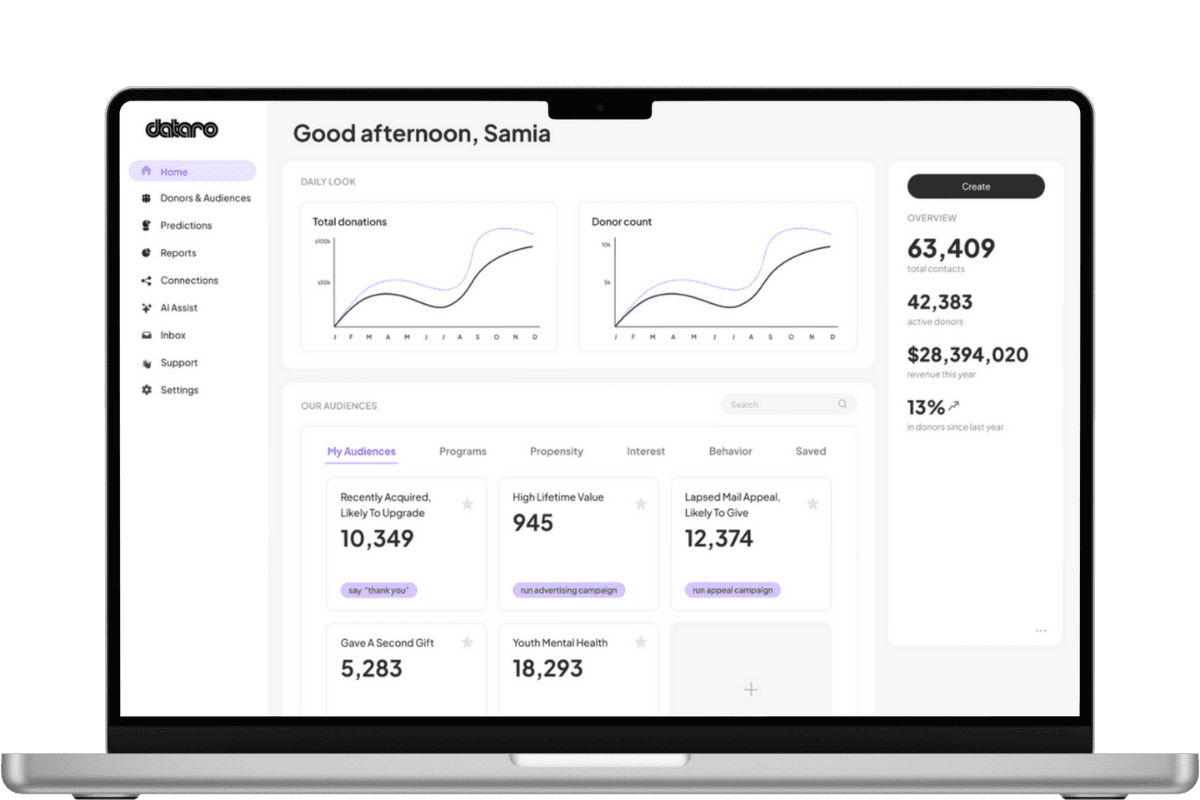
Continuous scoring sits on top of your CRM. It reads your data and writes ranked prospects and next steps back as fields, tags or lists, so officers see them in their daily view. Dataro is CRM-agnostic and works from a standard data export, so most fundraising databases are supported, including Salesforce, Blackbaud Raiser's Edge NXT, DonorPerfect and Bloomerang.
Practical takeaway: confirm the scores flow into your CRM workflow, not into a spreadsheet nobody opens.
Does it tell you what to do next?
This is the biggest split between the two approaches.
A wealth screen hands you a list and stops. What to do with each name is left to you, which means more triage and more meetings.
Continuous scoring is built to return a next step, not just a rank. For each prospect it can suggest the move that fits: qualify, cultivate, ask or steward. That turns a static list into a plan your team can run this week.
Practical takeaway: a ranked list saves you time only when it tells you who to contact and what to do next.
Can it scale into continuous intelligence?
A screen is an event. You run it, you work the list and it ages. Six months later the picture has drifted and you pay to run it again.
Continuous scoring is a rhythm. It follows a simple loop: predict who to focus on, act on the next step, measure what changed, then repeat with sharper signals. Each cycle teaches the model and tightens the list. Over time this grows into continuous intelligence across your programs, so major, mid-level and recurring giving share one view of each donor.
Practical takeaway: if you want pipeline that compounds, choose the approach that improves every cycle instead of resetting.
How to choose between them
Wealth screening still has a role. For a fast, one-off capacity read on a new file or an event list, it does the job.
For ongoing major gift discovery, continuous prospect scoring is the stronger fit. It finds ready donors a screen skips, ranks them by behaviour and capacity together, explains its reasoning and points to the next step. Most important, it gets sharper each cycle rather than going stale.
Start small. Run a short pilot on one segment, compare the ranked list against your current major gift list and look for the ready donors you were about to miss. Let the results, tied to real gifts, make the call.
Related articles
Find more non-profit fundraising and data insights from the Dataro team.