When to ask a new donor to become a monthly sustainer
Strategy & Frameworks

New donors convert to monthly giving at the highest rate within the first 60 days after their first gift.
The short answer
The best time to ask a new donor to become a monthly sustainer is within the first 60 days of their first gift, with the strongest window falling between days 7 and 30.
New donors are most receptive when the reason they gave is still fresh. Wait too long and intent fades, the relationship cools and the conversion rate drops.
Definition: the conversion window The conversion window is the period after a first gift when a donor is most likely to accept a recurring ask. For most new donors, that window opens within a week and closes around day 60.
Why the first 60 days matter
A first gift is a signal of intent, not a habit. The donor acted on a specific trigger: a story, an appeal or an urgent need. That motivation is at its peak in the days right after giving.
Recency drives response. The same pattern that makes recent donors the best prospects for a second gift makes them the best prospects for a monthly ask. As the days pass, recall of why they gave weakens and each subsequent ask works harder for less return.
There's also a practical reason. Converting a single-gift donor to a sustainer early protects long-term value. Monthly donors retain far better than one-time donors, so an early, well-timed ask compounds for years.
What most teams get wrong
Two default strategies dominate, and both leave revenue on the table.
Ask at every touchpoint. The logic is that more asks mean more conversions. In practice, a constant sustainer ask trains donors to ignore it, fatigues your file and dilutes the moments that actually convert. Volume is not timing.
Default to monthly for everyone. Some teams route every new donor into the same recurring ask on the same schedule, regardless of how or when they gave. This ignores the recency signal and treats a lapsing donor the same as a donor who gave yesterday.
Both approaches skip the real question: who is ready now, and what should we send them next.
The three approaches compared
Approach | How it works | Trade-off |
|---|---|---|
First 60 days window | Time the sustainer ask to the days after the first gift, prioritized by donor signals | Requires clean gift-date tracking and a defined cadence, but captures intent at its peak |
Ask at every touchpoint | Include a monthly ask in most communications | Simple to run, but fatigues donors and blurs the moments that convert |
Default to monthly | Route all new donors into one recurring ask on a fixed schedule | Easy to automate, but ignores timing and treats every donor the same |
A timing-based cadence to benchmark against
Use this as a starting benchmark, then measure and adjust to your own data.
Timing | Action |
|---|---|
Days 0 to 2 | Thank you and confirmation. No ask. Make the gift feel seen. |
Days 3 to 6 | Impact message. Show what the first gift made possible. Still no ask. |
Days 7 to 30 | Primary sustainer ask. Frame monthly giving as the next step in the impact they started. |
Days 31 to 60 | Second sustainer ask for non-converters, with a fresh angle or a suggested monthly amount. |
Day 60 and beyond | Move non-converters into standard stewardship. Re-ask around the next natural trigger, not on repeat. |
Two asks inside 60 days, separated by a thank-you and an impact story, tends to outperform both the constant-ask and the fixed-default models. The gap gives the donor room to feel valued before the next request.
How to prioritize within the window
Timing tells you when to ask. It doesn't tell you who is most likely to say yes. Not every new donor is equally sustainer-ready, and a blanket ask still wastes touches on donors who won't convert.
This is where donor-level signals help. Ranking new donors by their likelihood to become monthly givers lets you lead with the people most likely to convert and steward the rest without over-asking. You send fewer, better-timed asks and protect capacity for the donors who matter most.
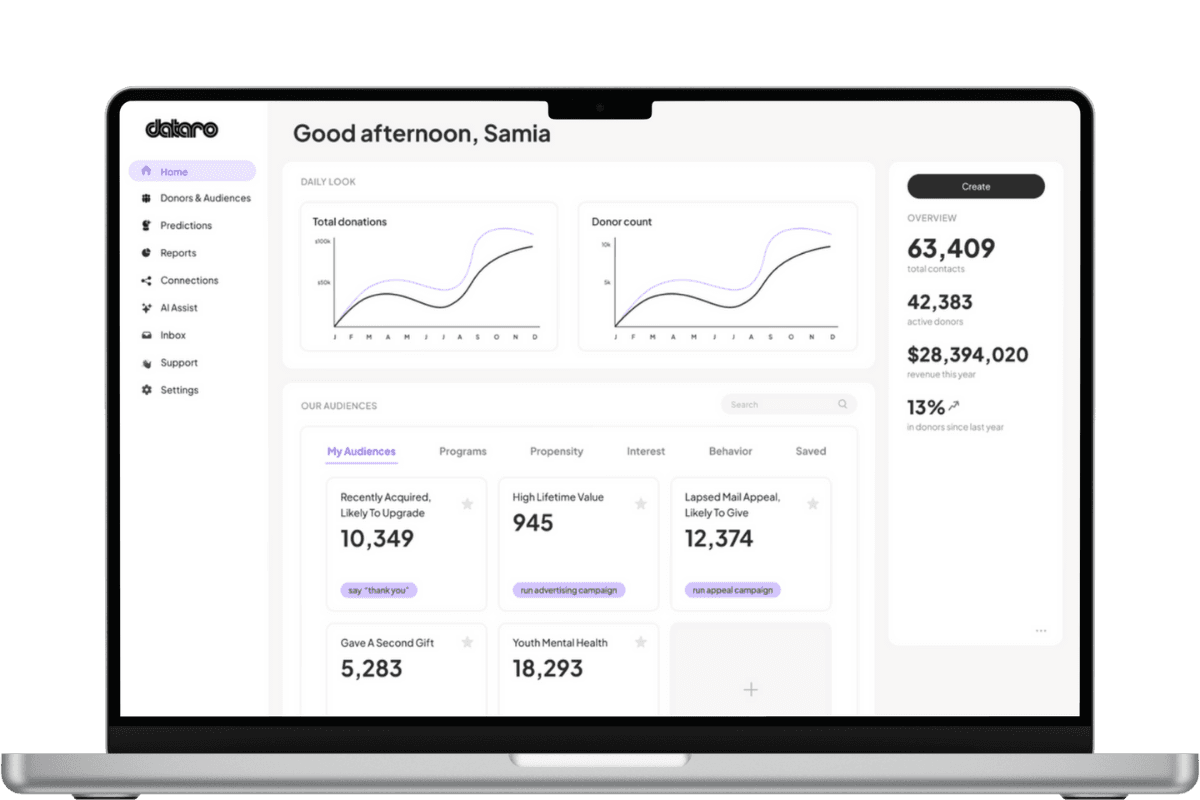
Dataro sits on top of your CRM and turns first-gift data into ranked sustainer prospects, so you can act inside the 60-day window with confidence rather than asking everyone the same way.
Practical takeaways
Treat the first 60 days after a first gift as your primary conversion window.
Lead with the ask between days 7 and 30, after a thank-you and an impact message.
Cap it at two asks inside 60 days. More asks fatigue donors, they don't convert them.
Don't default every new donor to the same schedule. Prioritize by likelihood to convert.
Move non-converters into stewardship and re-ask on a natural trigger, not on repeat.
Conclusion
The question isn't whether to ask new donors to give monthly. It's when, and who to ask first. Intent peaks early, so the first 60 days is the window that matters. A short, timed cadence, prioritized by donor signals, beats both asking constantly and defaulting everyone to monthly. Ask fewer people at the right moment and you convert more sustainers while protecting the donors you can't afford to fatigue.
Related articles
Find more nonprofit fundraising and data insights from the Dataro team.