Wealth screening vs prospect research vs fundraising intelligence: what's the difference and which do you need?
Strategy & Frameworks

Wealth screening tells you who can give, prospect research explains who they are, and fundraising intelligence tells you who to focus on and what to do next.
Buyers ask us a version of the same question every week: what's the real difference between wealth screening, prospect research and fundraising intelligence, and which one do we actually need?
The three terms get used interchangeably in sales decks, so it's easy to buy two tools that do the same job and still miss the one you needed. This explainer sorts them out. Each layer answers a different question, and they build on one another in a clear order.
The short answer
Wealth screening tells you who can give. Prospect research tells you who someone is. Fundraising intelligence tells you who to focus on and what to do next.
The first two describe donors. The third turns that description into a ranked list of who to contact and the next action for each person. You can buy them separately, but they work best stacked in that order.
What is wealth screening?
Definition: Wealth screening matches your donor records against external data on assets, property, stock holdings, business ownership and past giving to estimate a person's capacity to give.
It answers one question: how much could this person give if they wanted to?
What it delivers in practice:
A capacity or affinity rating appended to each record
Flags for real estate, business affiliations and securities
Philanthropic history, such as gifts to other causes
Wealth screening is useful for sizing a potential ask and spotting capacity you didn't know was sitting in your file. Its limit is that capacity is not intent. A donor can have a large estate and no interest in your cause. Screened scores tell you who's wealthy. They don't tell you who's ready.
What is prospect research?
Definition: Prospect research is the deeper, often manual work of building a full picture of a specific prospect: their wealth, relationships, interests, giving motivations and connection to your organization.
If wealth screening is a bulk scan across your file, prospect research is a profile on one person. It usually sits with a prospect researcher or major gifts officer who verifies screened data, adds context and prepares a brief before a conversation.
What it delivers in practice:
Verified capacity, confirmed rather than estimated
Relationship maps, such as board links and peer networks
Giving motivations and interests tied to your mission
A research brief the gift officer uses to prepare an ask
Prospect research turns a score into a story. Its limit is scale. Deep profiles are slow and expensive to produce, so they only make sense for a short list of prospects you've already decided are worth the time. That raises the obvious question: how do you decide who makes the short list?
What is fundraising intelligence?
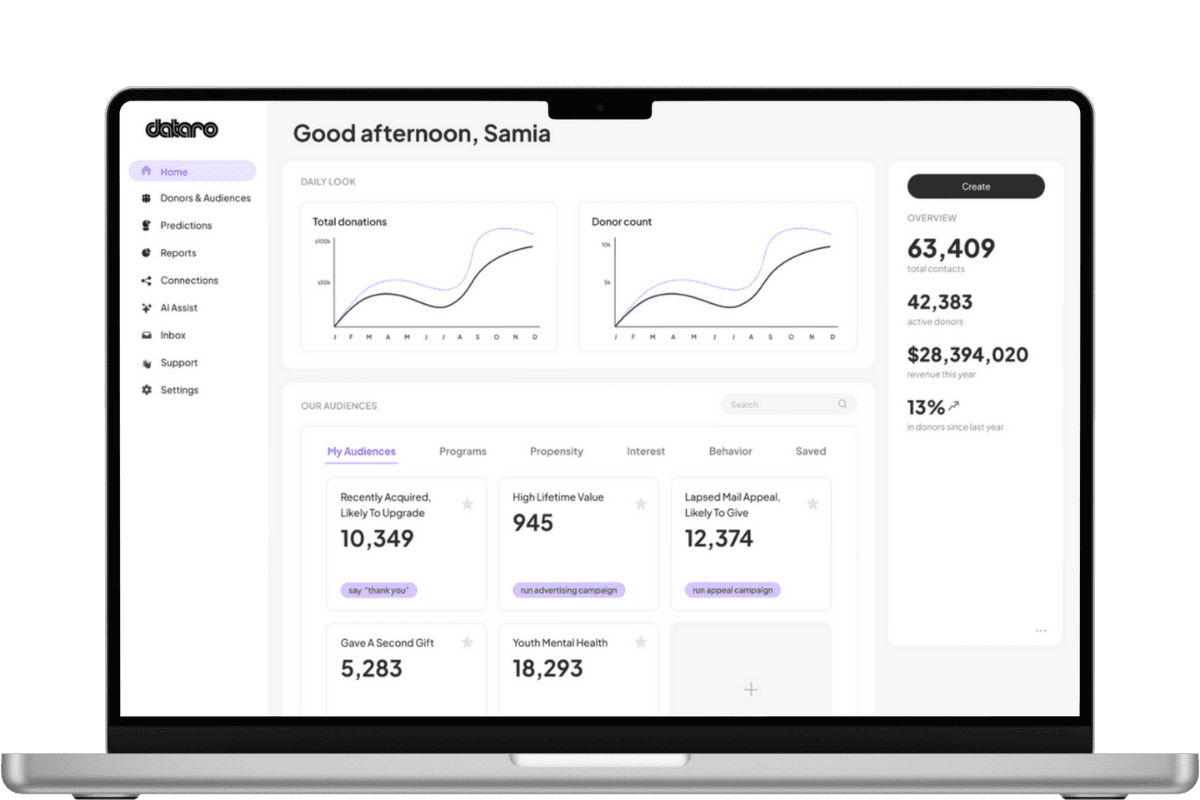
Definition: Fundraising intelligence is software that sits on top of your CRM and turns your own donor data into ranked priorities and a recommended next action for each person, across every program.
This is the layer that answers who to focus on. Instead of describing individual donors, it reads behavior across your whole file, giving patterns, engagement, recency, channel response, and produces a ranked list of who to contact now and what to do next.
What it delivers in practice:
Predictive propensity scores and a ranked list, not a single capacity rating
A defensible cutoff, so you can mail fewer people with confidence
A recommended next action per record: upgrade, steward, convert or suppress
Early signals on donors at risk of lapsing, while there's still time to act
The shift is from capacity to readiness. Wealth tells you who's rich. Behavior tells you who's ready to move. Fundraising intelligence ranks your file on readiness, then hands your researchers and gift officers a focused short list worth their deeper work.
How the three layers build on one another
These are not competing purchases. They stack.
Fundraising intelligence ranks your whole file and tells you who to focus on now. This is where scarce attention gets allocated.
Wealth screening sizes capacity for the people who rise to the top, so you know how much to ask for.
Prospect research builds the full profile for your highest-priority prospects, so the gift officer walks in prepared.
Many teams run these in the wrong order. They screen the entire file for wealth, hand a huge capacity-sorted list to a small major gifts team, then wonder why so many "qualified" prospects never move. Capacity alone creates oversized, unworkable portfolios. Leading with readiness right-sizes the list first, then layers capacity and research onto the names that matter.
Comparison at a glance
Layer | Question it answers | What it delivers | Main trade-off |
|---|---|---|---|
Wealth screening | Who can give? | Capacity ratings and wealth markers across your file | Capacity is not intent; wealthy is not the same as ready |
Prospect research | Who is this person? | Verified profiles, relationships and giving motivations | Deep and accurate, but slow and hard to scale |
Fundraising intelligence | Who do we focus on, and what next? | Ranked lists, cutoffs and next-best actions across programs | Needs clean CRM data to read behavior well |
Which one do you need?
Use this as a rough guide:
If your major gifts team has no short list and limited time, start with fundraising intelligence. The first problem is focus, not capacity. Ranking your file on readiness tells you where to spend finite hours.
If you have a short list but don't know how much to ask for, add wealth screening to size capacity on those names.
If you're preparing for high-value conversations, invest in prospect research to brief your gift officers on the handful of prospects that warrant it.
Most growing programs eventually want all three. The question is sequence. Lead with the layer that ranks your file and routes attention, because screening and research both get more valuable once you know who's worth them.
Practical takeaways
Wealth screening, prospect research and fundraising intelligence answer three different questions. Don't buy one expecting it to do another's job.
Capacity is not readiness. A high wealth score with no engagement is a poor use of a gift officer's time.
Rank first, then enrich. Use fundraising intelligence to build the short list, then screen and research the names at the top.
Match the spend to the stage. Bulk screening scales cheaply; deep research does not, so reserve it for your highest-priority prospects.
Conclusion
The three layers aren't rivals. Wealth screening sizes capacity, prospect research adds depth, and fundraising intelligence decides where your attention goes first. Get the order right and each layer makes the next one sharper. Get it wrong and you pay for data your team can't act on. If you're only going to fix one thing, fix focus: know who to prioritize before you spend another hour on research.
Related articles
Find more nonprofit fundraising and data insights from the Dataro team.