Why a specialized fundraising tool beats an all-in-one platform
Strategy & Frameworks

Running best-in-class channel tools with a separate predictive layer gives nonprofits sharper results than a single all-in-one suite.
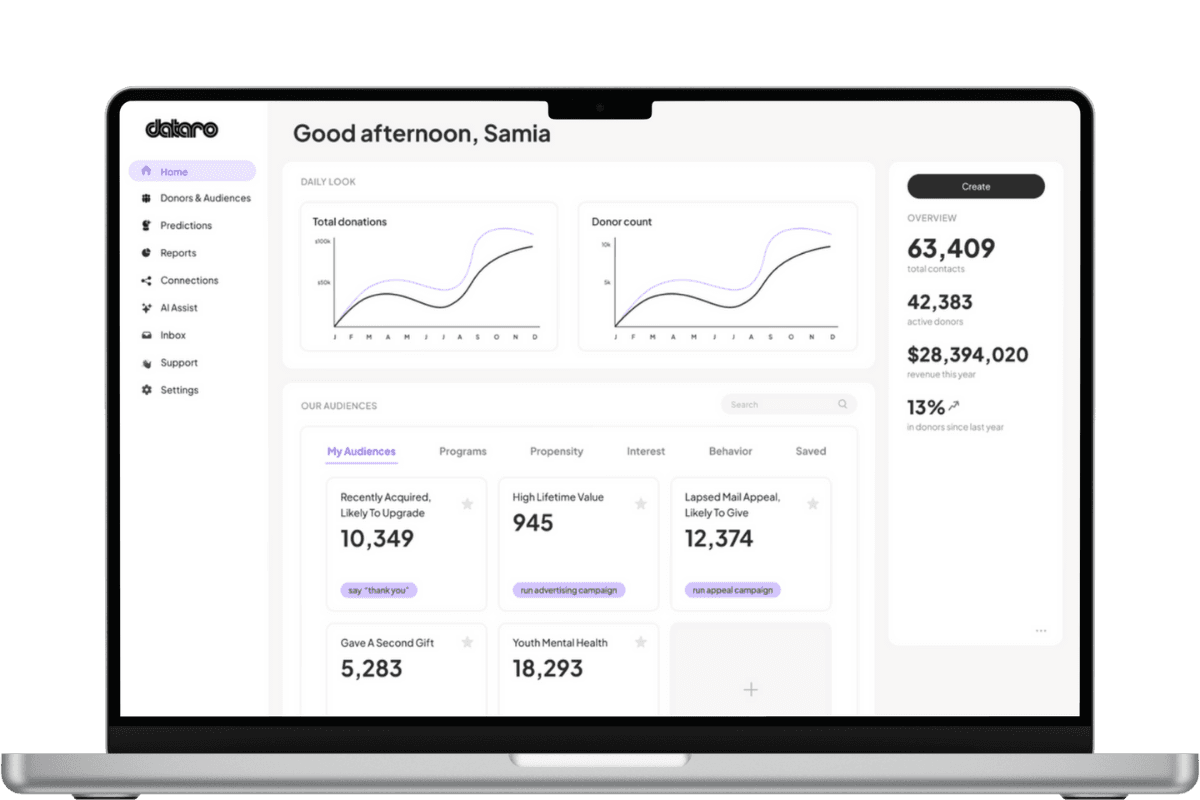
Dataro is an intelligence and prioritization layer, not a complete donor-engagement platform. That is a deliberate design choice, not a gap.
Dataro sits on top of your CRM, reads your data and returns ranked lists, clear cutoffs and a recommended next action on each record. It does not try to be your CRM, your email platform or your telemarketing tool. Its value comes from making the tools you already run sharper, not from replacing them. This article explains why that separation works in a nonprofit's favor.
What is a predictive layer?
Think of it like GPS for your donor file. Your CRM is the map and the road network: every record, every route, everything you already have. A predictive layer is the GPS on top. It reads that data and tells you which turn to take now and why, without rebuilding the roads underneath. And like GPS, it does not drive the car. Your team stays in the driver's seat, deciding and acting on the directions.
In practice, a predictive layer connects to your systems of record, usually the CRM, and turns fundraising data into execution-ready outputs: who to focus on, what action to take now and what to do next. It does not store your donor records or send your messages. It tells your existing tools who to contact and what to do.
The outputs land back in the tools you already use as audiences, tasks, tags or fields. Your team then runs the work in the channel tool built for that job.
Why would a nonprofit choose separate tools over an all-in-one?
The short answer: specialized tools do one job well, and fundraising results depend on doing several jobs well at once. An all-in-one suite asks you to accept the weakest module in the bundle. A best-in-class approach lets you pick the strongest tool for each job and swap any one of them without replacing everything.
Three reasons stand out.
You keep the best tool for each job
Email, SMS, telemarketing and marketing automation are mature, competitive categories. The leading tools in each are sharper than the equivalent module inside a suite that also tries to be a CRM and a reporting engine. When prioritization lives in a separate layer, you can run a strong email platform, a strong phone program and a strong CRM at the same time, then point all of them at the same ranked list.
You avoid lock-in
In an all-in-one, switching one weak component often means a full migration. Discrete tools reduce that risk. If your email platform stops serving you, you change it. Your CRM, your data and your rankings stay put. The predictive layer is CRM-agnostic, so the intelligence does not reset when a channel tool changes.
Your intelligence works across every channel
Prioritization built inside a single channel can only optimize that channel. A separate layer ranks the whole donor file and recommends the right channel per donor, whether that is mail, email, phone or SMS. That is how programs compound instead of competing. Appeals, retention and stewardship share one source of truth for who matters and what to do next.
Best-in-class stack vs all-in-one platform
Factor | Best-in-class tools plus a predictive layer | Single all-in-one platform |
|---|---|---|
Quality per function | Strongest tool for each job | As strong as the weakest module |
Switching cost | Replace one tool without the rest | Migration risk across the suite |
Prioritization scope | Ranks the whole file across channels | Often limited to in-suite channels |
CRM choice | Keep or change your CRM freely | Tied to the suite's CRM |
Upgrade path | Adopt new tools as they mature | Wait for the vendor's roadmap |
Trade-off | Requires light integration work | Convenience of one login and one bill |
The honest trade-off: an all-in-one gives you one login, one contract and one vendor to call. That convenience is real. But it comes at the cost of depth in each function and flexibility over time. For most growing programs, depth and flexibility matter more.
Does a separate tool mean more work to run?
Not in practice. The point of a predictive layer is to remove work, not add it. Outputs sync back into your CRM and channel tools, so your team executes in the systems they already know. There is no new place to log in to send a campaign. The rankings arrive where the work already happens.
Dataro integrates with the CRMs and engagement tools nonprofits already use, and supports two-way syncs so ranked actions appear as audiences, tasks and fields. Onboarding typically takes 4 to 6 weeks.
What this means for your stack
A few practical recommendations:
Treat your CRM as the system of record, not the engine that decides who to contact.
Choose channel tools on merit, one function at a time, and keep the freedom to swap them.
Put prioritization in a layer that spans every channel, so one ranked list drives mail, email, phone and SMS.
Judge any tool by the output it produces, not by how many boxes it ticks in a feature list.
Conclusion
An intelligence and prioritization layer is exactly what Dataro is, and it is the reason it works. By staying out of the CRM, email and telemarketing business, Dataro lets nonprofits keep the best tool for each job, avoid lock-in and apply one set of rankings across every channel. The result is fewer, better touches and programs that compound. An all-in-one trades that depth for convenience. For teams that want to mail fewer people with confidence and protect results, the separation is the advantage.
Related articles
Find more nonprofit fundraising and data insights from the Dataro team.