how charities/nonprofits can use AI responsibly/efficiently
General

Responsible and efficient AI go together: pick the smallest tool for the job, ground it in approved records and keep a human in the loop.
Most nonprofits now use AI, but few feel ready to use it well. A NTEN and Bridgespan report found 98% of nonprofits use AI tools, yet most lack the resources to use them responsibly. The AI Equity Project 2025 found a similar gap: 65% of nonprofits are interested in AI, but only 9% feel ready to adopt it responsibly.
That gap is the real risk, because the problem is rarely the technology itself. It is adoption without guardrails.
The encouraging news for stretched teams is that responsible and efficient are really the same goal. When you pick the smallest tool that solves the job and add a few clear review steps, you cut cost, energy and risk at the same time. Here is a practical approach you can repeat.
Responsible and efficient pull in the same direction
Smaller, task-specific models usually cost less, use less compute and carry less risk. Research by UNESCO and UCL found that small models tuned to a specific task can cut energy use by up to 90% without losing performance.
The lesson is simple: do not reach for the biggest model to answer a narrow question. Choose the smallest tool that solves the problem in front of you, because that choice lowers your bill and shrinks the surface area for errors.
Match the tool to the job
There are two main kinds of AI, and they do different work.
Predictive AI reads your history to forecast outcomes and rank who to prioritize. Generative AI writes new content, such as a draft email or a thank-you note.
Many workflows pair the two. Predictive AI tells you who to focus on. Generative AI helps you draft the outreach. The mistake is asking one tool to do the other's job.
Don't ask a chatbot to forecast who will give
Forecasting and ranking is a prediction job. A chatbot can write a warm appeal, but it cannot tell you which donors are most likely to respond.
If you want a ranked list of who to contact this week, that is work for a predictive model trained on your data. Ask a generative tool to do it and you get a confident guess, not a grounded answer.
The real risk is no guardrails, not AI
Generative models can state wrong facts with full confidence. They can invent a quote, a figure or a reference and present it as true. One study on the ethics of generative AI warns that these tools produce fluent, confident output that is sometimes simply false.
So the fix is not to avoid AI. The fix is to require human review before anything reaches a donor. A person signs off on high-stakes outputs. Nothing goes out unchecked.
This also explains a telling data point. Per Fast Forward's 2025 AI for Humanity Report, nonprofits using off-the-shelf tools like ChatGPT are far less likely to have responsible-use policies than those building their own tools, 35% versus 69%. The easier the tool is to pick up, the easier it is to skip the guardrails.
Ground every claim in approved records
The strongest guardrail is grounding. Tie each answer to your own trusted documents, so the model reads from approved records instead of guessing.
Grounding turns a guessing machine into a document-reading assistant. Pair it with human sign-off on anything high-stakes, and you close most of the risk gap.
In practice that means two habits. Feed the model your approved facts. Then have a person confirm the output before it ships.
Start governance light, and start now
A six-month framework that no one reads protects no one. A short policy and a few clear review steps protect your team today.
Begin with the basics. Write down which tools are approved, what data can go into them, and who signs off before anything reaches a donor. You can tighten the policy as you learn.
The goal is to move without stalling. Light governance beats perfect governance that never ships.
Treat efficiency as capacity, not more work
Small teams do not need another tool that adds tasks. They need time back.
Used well, AI handles the triage: sorting, ranking and surfacing what matters. That frees people for the judgment calls only they can make. If a tool adds work instead of removing it, it is the wrong tool or the wrong job.
Where Dataro fits
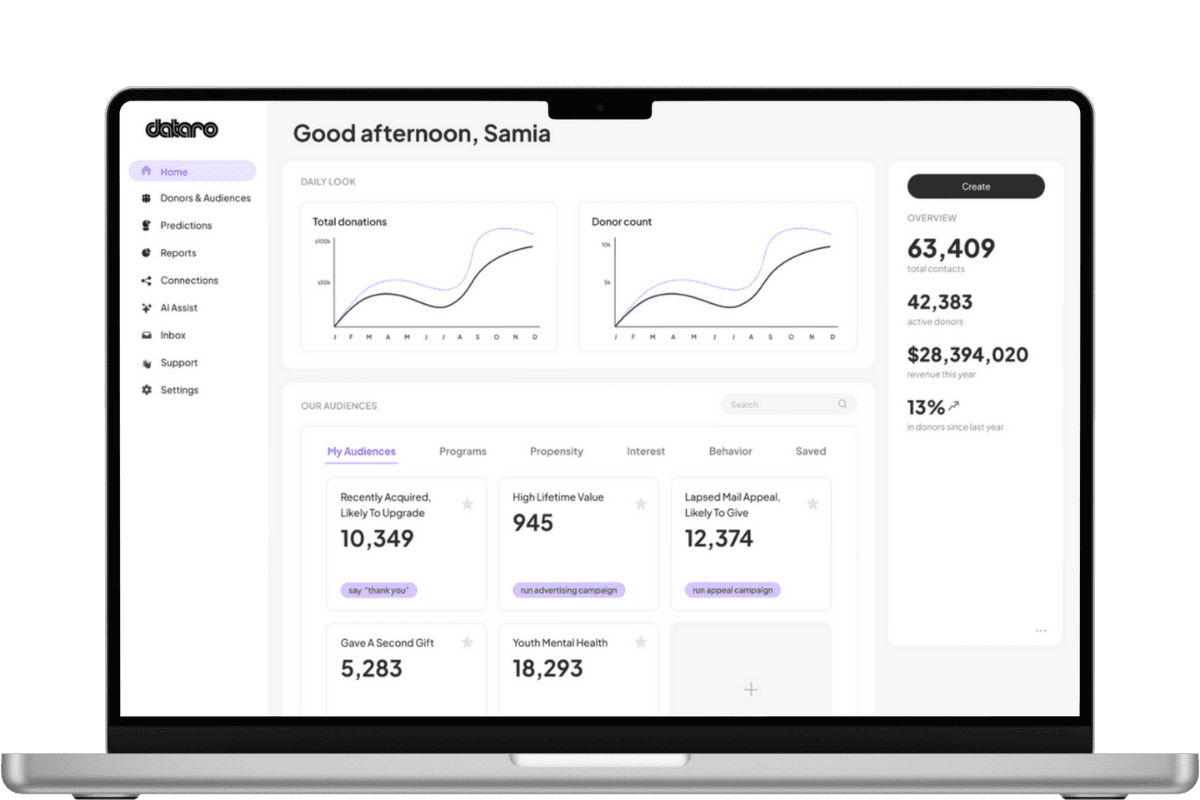
Dataro adds a predictive layer on top of your CRM. It reads your data and returns ranked lists, clear cutoffs and a recommended next action on each record.
That is the predictive half of the picture done right. You get who to focus on and what to do next, grounded in your own records and easy to explain to your team. Your people keep control of every decision that reaches a donor.
Takeaways you can act on
Pick the smallest tool that solves the job to cut cost and risk.
Use predictive AI to rank donors and generative AI to draft content.
Never ask a chatbot to forecast who will give.
Require human review before anything reaches a donor.
Ground every claim in your approved records.
Start with a light policy now, not a long one later.
Responsible AI is not a brake on a busy team. It is how a small team does more with less and keeps donor trust intact. Start small, keep a human in the loop, and let prediction handle the ranking so your people can focus on the work that matters.
Want to see what grounded, ranked actions look like on your own data? Book a demo.
Related articles
Find more nonprofit fundraising and data insights from the Dataro team.