Recurring giving conversion optimization: a practical guide
Strategy & Frameworks

Recurring giving conversion optimization: turning one-time donors into durable monthly revenue through better forms, offers and timing.
Recurring giving is the most durable revenue a nonprofit can build. Yet most programs leak conversions at predictable points, and teams try to fix everything at once instead of the one thing that matters. This guide explains what recurring giving conversion optimization means, the three levers that drive it and how to find the constraint holding your program back.
What is recurring giving conversion optimization?
Recurring giving conversion optimization is the practice of increasing the share of donors who start, and keep, a recurring gift. It measures how well you move people from intent to an active monthly commitment, then protect that commitment over time.
The goal is not more traffic or more appeals. It is a higher conversion rate on the audiences you already reach, and longer retention once they convert.
Key terms, defined
MRR (monthly recurring revenue): the predictable income your active recurring donors generate each month. It is the core health metric for a sustainer program.
Sustainer program: the structured effort to recruit, retain and grow recurring donors. Also called a monthly giving or regular giving program.
Recurring upgrade: an existing recurring donor increasing their gift amount or frequency. Upgrades compound MRR without acquisition cost.
Impact blocks: the parts of a donation form or appeal that tie a specific amount to a specific outcome, such as "$25 a month funds a week of clean water." They make the ask concrete and lift conversion.
The three levers of recurring conversion
Every recurring conversion problem traces back to one of three levers. Diagnose them in order.
Lever 1: donation form and UX
This is how easily a motivated donor can complete a recurring gift. Friction here caps everything downstream.
Practical fixes:
Default to monthly, or make it the visually prominent option
Reduce form fields to the minimum needed to process the gift
Offer digital wallets and saved payment methods
Use impact blocks on suggested amounts so the choice feels concrete
Confirm the gift clearly and set expectations for the next charge
Lever 2: message and offer
This is what you ask for and why. A form can be flawless and still convert poorly if the offer is weak or generic.
Practical fixes:
Make the recurring ask explicit rather than a checkbox on a one-time form
Tie amounts to outcomes with impact blocks
Test the suggested monthly amounts and the ask ladder
Give a clear reason to choose monthly over a single gift
Lever 3: audience and timing
This is who you ask and when. The same offer converts very differently across segments and moments.
Practical fixes:
Prioritize donors with a recent, positive first experience
Reach people inside the early window after their first gift
Use propensity scores to rank who is most likely to convert
Suppress low-propensity audiences to protect your sender reputation and staff time
Which donor segments convert best?
The strongest recurring converts are donors who have just shown intent and had a good experience. In rough priority order:
Recent first-time single donors, especially inside the early window
Reactivated lapsed donors who returned through a strong campaign
Engaged non-donors with high propensity, such as petition signers or event attendees
Existing recurring donors, for upgrades rather than new conversions
Cold, unengaged audiences convert poorly no matter how good the form is. Targeting fixes this faster than design.
What is the 60-day conversion window?
The 60-day conversion window is the roughly two-month period after a donor's first gift when they are most likely to convert to recurring. Motivation and recall are highest right after the first gift, then decay.
Practical takeaway: build a defined sequence that reaches new single donors within days, not months, and treats the first 60 days as the priority window for a recurring ask. Waiting until a year-end appeal wastes the moment of highest intent.
How to diagnose the binding constraint
The binding constraint is the single lever limiting your conversion rate right now. Fixing anything else produces little lift until you address it. Work through the levers in sequence and stop at the first that fails.
Symptom | Likely binding constraint | First move |
|---|---|---|
High traffic, many form starts, few completions | Form and UX | Cut fields, default to monthly, add wallets |
Good completion rate, but few choose monthly | Message and offer | Strengthen the recurring ask and impact blocks |
Solid form and offer, but volume of qualified donors is low | Audience and timing | Rank and target high-propensity donors in the window |
A simple rule: form problems show up as drop-off, offer problems show up as one-time gifts instead of monthly, and targeting problems show up as low qualified volume despite decent conversion rates.
Measure each lever with its own metric. Track form completion rate for UX, recurring share of completed gifts for the offer and conversion rate by segment for targeting. The lever with the weakest number is usually your constraint.
Practical takeaways
Optimize one lever at a time, starting with the binding constraint
Default to monthly and strip the form to essentials
Use impact blocks to make amounts concrete
Ask recent first-time donors inside the 60-day window
Rank audiences by propensity so you ask fewer, better-fit people
Grow MRR through upgrades, not just new conversions
Conclusion
Recurring giving conversion optimization is less about polishing everything and more about finding the one lever that is holding you back. Diagnose form, then offer, then targeting. Fix the binding constraint, measure the lift and repeat. That disciplined loop is how a sustainer program compounds MRR year over year.
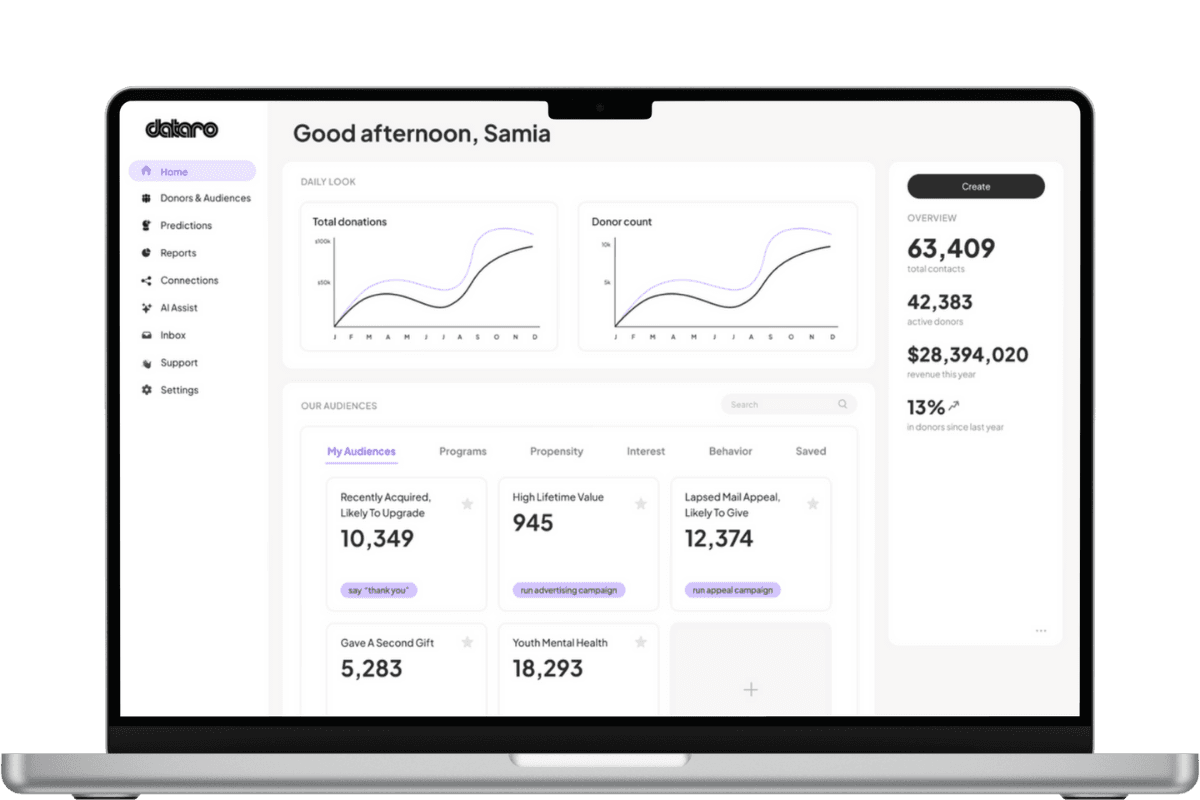
Dataro sits on top of your CRM and ranks who is most likely to convert to recurring and when, so you can focus your asks on the donors who matter and act inside the window that counts.
Related articles
Find more nonprofit fundraising and data insights from the Dataro team.