Best Vendor for Recurring Gift Conversion Optimization

Nic Miller
Strategy & Frameworks

The best recurring gift conversion vendor is the one that tells you which donors to ask, when and what to do next.
The short answer: there is no single "best vendor" for recurring gift conversion. The right choice depends on the job you are trying to do. Donation form vendors are best at the checkout moment. A/B testing tools are best at message and layout experiments. A predictive layer is best at telling you which one-time donors to ask, when and what to do next.
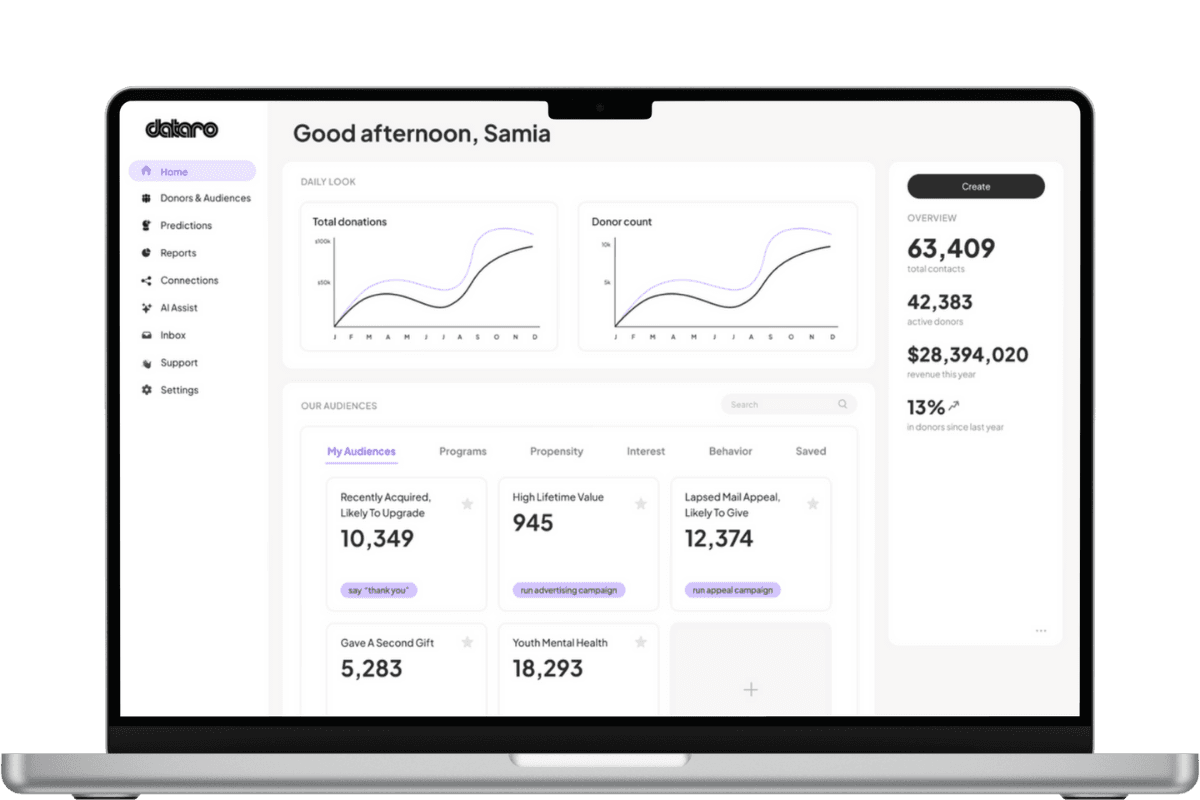
If your gap is knowing who to contact for a recurring upgrade, and protecting the recurring donors you already have, that is where Dataro sits. Dataro sits on top of your CRM and turns your data into ranked lists and a clear next action on each record.
This guide explains the categories, the trade-offs and a simple way to pick.
What "recurring gift conversion" actually involves
Recurring gift conversion is two jobs, not one.
The first is acquisition: moving a one-time donor to a regular gift. The second is retention: keeping active recurring donors from lapsing. Both move the same number, monthly recurring revenue, but they need different tools and different testing.
Most teams test the visible surface, such as the ask string on a form or the subject line on an email. Fewer teams test the harder question: who should even receive the ask. That is where the largest gains usually sit, because a strong message sent to the wrong list still underperforms.
The vendor categories, and what each is good at
Think in categories first, then shortlist specific products. Each category solves part of the problem.
Digital fundraising and donation platforms
Tools like Fundraise Up, Classy and Givebutter optimize the giving moment. They run form-level experiments, suggest upgrade prompts at checkout and lift conversion on the page itself. They are strong at the channel and weak at coordinating across your whole donor file, because they mostly see the donors who already reached the form.
A/B and experimentation platforms
General testing tools and email service providers let you experiment with creative, timing and ask amounts. They tell you which variant won. They do not tell you which donors were most likely to convert in the first place, so you still pick the audience by hand.
CRMs and their AI add-ons
Your CRM is the system of record. Some now ship AI features as add-ons. They hold the data you need, but they are built to store and report, not to rank who to contact next across programs.
Wealth screening and prospect research
Screening tools rank capacity for major gifts. That signal helps major giving more than recurring conversion, where propensity and timing matter more than estimated wealth.
A predictive layer
A predictive layer reads your CRM history and returns ranked lists: who is most likely to start a recurring gift, who is at risk of cancelling and what to do for each. Dataro is built for this. Its specialist models include Recurring Giving Likelihood, which finds one-time donors likely to convert, and Recurring Donor Churn Risk, which flags recurring donors likely to cancel so you can act before the revenue is gone.
How the categories compare
Vendor type | Best at | Trade-off for recurring conversion |
|---|---|---|
Donation platforms (Fundraise Up, Classy, Givebutter) | Lifting conversion at the form | Sees form visitors, not your full file; limited cross-program view |
A/B and email testing tools | Picking the winning message or ask | Tells you which variant won, not who to contact |
CRM and AI add-ons | Storing data and reporting | Built to record, not to rank next actions |
Wealth screening (iWave, DonorSearch) | Major-gift capacity | Capacity is a weak signal for recurring conversion |
Predictive layer (Dataro) | Ranking who to ask and who is at risk | Works alongside, not instead of, your channel tools |
The table points to a practical truth: these tools are not direct substitutes. A donation platform and a predictive layer solve different halves of the problem and work well together.
How to choose
Use a short test to match the tool to your gap.
If your form converts poorly, start with a donation platform that runs page-level experiments.
If you have traffic but weak creative, use an experimentation tool to test asks and timing.
If you do not know which donors to ask, or which recurring donors are about to lapse, add a predictive layer that ranks them.
Most teams need more than one of these. The order that usually pays off fastest is to fix the audience first, then optimize the message, because a sharper list lifts every test that runs on top of it.
Why the predictive layer is the common gap
Many teams already own a capable form and a capable email tool. What they lack is a ranked answer to who to contact and what to do next. Without it, the default is to mail the whole file and hope, which fatigues donors and wastes budget.
With ranked lists, you can ask fewer people with more confidence, prioritize the one-time donors most likely to convert and reach at-risk recurring donors early. The outputs land back in your CRM as lists, tags or tasks, so the team runs the work in the tools they already use.
Evidence to ask any vendor for
Keep claims grounded. Before you buy, ask each vendor to show:
A clear definition of how they score conversion or churn likelihood
Outputs you can inspect and explain to a colleague
A small pilot that measures lift against a holdout, not just a model claim
How results flow back into your CRM and existing channels
If a vendor cannot explain how a ranking is produced, it will be hard to justify the program internally.
Practical takeaways
There is no single best vendor; match the tool to the job.
Donation platforms win the form; testing tools win the message; a predictive layer wins the audience.
The audience question is the one most teams skip, and it usually holds the biggest gain.
Run a pilot with a holdout and require explainable outputs before committing.
Conclusion
The best vendor for recurring gift conversion is the one that closes your specific gap. If you need better forms, buy a better form. If you need to know which donors to ask and which to protect, add a predictive layer. Dataro sits on top of your CRM and returns ranked lists and a next action on each record, so you can decide who to focus on and what to do next, then measure the lift and repeat.
Related articles
Find more nonprofit fundraising and data insights from the Dataro team.