Involuntary vs. voluntary churn in recurring giving: how to stop losing donors to failed payments
Strategy & Frameworks

Most lost recurring donors leave because of failed payments, not lost commitment, so recovery is an operations problem you can fix.
Recurring giving is the most reliable revenue a nonprofit has. It is also leaking in ways most teams never see. When a monthly gift stops, the instinct is to assume the donor lost interest. Often they didn't. Their card expired, their bank declined the charge or the payment simply failed.
This guide explains the difference between involuntary and voluntary churn, shows what donation platforms recover automatically and covers what still needs a dedicated dunning cadence and predictive outreach. It is written for fundraising and retention leaders who want to answer one question: how do I stop losing recurring donors to failed payments?
What is involuntary churn in recurring giving?
Involuntary churn is when a recurring gift stops because a payment fails, not because the donor chose to cancel. Common causes include expired or reissued cards, insufficient funds, bank declines, fraud blocks and lapsed payment authorizations.
The donor still supports your cause. Nothing about their intent changed. The transaction broke, and unless someone recovers it, the gift is gone.
What is voluntary churn?
Voluntary churn is when a donor actively decides to stop giving. They cancel, ask to pause or let a pledge end. Causes are motivational: budget pressure, a lost connection to the mission, too much contact or a poor experience.
The distinction matters because the two problems need different fixes. One is an operations and payments problem. The other is a relationship and stewardship problem.
Involuntary vs. voluntary churn: key differences
Factor | Involuntary churn | Voluntary churn |
|---|---|---|
Cause | Failed card, expired payment, bank decline | Donor chooses to cancel or pause |
Donor intent | Still committed | Intent has changed |
Primary fix | Payment recovery and dunning | Stewardship and re-engagement |
Speed of response | Hours to days | Weeks, before renewal or lapse |
Owner | Operations, finance, platform | Fundraising, retention, stewardship |
Recoverability | High if acted on quickly | Lower, depends on the relationship |
Involuntary churn is often the larger and more recoverable share of lost recurring donors, because the commitment is intact. That makes it the first place to look when monthly revenue slips.
What donation platforms automate out of the box
Most modern donation and payment platforms handle the mechanical layer of involuntary churn. Expect some or all of the following as standard:
Automatic card retries on a fixed schedule after a failed charge
Card account updater services that refresh expired or reissued card numbers
Basic decline notifications to the donor or admin
Standard receipts and failed-payment email templates
Simple retry logic tied to the payment processor
These features recover a meaningful slice of failed payments with no manual effort. If you are not using them, turn them on first. They are the cheapest revenue you will ever recover.
What platforms don't do well
Out-of-the-box tools stop at the transaction. They rarely coordinate the human follow-up that recovers the rest. Gaps usually include:
Timed, multi-touch dunning across email, SMS and phone
Message sequencing that escalates from gentle reminder to personal outreach
Prioritizing which lapsed gifts are worth a call versus an email
Separating a payment failure from a genuine cancellation intent
Flagging donors likely to fail or cancel before it happens
This is where teams lose the donors who would have stayed. The retry ran, the email bounced past an inbox and no one followed up.
What a dunning cadence adds
Definition: dunning is the structured sequence of reminders and outreach that recovers a failed recurring payment before the donor lapses.
A good dunning cadence turns a silent failure into a recovered gift. Build it around three ideas:
Act fast. The first 24 to 72 hours after a failure matter most. Retry, then reach out while the donor still remembers the gift.
Use more than one channel. Email alone underperforms. Layer SMS and, for higher-value gifts, a personal call.
Make it easy to fix. Send a one-click update link, not a login maze. Every extra step loses recoveries.
Keep the tone helpful, not transactional. The donor already said yes. You are removing friction, not making a new ask.
Where predictive outreach comes in
Dunning recovers gifts after they fail. Prediction helps you act before they do, and helps you spend limited time on the donors who matter most.
A predictive layer that sits on top of your CRM can score recurring donors on churn risk, so you know who to contact and what to do next. Two signals are useful here:
Payment-risk signals flag cards likely to expire or fail soon, so you can prompt an update before the charge breaks.
Cancellation-risk signals flag donors whose behavior suggests they may cancel, so stewardship can reach them early.
This is the difference between reacting to every failure the same way and prioritizing. A ranked list lets a small team protect the most revenue with the fewest touches.
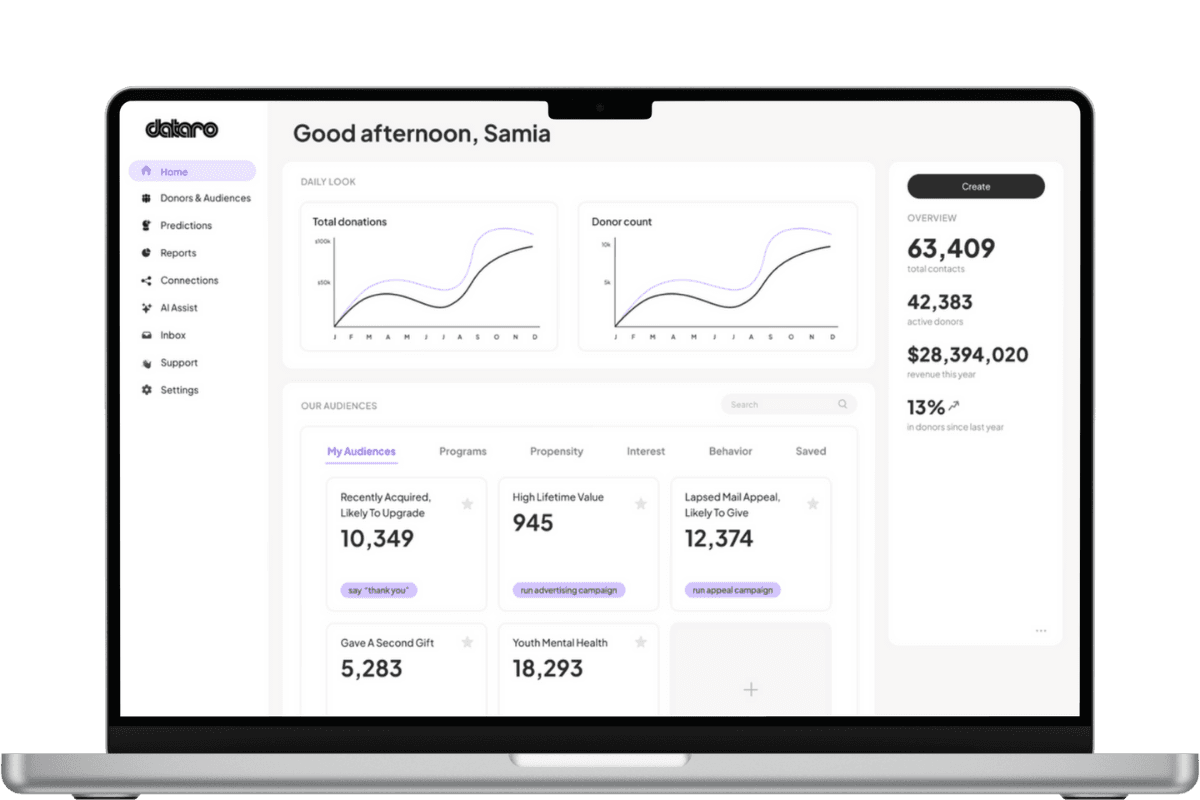
Dataro's Recurring Donor Churn Risk model does exactly this: it flags recurring donors likely to cancel so you can act before the revenue is gone. Paired with a strong dunning cadence, it closes the gap between what your platform recovers automatically and what needs a human.
How to stop losing recurring donors to failed payments
Here is a practical sequence you can run:
Turn on every automated recovery feature your platform offers: retries, card updater and failure notifications.
Measure your involuntary churn rate separately from voluntary cancellations, so you know the size of the problem.
Build a multi-touch dunning cadence across email, SMS and phone, with a one-click update link.
Prioritize outreach using churn-risk scores so staff time goes to the highest-value, most recoverable gifts.
Move upstream by prompting card updates before expiry and stewarding at-risk donors before they cancel.
Review monthly and refine timing, channels and messaging based on what recovers.
Key takeaways
Involuntary churn is a payment problem. Voluntary churn is a relationship problem. Fix them differently.
Platforms recover the easy failures automatically. The rest needs a deliberate dunning cadence.
Speed and multiple channels drive recovery. Act within days, not weeks.
Predictive churn-risk scoring lets small teams focus outreach where it protects the most revenue.
Conclusion
Most lost recurring donors never meant to leave. They fell out of your program because a payment failed and no one followed up in time. Combine your platform's automated recovery with a fast, multi-channel dunning cadence and predictive outreach, and you recover revenue you were already losing quietly. Protect the gift before it churns, and you protect the most dependable income your organization has.
Related articles
Find more nonprofit fundraising and data insights from the Dataro team.