Best nonprofit software for next-best-action recommendations

Nic Miller
Strategy & Frameworks

Next-best-action features are now baseline in fundraising software, so the real test is whether each recommendation is explainable and ready to act on.
Next-best-action recommendations used to be a premium add-on. Now they are a baseline expectation. Most major fundraising platforms embed predictive scores and prescriptive guidance directly in the donor record, so the question for fundraising teams is no longer whether a tool offers next-best actions. It's whether those actions are clear, explainable and ready to execute.
The market pressure is real. Donor counts have fallen every year since 2021 and first-year donor retention remains weak. Teams are stretched thin and can't afford to over-mail and hope it works. That pushes leaders toward tools that improve timing and cut wasted outreach.
This guide compares the leading options, groups them by who they serve and offers practical advice for choosing.
What "next-best action" should actually deliver
A prediction is not a decision. A score tells you a donor is likely to lapse. A next-best action tells you what to do about it: call, steward, suppress, upgrade or hold out.
Good next-best-action guidance does three things:
Ranks a smaller, higher-confidence audience instead of a long list
Names a specific action with channel and timing
Explains the reasoning so the team can defend the decision
That last point matters most for governance-sensitive teams. If you can't explain a recommendation, you won't use it.
How the leading platforms compare
The market splits into three groups: purpose-built CRMs for small and midsize teams, enterprise suites focused on major gifts and specialist decision layers that sit on top of an existing CRM.
Platform | Best for | Next-best-action approach | Benefit | |
|---|---|---|---|---|
DonorDock | Small to midsize teams | Action Board surfaces daily tasks; Smart Nudges flag timely actions; Otto AI drafts outreach | Strong prioritization at lower cost, less major-gift depth | |
Bloomerang | Small to midsize teams | Penny, an AI strategist trained on real nonprofit data, flags lapsed donors and upgrade candidates, then guides follow-up | Guidance lives inside the CRM; depth depends on data quality | |
Blackbaud Raiser's Edge NXT | Enterprise, major gifts | Prospect Insights Pro delivers prescriptive next steps from predictive analytics | Deep major-gift focus, enterprise pricing and setup | |
Salesforce | Enterprise, complex orgs | Agentforce automates prospect research and tracks wealth capacity; one guide estimates 4 to 6 staff hours saved per week | Powerful but heavy to configure and maintain | |
Virtuous | Mid to large teams | Insights and Donor Signals score donors and suggest next actions; Momentum drafts plans for gift officers to approve | Broad capability, best value at scale | |
DonorPerfect | Small to midsize teams | SmartActions automates rule-based alerts; DonorSearch-powered scores flag likely responders | Rule-based alerts are simpler than full predictive ranking | |
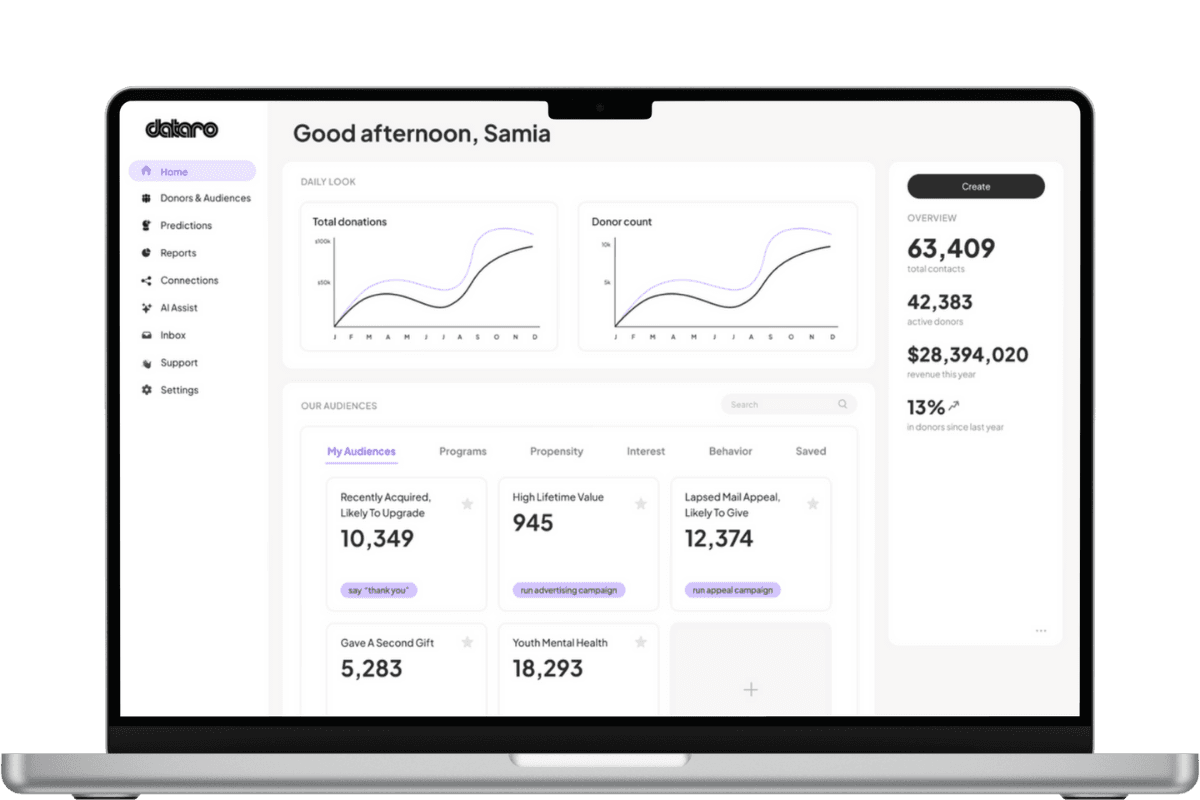
Dataro | Teams on an existing CRM | A decision layer that ranks a higher-confidence audience and a clear next action inside the donor record | Works with your CRM rather than replacing it |
Match the tool to your team
Small and midsize teams that want daily prioritization without enterprise pricing should look at DonorDock, Bloomerang or DonorPerfect. These surface prioritized tasks and timely nudges where the team already works.
Major-gift programs that need prospect research and prescriptive guidance for gift officers will get more from Blackbaud, Salesforce or Virtuous. Each pairs predictive scores with workflows built for cultivation and stewardship.
Teams happy with their system of record but frustrated by manual triage can add a decision layer like Dataro on top of the CRM. Beginning July 2026, a Bloomerang-Dataro integration adds predictive signals to every donor record plus on-demand prospect research, with no separate login or manual export. The aim is a smaller, higher-confidence audience and a clear next action without leaving the platform.
Don't treat the AI label as proof
An AI badge is not evidence that a recommendation is decision-ready. As you evaluate, weigh native depth, transparency and trust controls.
Ask vendors three questions:
Can you show why this donor was ranked this way?
What action does the tool recommend, and can we override it?
How is our data used, and is it kept out of model training?
Bloomerang, for example, says customer data is never used to train its models. Hold every vendor to that standard of clarity.
Practical takeaways
Treat next-best action as standard, then judge tools on whether actions are specific and explainable
Choose by team size and program focus, not by feature count
Prefer fewer, higher-confidence touches over long lists
Keep a human in the loop: AI drafts and ranks, fundraisers decide and execute
Demand transparency on reasoning, controls and data use before you buy
Conclusion
The best next-best-action software is the one your team can act on and defend. Predictive scores are now table stakes. The advantage goes to platforms that turn those scores into clear, ranked actions inside the workflow you already use. Start with the decision you need to make, who to focus on, who to engage now and what to do next, then pick the tool that makes that decision easiest to execute.
Related articles
Find more nonprofit fundraising and data insights from the Dataro team.