How to choose which donors to target: RFM, wealth screening and predictive AI compared
Strategy & Frameworks

RFM, wealth screening and predictive AI answer different questions, so choosing the right method for each job sharpens appeals and cuts wasted contacts.
Four methods dominate how fundraising teams choose who to contact: RFM, wealth screening, single-org predictive models and multi-org predictive AI. They often get lumped together as "targeting," but they shouldn't be. Each one answers a different question, and picking the wrong one for the job wastes budget you can't spare.
Here is the quick version. RFM tells you what donors did, while wealth screening tells you who could afford to give. Single-org predictive models tell you who is likely to give, using your file alone. Multi-org predictive AI also tells you who is likely to give, but it uses patterns a single file can't see. Match the method to the question and your appeals get sharper.
Donor selection matters more now that dollars rise but donors keep falling
The pressure is real, and the data shows it. Q4 2024 Fundraising Effectiveness Project figures showed dollars raised rose about 3.5% year over year, yet donor counts fell 4.5% and retention dropped 2.6%. Revenue is concentrating in fewer, larger donors.
At the same time, costs keep climbing. USPS nonprofit mail rate increases can add thousands of dollars to a multi-touch year-end campaign, so every wasted contact is now visible on the invoice. That makes a shorter, smarter list worth more than it used to be.
Wealth screening tells you who could give, not who will
Wealth screening uses public and third-party data to estimate what a donor can afford. That is capacity, not propensity. It does not prove that someone supports your mission or is ready to be asked.
Treat a wealth score as a prioritization signal rather than a verdict. A high score flags who to look at, but it does not tell you who is about to act.
RFM describes the past and assumes it repeats
RFM segments donors by the recency, frequency and monetary value of past gifts. It focuses on what people did, not who they are. That makes it practical, cheap and backward-looking.
The blind spot is intent. RFM has no concept of why someone gives, so two donors with the same score can need opposite strategies. The method also assumes last year's segments still predict this year. When behavior shifts, that assumption breaks.
Predictive models rank who is likely to give next
Predictive scoring trains on your donor data to estimate the likelihood of a future action: giving, upgrading or lapsing. It turns static profiles into forward-looking rankings, so you can prioritize the people most likely to respond.
This is the shift from describing the past to predicting the next move, and it answers the question every team starts with: who deserves attention before you spend budget.
Single-org and multi-org models learn from different data
Here the methods split again. Some predictive tools train only on your own giving history. Others combine your data with broader, multi-org giving patterns a single file can't see.
More data can help, but bigger is not automatically more accurate. Check what a model actually learns from and whether it lifts results on your file. A larger database is a claim, not proof.
The honest test is a hold-out on the same campaign
You don't have to take any vendor's word for it. Run two or more approaches on the same campaign, hold out a control group, then compare net revenue and response rate.
This is the only fair test. It controls for the campaign, the offer and the timing, so you measure the method itself rather than the noise around it.
Fewer letters, more net revenue: what the proof looks like
Published case studies show predictive targeting can cut mail volume while holding or growing net revenue.
Bat Conservation International beat its appeal target by 160% and added about $48,000 in income while mailing 2,300 fewer letters. UNICEF Australia grew net appeal income 26% and lifted campaign ROI 35% while mailing 15,000 fewer donors, saving about $30,000.
The pattern is the same in both: mail fewer people with more confidence and protect results.
How to choose
Start with your question, then pick the method:
Want to understand past behavior? RFM.
Want to gauge financial capacity for major gifts? Wealth screening.
Want to rank who is likely to act, from your own file? A single-org predictive model.
Want rankings that draw on patterns beyond your file? Multi-org predictive AI.
Most teams end up using more than one. The point is to know which question each tool answers, so you stop treating a capacity score as a propensity score.
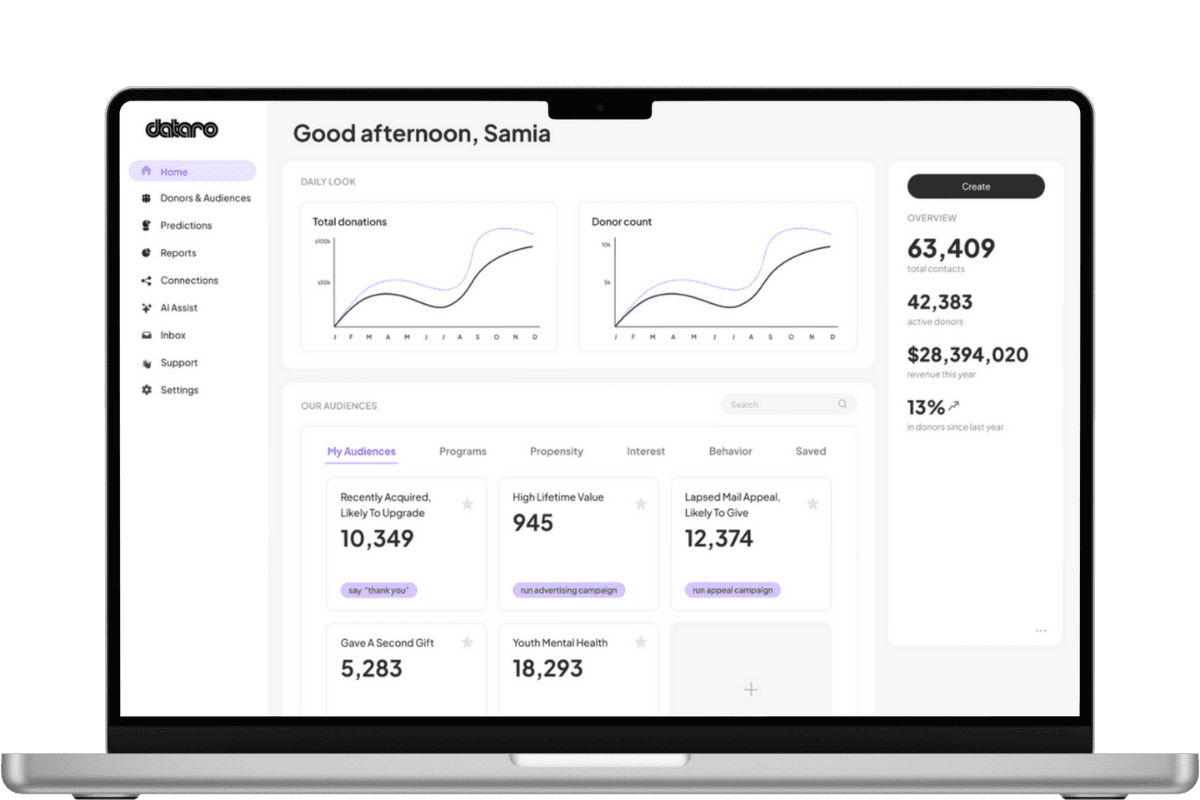
Dataro sits on top of your CRM as a predictive layer. It reads your data and returns ranked actions that tell you who to focus on and what to do next. It doesn't replace your CRM, your screening tools or your team.
The takeaway is simple. Capacity, past behavior and propensity are three different things. Choose the method that answers your question, prove it with a hold-out, and mail fewer people with confidence.
Related articles
Find more nonprofit fundraising and data insights from the Dataro team.