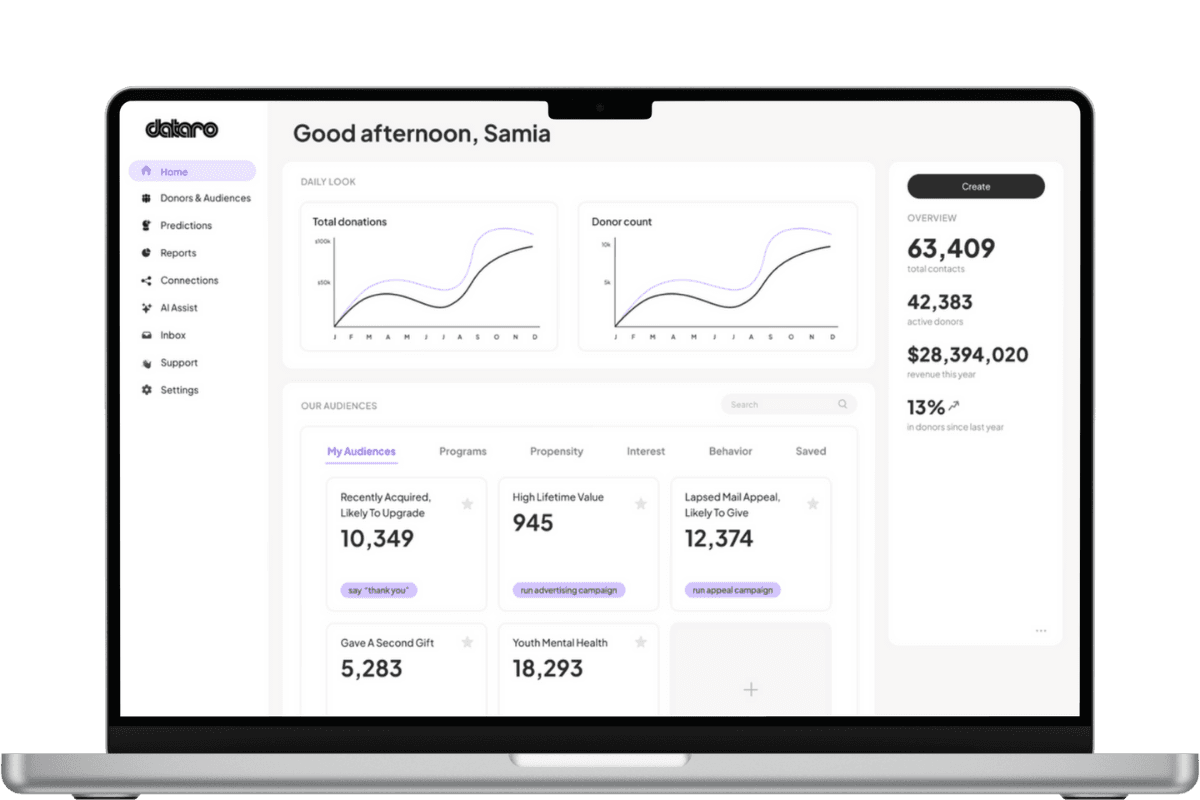
Your donors are already telling you what to do next
Katrina Grant
General

Predictive AI turns donor signals into three clear calls: focus, engage now, and what’s next.
Donors don't see themselves as part of a segment. They expect to be understood as individuals. That single shift, more than any technology trend, is what's changing fundraising.
At the F&P AI Summit, we walked an audience of fundraising leaders through what that shift means in practice, and how predictive AI helps teams keep up.
The signals are already there
Every donor interaction leaves a signal. A gift given or not given. An email opened or ignored. A call answered. A monthly payment that declines.
Taken together, those signals tell a story. They show where a donor sits in their relationship with your organization, how that relationship is changing and what they might be ready for next.
Most teams already collect this data. The challenge is reading it at scale. No team can manually interpret thousands of donor stories at once, let alone act on them in time.
Three decisions every fundraising team has to make
Whether you use AI or not, every fundraising team faces the same three questions:
Who should we focus on? Inside the file and beyond it.
Who should we engage right now? Given limited time and budget, who deserves attention and who can wait?
What should we do next? For the people you do engage, what channel, what ask and what timing actually fits?
These decisions don't change. What changes is how clearly your team can answer them.
Why RFM and static segments stop working
RFM tells you what a donor has done. It can't tell you what they're likely to do next. Traditional segmentation has the same limit: it groups donors by surface traits, without any read on intent or readiness.
The result is familiar. Campaigns filled with some of the right people, a lot of the wrong people and a few who would have responded perfectly but never made the list. Wasted budget. Missed revenue. A donor experience that doesn't quite land.
What predictive AI actually is
Predictive AI in fundraising is pattern recognition across your donor data. Models look at historical behavior and learn which signals tend to come before specific outcomes like giving, lapsing, upgrading or converting. They then score every donor against a clear question: how likely is this person to take this specific action?
The scores update as new data comes in, so your view of each supporter reflects where they are now, not where they were six months ago.
It's worth being clear about what this isn't. Predictive AI deals in probabilities, not certainties. It does not replace fundraiser judgment. It is a decision-support tool that surfaces patterns your team can act on with more confidence and less guesswork.
From broad segments to precision audiences
Most campaign planning still starts with the campaign and then asks who should receive it. AI lets you flip that order.
Instead of treating donors as part of a segment, you understand them as individuals and build audiences from shared intent: who's ready to convert to recurring giving, who's showing capacity for a mid or major gift, who is at risk of canceling a monthly payment and who is showing early signs of a legacy conversation.
The campaigns that come out of this approach feel more like personal conversations than broadcasts.
Four steps to put it to work
Predictive AI only creates value when it's embedded in how your team makes decisions. Kat's framework is deliberately simple:
Start with the donor. Use your data to understand what different cohorts are likely to do, before you plan the campaign.
Build audiences from likelihood, not rules. Pull the top appeal prospects, the at-risk monthly donors and the hidden mid-value opportunities.
Match the audience to the right action. A retention call for an RG churn risk. An upgrade ask for a donor showing capacity. A stewardship touchpoint for a warming legacy prospect.
Operationalize it. Bake the outputs into your campaign calendar, segmentation workflows and channel strategy. A score sitting in a spreadsheet nobody opens doesn't change anything.
What this looks like in real programs
Across appeals, monthly giving, mid and major, and legacy, results compound when teams act on these decisions consistently.
MAZON reduced their appeal mail file by 10% and grew gross revenue by 23%.
Greenpeace donors who received intervention calls were 2.5 times less likely to cancel. Over nine months, the team prevented more than 500 cancellations and retained around $200,000.
Edinburgh Cat and Dog Home ran a single calling campaign that upgraded 156 donors, reactivated 40 lapsed supporters and converted 35 single givers to monthly.
Amnesty International grew confirmed gifts in wills by 60% in year one, 17% in year two and 62% in year three.
Across customers, teams report a 15% lift in major gift income year on year, a 45% lift in standard value income from mid-level prospects, legacy conversion rates above 30% on top-rated prospects, and more than $831,000 in appeal revenue that would have otherwise been left on the table in a single year.
Where to start
Readiness isn't perfection. A few things help:
Usable data, not flawless data. A reasonable giving history is enough. Models work with what you have and sharpen over time.
An aligned team. Everyone agrees on which decisions you want to improve. Data, fundraising and program leads in the same conversation.
Defined use cases. Start with one or two priorities. Test, learn, then expand.
Governance. Decide who reviews outputs and where human judgment has the final say.
Transparency with donors. Make sure your privacy statements reflect how you use AI and follow your local guidance, like the FIA's recent direction in Australia.
Build or buy
Predictive models have existed for years. What's different now is bringing many models into one place, so decisions across appeals, RG, mid, major and legacy stop happening in silos.
Building this in-house is rarely a one-off project. It usually takes 12 to 24 months for a well-resourced team and a permanent commitment to retrain models as donor behavior shifts. Rare outcomes like a legacy bequest also need thousands of examples to learn from, which most single organizations don't have. Amnesty originally tried to build their own gifts-in-wills model and couldn't get the predictions reliable enough to trust. Sector-wide training data closed that gap.
That's the practical case for partnering: models that update in the background, training data drawn from across the sector and a team free to focus on decisions rather than infrastructure.
The bottom line
Your data tells a unique story of every donor. With predictive AI, your team can start writing a better next chapter — sharper decisions, fewer wasted touches and donor experiences that actually feel personal.
If you'd like to see what this could look like for your program, book a demo with us.
Related articles
Find more nonprofit fundraising and data insights from the Dataro team.