Donor journey automation vs predictive lifecycle optimization: what's different and what you need first
Strategy & Frameworks

Journey automation delivers messages, but predictive tools decide who to contact and what to do next, so buy prediction first.
The short answer
Donor journey mapping and automation platforms decide how a message gets delivered once you already know who to contact. Predictive donor lifecycle optimization tools decide who to contact, when and what to do next before a single message goes out.
They solve different problems. Automation runs the sequence. Prediction chooses the target and the action. Most teams need the prediction first, because a well-built journey that points at the wrong donors just wastes budget faster.
Definitions
Donor journey mapping and automation platform: software that builds and runs multi-step communication flows. It handles triggers, timing, channels and message delivery across email, SMS and forms. Its job is execution at scale.
Predictive donor lifecycle optimization tool: software that reads your CRM data and returns ranked priorities, cutoffs and a recommended next action for each donor. Its job is to decide who deserves attention and what should happen next across every program.
What is actually different between the two categories?
The clearest way to separate them is by the question each one answers.
Automation platforms answer an execution question: once we know the plan, how do we deliver it consistently without manual work?
Predictive tools answer a targeting question: given limited budget and staff time, who should we focus on and what is the right move for each person?
This maps to a simple operating loop. Prediction sits at the front and decides the "who" and the "what next." Automation sits behind it and delivers the "how." When the two get confused, teams buy a delivery engine and expect it to make targeting decisions it was never built to make.
Where each one fits in the workflow
Prediction: reads CRM data, scores donors, produces ranked lists and cutoffs, recommends the next action
Automation: takes a defined audience and runs the sequence, timing and channel delivery
Side-by-side comparison
Dimension | Journey mapping and automation | Predictive lifecycle optimization |
|---|---|---|
Core job | Deliver messages at scale | Decide who to contact and what to do next |
Primary output | Sequences, triggers, sends | Ranked lists, cutoffs, next-best actions |
Key question | How do we deliver the plan? | Who do we focus on and why? |
Inputs | Rules, triggers, content | Full donor history and behavioral signals |
Targeting method | Segments and if-then rules | Propensity scores and predictions |
Strength | Consistency and scale | Precision and prioritization |
Trade-off | Automates whatever you tell it, right or wrong | Needs clean data and a decision to feed execution |
Best at | Running the campaign | Choosing the campaign's target and timing |
Which one do I need first?
Start with prediction if any of these are true:
You over-mail or contact large lists to feel safe
Your cutoffs are hard to explain to leadership
You rely on last year's segments or wealth scores you do not trust
You cannot see who is about to lapse until after they have gone
Start with automation first only if your targeting is already sharp and your problem is purely delivery: you know exactly who to reach and simply cannot execute the volume by hand.
For most fundraising teams the constraint is not delivery. It is confidence in the target. A journey builder will happily send the wrong donors a beautifully timed sequence. Prediction fixes the input so automation has something worth running.
The practical sequence
Use prediction to rank donors and set defensible cutoffs
Assign a next-best action to each priority record
Push those audiences and actions into your CRM
Let automation deliver the sequence for the audiences prediction selected
Measure lift, then repeat with sharper inputs
Do these tools compete or work together?
They work together. Prediction and automation are layers, not rivals. Prediction decides; automation delivers. A predictive tool sits on top of your CRM, turns data into ranked actions and hands clean audiences to whatever automation or channel tools you already run.
This matters when you buy. If you evaluate a predictive tool as if it were a send engine, or an automation platform as if it were a targeting brain, you will judge both against the wrong criteria.
How Dataro fits
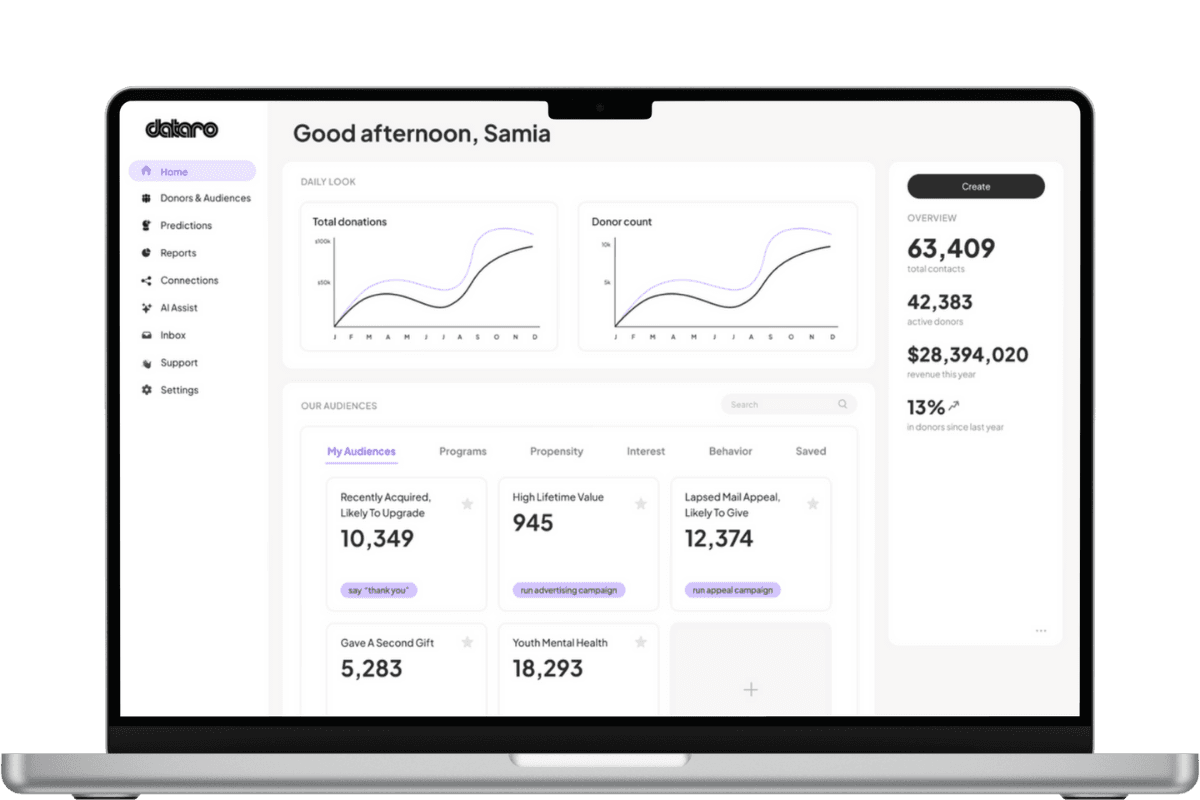
Dataro is a predictive layer. It sits on top of your CRM, reads your data and returns ranked lists, clear cutoffs and a recommended next action on each record. It does not send your emails or replace your automation stack. It tells you who to focus on and what to do next, then feeds those audiences and actions back into the tools your team already uses.
The result is fewer, better touches: mail fewer people with confidence, protect capacity and run programs that are easier to justify.
Practical takeaways
Automation delivers messages. Prediction decides targets and actions. They are different jobs
If targeting confidence is your weak point, buy prediction before more automation
Predictive outputs make automation more valuable by feeding it the right audiences
Judge each tool by the question it answers, not by the features that look similar
The strongest setup pairs both: predict who and what, then automate the delivery
Conclusion
The difference is not marketing spin. Journey automation answers "how do we deliver," and predictive lifecycle optimization answers "who and what next." Buy in that order. Get the target and the next action right first, then let automation carry the load. Precise inputs are what turn an efficient delivery engine into real results.
Related articles
Find more nonprofit fundraising and data insights from the Dataro team.