Donor data enrichment vs. activation: what to do next
Strategy & Frameworks

Enriched donor fields only drive revenue once you map them to specific annual fund actions.
Most annual fund teams have already paid for enrichment. Wealth ratings, appended employers, updated contact records and engagement scores now sit in the CRM. Then the question lands: we enriched our donor data, now what?
The short answer: enrichment is not the finish line. It is the setup. The revenue comes from activation, the step most teams skip.
What is the difference between donor data enrichment and activation?
Donor data enrichment is the process of adding or correcting fields on a donor record. It appends wealth tiers, employer names, demographic markers and engagement scores so records are more complete.
Donor data activation is the process of turning those fields into specific, assigned actions. It answers who to contact, what to ask for and what to do next across your annual fund.
Enrichment describes the donor. Activation moves the donor. One is a data property. The other is a decision.
Enrichment | Activation | |
|---|---|---|
Question it answers | What do we know about this donor? | What should we do for this donor now? |
Output | Fuller records, appended fields | Ranked actions, assigned owners |
Owner | Data or operations team | Frontline fundraisers |
Measured by | Match rate, field coverage | Revenue, retention, response |
Risk if you stop here | Better data, same results | None: this is where value lands |
Why does enrichment alone rarely lift revenue?
Enriched fields sit idle unless someone builds an action on top of them. A wealth tier does not send an upgrade ask. An appended employer does not trigger a matching-gift email. The fields raise potential, not results.
This is the silo problem in a different form. Enrichment lives with data teams. Asks live with fundraisers. Without a handoff, the enriched file becomes a report nobody acts on. Activation closes that gap by assigning a next-best action to a person and a workflow.
The activation framework: mapping fields to annual fund actions
Use this as a working map. Each enriched field points to a trigger, a specific action and an owner. The goal is fewer, better touches, not more mail.
Wealth tier plus rising giving history: the upgrade ask
Trigger: a donor sits in a higher wealth tier than their current giving suggests, and recent gifts are flat or trending up.
Action: move them onto an upgrade ask ladder. Raise the suggested amount and, for the top of the file, route to a personal call or a mid-value officer instead of the standard appeal.
Owner: annual fund manager for mail and email; gift officer for the top tier.
Don't rely on wealth tier alone. Capacity shows who could give more. Giving history and engagement show who is likely to. Pair them before you raise an ask.
Giving history plus lapsed status: reactivation
Trigger: a previously reliable donor has missed their expected gift window based on past frequency.
Action: run a win-back series before the record hardens into a deep lapse. Lead with the mission and the relationship, not a generic renewal. Reserve phone or personal outreach for donors whose giving history shows real value.
Owner: retention or annual fund lead.
Acting early matters. Reactivation gets harder and more expensive the longer a donor stays lapsed, so the enriched recency and frequency fields are most useful as an early warning, not a year-end cleanup.
Employer plus giving history: corporate matching outreach
Trigger: an appended employer is known to run a matching-gift program, and the donor has already given this year.
Action: send a targeted matching-gift prompt that names the employer and the simple next step. This can double a gift with no new acquisition cost.
Owner: annual fund or stewardship coordinator.
This is often the fastest return on enrichment. The donor has already said yes. You are asking them to unlock money that is already on the table.
Engagement signals plus mid-tier giving: stewardship and cultivation
Trigger: rising engagement, such as opens, event attendance or site visits, from a donor who gives steadily but modestly.
Action: steward before you ask. Send an impact update or a thank-you touch, then time the next ask to the engagement peak rather than the calendar.
Owner: stewardship lead.
Engagement signals are the clearest read on timing. They tell you when a donor is paying attention, which is when an ask is most likely to land.
How do you turn this framework into a weekly rhythm?
Activation works when it repeats. A simple loop keeps the enriched file earning:
Predict: rank the file so the highest-value actions surface first.
Act: assign each action to an owner and push it into the tools the team already uses.
Measure: track what changed by action type, not just campaign totals.
Repeat: feed results back so next week's ranking is sharper.
The point is not more activity. It is a short list the team can approve and run, with a clear reason behind each ask.
Practical takeaways
Enrichment is the setup. Activation is where revenue lands.
Map every enriched field to a specific action, an owner and a trigger.
Pair wealth tier with giving history before raising an ask. Capacity is not intent.
Treat lapsed signals as an early warning, not a year-end task.
Matching-gift outreach is often the fastest return, because the donor already gave.
Let engagement signals set the timing of the ask.
Conclusion
If you have already enriched your donor data, the value is sitting in your CRM waiting for a decision. Activation supplies that decision: who to focus on and what to do next, across every program. Map the fields to actions, assign the work and run it on a weekly rhythm. That is how enriched data stops being a report and starts driving gifts.
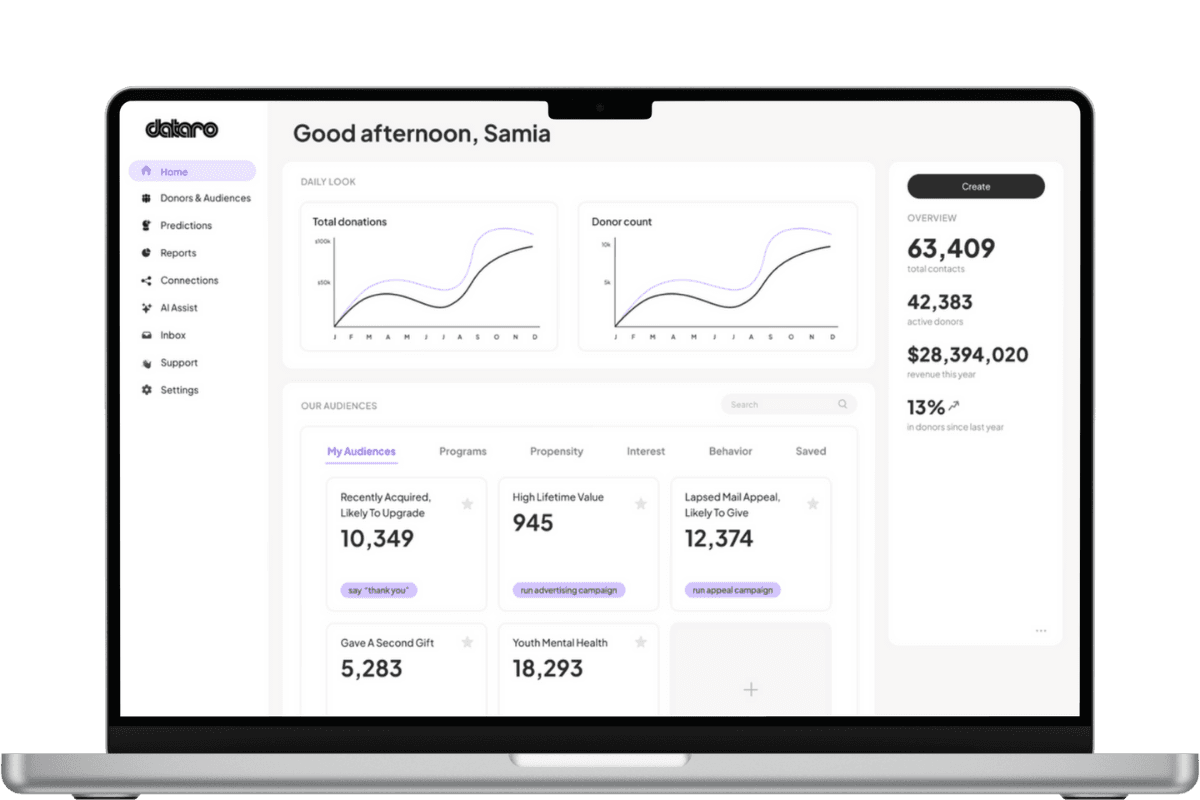
Dataro sits on top of your CRM and turns your enriched data into ranked actions your team can run next week.
Related articles
Find more nonprofit fundraising and data insights from the Dataro team.